Review – One Buck Horror Vol. 3

2

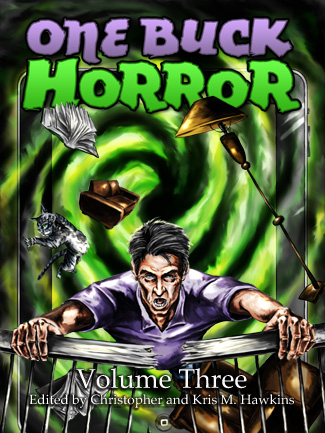
Sporting a sharp psychotronic cover by Shawn Conn, the latest issue of this relatively new e-pub is exactly what the title proclaims. You pay your buck, you get horror. Edited by Christopher and Kris M. Hawkins, a lot of effort has clearly gone into this magazine, and it shows.

Kicking off is “Helpers” by David Steffen in which we find a nefarious character stalking children in the night. Basking in the aura of a grim fairytale, it was marred for me only by a moment of awkwardly whispered dialogue, but is a very promising start to the issue with a well executed – if slightly derivative – pay off.

Next up is “Home” from Augusto Corvalan. This is a triumph of evocation that paints an uneasy world with barely any description. It opens with a domestic family scene littered with sinister teasers, before introducing us to a grim apocalypse. With shades of The Road and even The Texas Chainsaw Massacre, it keeps a few surprises up its sleeve.

Despite a dodgy opening line that put me off, John F. D. Taff’s “Child of Dirt” is an intriguing read. It presents the psychological descent of a man’s journey through the pregnancy and birth of his son. Is the child his? Is it even human?  I found the flow broken up by too much description between lines of dialogue, and a few adjectives too many, but that said, the style does lend it an old-school horror flavour that works here. The tale never lags, oozes a discomforting atmosphere and evil tone throughout, and handles the moments of horror with aplomb.

A more unusual contribution is “The Catman Blues” by Leisa K. Parker. Devoid of dialogue, this first person tale concerns a strange feline musician who brings death to a smoky blues club. I don’t normally favour this informal, anecdotal style of storytelling, but I was happy to find it a colourful and beautifully told piece.

In “Vacation” by J. Tanner we meet a young girl reluctant to go on holiday with her family, so much so that duct tape is employed, and we slowly learn why through her grave reminiscing. Gripping from the off, this is an original tale that doesn’t just rely on concept and shocks, full of real characters and dialogue.

Finally, Mark Budman brings the issue to a satisfying close with “Off With His Head”, a flash piece about a man who awakes to discover he has quite literally lost his head. It’s an odd and brave story, but well executed and palpably real, and owes more to Kafka than bizarro.

Despite the occasional flaws, this is a robust mix of horror fiction. It doesn’t have a specific theme, but certainly its own flavour: the stories all possess a  wickedly gleeful streak beneath the darkness that prevents the magazine from sinking into bleak. The lay out and editing are perfect – credit to the editorial team –  and although a relatively slim volume, it’s great value for 99c, and I’ll certainly be sampling again.

One Buck Horror is available for 99c from Amazon, Smashwords and all usual e-book venues.

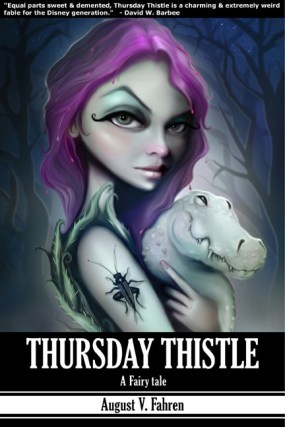
Review – “Thursday Thistle” by August V. Fahren

0

This bizarro e-fairytale comes courtesy of relative newcomer August V. Fahren. I was put off slightly by a familiar concept, but it’s clear within a couple of pages that the writing is crisp and the tale easy to engage.Thursday ThistleThe title refers to our heroine: a downtrodden Cinderella-esque misfit who lives with her sneerful stepsisters and likes drawing robotic mermaids. Her humdrum life is interrupted one day when she’s led into the land of Lethe by a two-headed talking mouse, and discovers that a cannibal witch queen is destroying the paranormal princesses, each named after a day of the week. Like herself.

The “Alice in Wonderland” structure is a well beaten path in this genre, and such formulas need investable characterisation and depth otherwise even the most outrageous ideas become bland. I was pleased to discover that although a couple of the set pieces didn’t quite have the substance or staying power of others, Thursday Thistle is on the whole an entertaining tale.

Along the way we encounter – amongst other things – tarantulas on methamphetamine, a breadcrumb trail of lamb foetuses, a spider-cow man, and a bunch of racist dwarves who keep princesses as sex slaves. The whole thing feels ever-so slightly cluttered, but then the format does allow for this to a degree, and the characters we meet are well realised. I particularly enjoyed the Zen monk who manages to confuse himself with his philosophy, as well as our patient protagonist. Thursday herself is a likeable, feisty guide, and her reactions provide much of the irreverent humour as she becomes accustomed to – and slightly jaded by – her threatening, otherworld surroundings.

“I am the lion prince,” he said.
“Good for you.”

The prose has a wry innocence, sharp with contemporary culture references, and it becomes quite unsettling when the whimsy takes a turn to the dark side.

I’ve read some bizarro that clearly rated psychedelic and weird above plot and personality. But this book is never turgid, flush with dialogue that ensures that it keeps moving, and the characters’ natural human responses prevent it from wandering from the reach of both our grasp, and our interest.

It has a cartoonish feel at times, like Disney’s long-suppressed dark side has suddenly leaked through the facade. The author also uses music to good effect, describing the dramatic orchestral accompaniment to scenes of action and fighting, like a film score, in which the instruments also become involved. This was a risk, but it definitely pays off.

There are a couple of spelling mistakes unfortunately, and a couple of the segments were by the numbers, whereas others would’ve been better expanded, but it’s a colourful and effortless read. I expected it to be more twisted, having read similar fayre more devoted to horror, though it certainly isn’t for kids. There are still moments of sour nastiness that balance it out nicely and ensure it stays the right side of the watershed.

Carroll meets Mellick, Thursday Thistle is a good value buy from Amazon and available now.

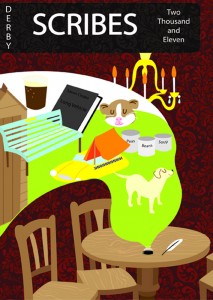
Review – Derby Scribes 2011

2

This new anthology from Stumar Press comes courtesy of the combined efforts of the Derby Scribes, a keen UK writing group who’ve been gathering twice monthly in a pub for several years. The book features tales from both regular members and guests at their meetings, some of whom are established authors, others less known. I’m always tentative when approaching books like this, even with a sprinkling of familiar names on the TOC. The efforts of some writing groups – despite their well-meant enthusiasm – can be rather hard work, but I needn’t have worried. The Derby Scribes’ 2011 anthology is an enjoyable tome of drama, whimsy and chills.

Simon Clark opens the proceedings with “In the Spirit of Darwin”. Here we find an elderly gentlemen, Lloyd Jefferson, who meets a young man on a stroll who claims to be Charles Darwin, and the two engage about evolution, race and tribe. An unusual but satisfying tale, it sets the bar pleasingly high.Next up is “Brylcreem and Pipe Tobacco” by Stuart Hughes, a supernatural story with an old-school twist. A woman seeks out a medium to ask her dead husband if he minds her remarrying, much to the chagrin of her current sceptical and somewhat boorish partner. I found the style slightly too descriptive in places, but the dialogue and character empathy are strong. And while connoisseurs of the spooky might find the conclusion somewhat familiar, it’s perfectly executed and I didn’t see it coming.

“Sophie had named the guinea pig Stump, just in case.” That’s the great opening line of Victoria Charvill’s refreshingly innocent “Stump”, a gentle flash piece about a girl’s accident-prone pet.

Then it’s time for a thrilling snippet of first-person crime with Jennifer Brown’s “Leaving Jessica”. This is narrated by a hunted woman, currently working as a nanny, who realises she’s been tracked and needs to hit the road once more. Well written, it opens with an especially tense scene involving her employer’s child and an approaching sinister stranger. It finishes with a brief but neat touch, cleverly framing a tale that might have otherwise seemed inconclusive.

“Bryan Lamb leaned against the chalky wall, his eyes closed. Someone was whispering — either prayers or a quiet conversation, he couldn’t tell which. He pretended to sleep, pretended that he couldn’t hear the howitzers and feel the whole earth shake when they found their mark.” Thus begins “Last Respects” by Richard Farren Barber. This is a very human and poignant tale that scarcely seems like fiction in which we meet a group of doomed soldiers in the rain and blood-caked trenches of wartime Europe. A sobering journey through the reality of war, the attention to detail is immaculate, and the story swings from melancholy to brutal and then back again to a haunting finale that inspires grave reflection. Brilliant.

“The Wake-up Call” by Alison J. Hill begins with a flurry of panic: the story of a man who thinks he’s just done a possibly fatal hit and run in his car. Although marred by some superfluous description and explanation in the prose, I was genuinely caught up in his intriguing descent and the finale caught me out.

One of the longer tales, “The Gallery” by Conrad Williams paints a picture of subversion in a vicious dystopia. A sharp and gruesome piece of sf, this is full of the author’s stark imagery and packs a knockout pay-off. And the references to 20th century “miserablist” writers should raise a smile from fans of the genre small press.

“Dave’s Dinosaur” by Peter Borg is a short fantasy about a couple menaced Jurassic Park style while out camping. I liked how oddly realistic it seemed despite the content, although a couple of light-hearted but clunky similes jarred me out of the moment.

David Ball’s “An Interstellar Taxi Ride” is just that, starring a conservative ambassador who’s forced to travel in a scruffy space-taxi. It reminded me of Red Dwarf before I read in the author bio that he is indeed a huge fan, and it shows. I loved the humour in the snobbish passenger’s indignance, and my only complaint is that it ended just as I was getting comfy. More please.

A strong voice comes through in “Obsolete” by Chris Barker. It begins with an old man gardening, then teases our curiosity with snippets of background. Is he some kind of retired military? A prisoner? His long-awaited journey from the confines of his house and garden sees him struggling to keep up with the modern world, and his sheltered observations are a treat. My favourites included his reaction to a rude slogan on a barmaid’s tee-shirt, and a flatscreen television mounted on a wall into which he assumes the bulky rear of the device is embedded. Unfortunately, the story’s shine is dulled slightly by a couple of spelling mistakes and a final scene of public dialogue that seemed slightly contrived in comparison to the rest. Neverthless, it’s a memorable tale of consequence.

Finally, “The Smell of Fear” by Neal James presents an ugly, selfish thug called George who terrorises the streets like a villain in a Western, and Micky, the one determined to bring him to justice. This is very tight storytelling, and the twist made me chuckle: a great way to conclude the book.

As the Derby Scribes’ founder Alex Davis notes in the introduction, the vibe here is probably darker than the average writing group, but there’s still an eclectic mix of sf, supernatural, drama, thrills and humour. I enjoyed the mystery of what might be next, and despite the range of styles and genres, it manages a strangely cohesive feel. A few of the tales might have benefitted from a little more plot or a bit of a short back and sides, but they all bring something to the party, and several of them are real stayers. As writing groups go, this is clearly a dedicated and damned good one.

“Derby Scribes 2011” is a solid anthology, and currently available in all e-formats with a print edition to follow. Details at the website here.

‘Till Death Do Us Part…

2

Looking at my cluttered shelf of recent genre collections and anthologies, I realised that sometimes without even peeking at a book’s contents, a single story leaps instantly to mind. For various reasons, some tales make a nest in our brains and refuse to be evicted whether their presence is welcome or not. So I thought I’d share thirteen stories of the last few years that for me, are real “stayers”. In no particular order…“The Brothel Creeper” by Rhys Hughes. Gray Friar Press.

I only read this collection a few months ago, but I’m pretty sure The Ditching won’t be forgotten in a hurry. We find a passenger airline surely doomed to crashing in a fatal fireball. But not before the pilot has an outrageous, selfish but utterly brilliant idea of how to make the best of the grim situation. Full of the author’s wry humour, it’s a perfectly executed tale and I’m smiling now just thinking about it.“End of the Line” Edited by Jonathan Oliver. Solaris.
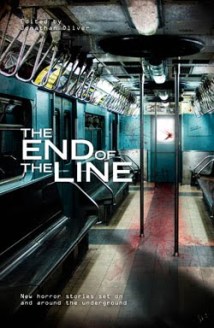
This anthology has plenty of highlights, but Siding 13 by James Lovegrove slapped my face the hardest. Set on the London Underground, it concerns a man (an artist I think, on route to an important interview) on an increasingly busy train. A masterpiece of claustrophobic descent, the last few sentences are scorched into the back of my skull. They form one of the most gleefully ghastly uppercuts of a conclusion I’ve ever read. And I’ve read a few.“Push of the Sky” by Camille Alexa. Hadley Rille Books.

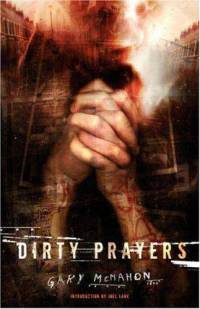
Ah, who could forget Flaming Marshmallow and Other Deaths? While that last tale was cold as ice, this one has warmth with its punch. A colourful fantasy, it presents a world in which everybody learns how they’ll die on their 16th birthday. Our teenage heroine is about to find out whether she’s just going to get old and ill, or become one of the in-crowd and die in a cool way like the “crashers”, “burners” and “fallers”. This is sharp stuff, and delivers poignancy with the dark humour.“Dirty Prayers” by Gary McMahon. Gray Friar Press.

No contest. For me, The Bungalow People is the dark lord of Gary McMahon’s first collection. I’ll never forget the frail and elderly couple trapped in their bungalow, praying it’s just paranoia as they wait for the sinister figures glimpsed in the street to come and get them. Gary absolutely nails their truly helpless scenario, and the unsubtle metaphor about the vulnerable and disposable members of society is delivered with a bite.“The Faculty of Terror” by  by John Llewellyn Probert. Gray Friar Press.

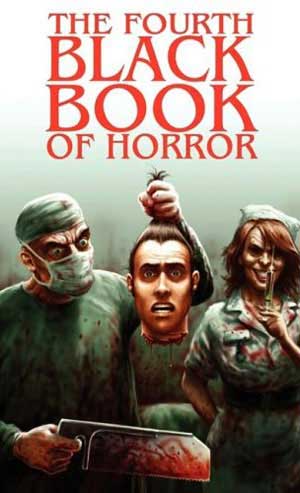
JLP’s stories are always a blast, and Overtime is a delicious example of his inimitable style of old school horror with a contemporary setting. It’s about a young woman working late in an office block when things start to get nasty. 8mm meets Tales from the Crypt, I loved every second.“The Fourth Black Book of Horror” Edited by Charles Black. Black Books.

I bought Johnny Mains’ collection on the strength of With Deepest Sympathy. A Pan-esque story, it introduces an interfering old busybody in a quaint rural village who amuses herself by tormenting bereaved villagers with poisonous letters about their secrets. Suffice to say, the tables soon become turned, and it’s a grisly ride with a perfectly appropriate pay off.“One Monster is Not Enough” by Paul Finch. Gray Friar Press.
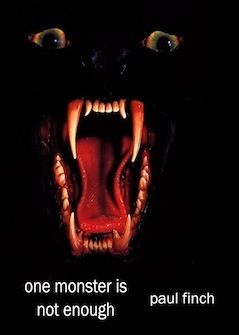
Several tales jostle for attention here, but The Tatterfoal barges to the front. It’s a masterpiece of atmosphere and evocation in which widow of an 80s pop star holds a party in her mansion out in the sticks where a legendary man-horse is said to roam. Although I recall finding it slightly overlong, there’s no denying that this fog-shrouded creepfest still lurks in my subconscious like the memory of a nightmare. “In Sickness” by LL Soares and Laura Cooney. Skullvines Press.

Lots of bleak in this book, but none more than in The No! Place by LL Soares. The title refers to a place in a woman’s head, a sanctuary into which she can retreat when being abused by her husband/boyfriend. I love a tale with a dark twist (as you might have guessed) and this one is seriously pitch-black. Horrible. But good too, you ask? Oh yes. Very good.”The Book of a Thousand Sins” by Wrath James White. Two Backed Books.

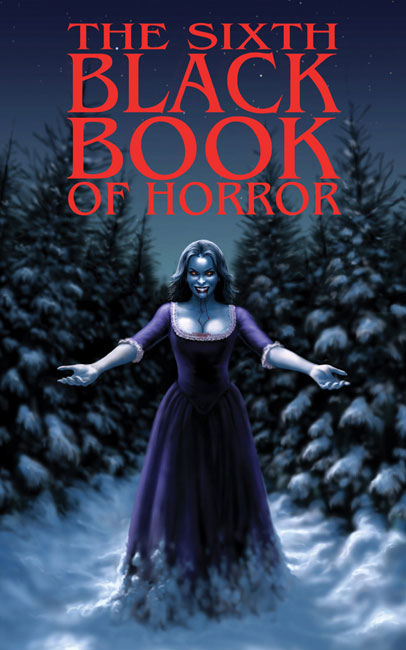
A hellish collection overall, The Myth of Sisyphus actually made me short of breath. A man is trapped in some kind of huge storm drain on a building site, constantly fighting a battle against drowning that just seemed to go on and on. A relentless and literally breathtaking experience that nobody does better than Mr White.“The 6th Black Book of Horror” Edited by Charles Black. Black Books.
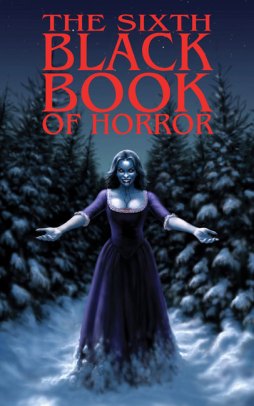
Another gem from the mighty Paul Finch, The Doom tells of a young parish priest and his pretty wife. He finds his idyllic country world darkened by the appearance of a clever but sinister stranger wanting to discuss moral and criminal responsibility. As with many of my favourites, not only is this an elegant and perfectly written journey, the conclusion is shattering. Have you ever breathed “No….” at the end of a story, and tried to somehow will it into ending differently? If not, try The Doom.“Nemonymous #10: Null Immortalis” Edited by DF Lewis. Megazanthus Press.
Rising to the fore of this great anthology is Lucien’s Menagerie by David M. Fitzpatrick. A woman has to spend the night in her utter bastard of an ex-husband’s house in order to claim her inheritance. But the house is full of creepy stuffed animals, and her experience obviously isn’t without incident. I enjoyed how it really kept me guessing as to whether it was supernatural or just a big prank. A wonderfully tense and cinematic piece of work.“Nemonymous #9: Cern Zoo” Edited by DF Lewis. Megazanthus Press.

This is very rich and atmospheric book,  and Mellie’s Zoo by A.C. Wise nails the mood.  A young girl wanders through a decrepit, abandoned zoo, and the cages seem to be full of dark childhood/metaphorical monsters. I can still taste the dust, the eerie stillness and the rusted bars of the cages. Masterful.“Pictures of the Dark” by Simon Bestwick. Gray Friar Press.

There’s quite a range of fiction on offer here, but The Slashed Menagerie is one that leaves nothing but a horrible taste. If ever you despaired at the depths human beings will plumb regarding cruelty and the abuse of power, then this tale will only lower your estimations another notch. Save yourself, and read one of Simon’s more poignant or fun stories instead. No, actually, read The Slashed Menagerie and join me down here. It’s very cold. And so dark.

And there it is. Apologies if my recollections of any of the stories are incorrect in any way: it’s been several years since I read some of them.

And I’d like to stress that this isn’t necessarily a list of my favourite stories of late (although they’re all exceptional, obviously). This is a few of those individual tales that manage to whisper louder over time than their immediate peers. Whether through humour or shocks, mood or a blinding pay-off, these all have hooks inside them that snagged and won’t be shaken free.

Thanks to all the authors mentioned above. Your stories were only ever briefly invited into my head for tea. They weren’t supposed to move in.
Review – “Butterfly Winter” by Weston Ochse

1

“Even in the end the children still dance.”

I’m a sucker for a great opening line, and that one certainly delivers. But that’s not all. Despite its bland cover, this novelette from Crossroad Press presents a beautiful, precision story about humanity, war and the dangers of hubris.The tale concerns the crew of a bomber, part of a squad flying to Shanghai in a nuclear war of mutually assured destruction. But when it comes to the crunch, one well-intentioned soldier named Leroy Pearson struggles to deal with the genocidal potential of his trigger finger. After the attack, the bomber crashes in a remote part of China and Pearson awakes in a rustic village by a lake. A place populated by an unaffected and artistic people, colourful butterflies, and curious dancing children who embrace the bedraggled warhorses without prejudice or suspicion.

This is a perfectly crafted story. The haunting introduction – a post-apocalyptic scene on the edge of the lake – has overwhelming tones of nostalgia and insidious darkness, and segues nicely into the build up of the bomber’s mission. This is appropriately tense, and the switch from cacophonous war to the eerie tranquillity of the village is fantastic, setting the mood for the second half. Leroy Pearson’s back story is seamlessly worked into the flow – especially his defiant father’s refusal to buckle beneath racist abuse – and explains our protagonist’s motives and why he’s the man he is today.

Another strength is evocation. As well as the nightmarish opener, equally outstanding is a scene atop a blazing pagoda that catalogues an unhinged soldier’s life from childhood to present. It’s incredibly elegant, yet also rendered hopeless by the inevitability of doom. There’s genuine humanity here, but what seems to be hope in a world of contamination and death soon becomes tainted. The author manipulates our sense of duty, and where our moral decisions fit into actual right and wrong.

With a breathtaking conclusion, “Butterfly Winter” is superb and I couldn’t find fault. This is a journey we really share with the characters, and well worth a purchase. Thought-provoking and elegiac, it’s an experience that lingers.

Weston Ochse

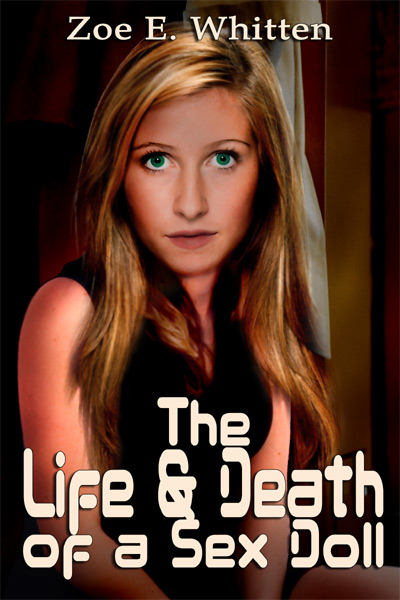
Review – “The Life and Death of a Sex Doll” by Zoe E. Whitten

3

I purchased this ebook on the strength of a short promotional excerpt. It was immediately intriguing – a dialogue between a woman and a state-of-the-art sex doll purchased not for sex, but for mother-daughter companionship. This sharp slice of sf had a bubbling sense of humour, but was infused with a gentle melancholy, and this turned out to be the flavour of the whole book.It contains two novellas, the first being “Adopting a Sex Doll”. The story begins in 2028, and we meet Kelly Braun: a single professional incapable of bearing children. She buys a futuristic Sensu-Doll® named Ashley, and modifies its appearance into something more childlike. As the months go by, she gradually recodes the doll to allow the development of a willful personality, and encounters difficulties both technological and those universal to parenthood.

The book has a bit of a slow start, and some of the minor techno-clutter could’ve perhaps been lost, but the pace soon picks up with humour. A scene when Kelly and a fellow passenger are humiliated by a talking advertisement on a bus made me laugh out loud, and Ashley’s first trip out to a pharmacy is also a gem, invoving a very public and shameless discussion about lube. But although the doll’s core sexuality is initially played for laughs, the mood take a very dark turn when Ashley is used by somebody for her manufactured purpose.  It’s a very sobering moment in the book and made me squirm, and yet also question why.

The novella builds nicely as Kelly becomes romantically involved with a work colleague. She’s a likeable lead: clever, sensible, yet wounded, and her struggle to balance being a parent and simply an owner is perfectly believable as what began as a bit of a game develops into something much deeper.  I enjoyed the way the the author pounced upon every opportunity for entertainment in the practical elements of running such an unusual family unit, but as well as the laughs, the pathos is always there thanks to excellent dialogue and characterisation. Kelly also has legal issues to juggle. A moment of real pride comes when she stands her ground against some vile corporate blackmail. It’s been a while since I silently cheered somebody on in a book.

“When a Sex Doll Dies” is the second part, set four years later, and finds Kelly’s artificial family extended. I was just relaxing gently into the first chapter, drifting through the back story and wondering if this was going to be as good as the first tale, when it suddenly decided to punch me in the face. This novella shoots for the heart in a much less subtle manner than the opener, and I won’t ruin it with spoilers. Since the first story, Kelly and Ashley have become minor celebrities, and this story includes violence, a very clever and dramatic scene with the media, and and presents a discussion upon the value of artificial life. Although this latter topic has been tackled many times before, it’s elegantly handled here, and the fact that they’re sex dolls gives an unusual perspective.

I have a couple of buts. A few places needed a spit and polish, and one scene involved a couple of swift changes that had me lose track of location. And although the appearance of zombies doing manual jobs was entertaining enough, I thought them an unecessary garnish.

But minor quibbles aside, this is a strong and refreshingly different read. I’ve enjoyed this author’s work before, and her voice has a very natural flow. It’s pleasingly unintrusive, and the prose lets the characters and dialogue shine.

Don’t let the lurid-sounding title put you off. Poignant but never saccharine, “The Life and Death of a Sex Doll” is intelligent and amusing sf that surprises without ever resorting to cheap shots.

I bought my ebook from Smashwords here. Find other options – including a print edition – at Zoe’s blog.

Review – “Do Not Pass Go” by Joel Lane

1

The first thing I noticed about this chapbook from Nine Arches Press – part of their new Hotwire crime imprint – is the physical quality. It’s immaculately inked and typeset on thick, cream-coloured paper, with a double red and black card cover. Having paid good money for wonky, flimsy pamphlets in the past, this is a promising start and shows a passionate attention to detail. But is the content any good?As the monopoly-themed title suggests, there is a downbeat vibe to these urban crime tales. Our protagonists are as flawed as you would expect, but any cliches are acknowledged with a weary smile as they search for destruction or redemption – often both – in this perfectly evoked world of smoky pubs, prisons and decrepit warehouses.

The first 3 tales are written in the 1st person, the author’s short sentence style lending a spoken word flavour. I could imagine being regaled by some jaded ex-con leaning on the bar at closing time.

“This Night Last Woman” is first, narrated by a hard drinker with nothing better to do at a karaoke night. He begins a relationship with a similar wayward soul, a pale, dark-eyed siren who promises a textbook disaster, but it turns out that both of them have encountered more than they bargained for.

“No More the Blues” is a short but powerful anecdote of a tense music fan attending a blues gig that descends into violence. The voice is strong as ever, and I was spoiled for choice when trying to select an example.

“Before I really have time to think about it, my pen-knife is open in my hand and my hand is pressed to his throat. Like a knee-trembler, how quickly you reach the point of no return.”

The story manages to carry much more weight than its few words should allow, and concludes with a surprisingly, yet very pleasing, elegiac tone.

“The Black Dog” brings strong elements of mystery to the story of murder: a woman bludgeoned and drowned beneath a pile of hot tarmac. It has a couple of tricks up its sleeve, using oblique references that allow us to piece the story together ourselves.

Switching to 3rd person, we get “Blue Mirror” which presents the less glamorous side of rock n’ roll. It follows the love/hate relationship of two key players in a moderately successful band that is losing its way, and even the booze and hedonism becomes depressing beside the frozen pizzas, debt and undiscipline. The author has a talent for painting huge vistas with the tiniest dabs of paint, and I would’ve happily seen this story expanded.

It saves the best until last with “Rituals”, the tale of a drug-gang who stumble upon the scene of underground gay porn being filmed in a derelict factory. An accidental fatal shooting by tough guy Finlay gives him some real inner demons of guilt and desire, and we almost empathise with his dark but subtle downward spiral. It asks some interesting questions about human nature, and his journey into one of the city’s seediest nightclubs is an incredible piece of cinematic noir fiction.

“As a child, he’d believed the outside world was only a city in daylight: after nightfall it became a forest.”

Joel Lane is capable of  incredible place, and there are no weak links here, the characters and plot devices all very self-assured. Like Gene O’Neill’s moody masterpiece Taste of Tenderloin, I could feel the oily rainwater soaking through my shoes, the cloying taste of happy-hour whiskey and too many cigarettes. I also enjoyed the musical elements. It requires a deft turn of phrase to effectively weave music into fiction, but the author has it down to an art. Whether as integral to the plot or trickled in for ambience, it gives the collection a lyrical, heartbreaking flavour. Songs are sung, they mingle with  memories, and infuse the text with that sense of regret and loss that is the essence of any gritty crime fiction.

At £5 for 40 pages, Do Not Pass Go certainly isn’t cheap, but still worth a purchase.  It’s immediately obvious that during the writing, compiling and printing stages, somebody has thoughtfully tweaked this little book until it’s just right, and that’s much more satisfying than a bargain. Click here to join these troubled and dangerous protagonists on a walk through the city’s lurid shadows. They don’t all go directly to jail, but nobody passes go, and as for collecting the 200 quid…

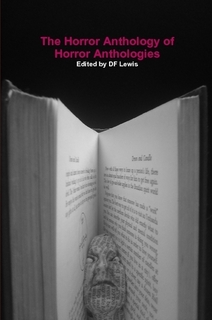
Review – The Horror Anthology of Horror Anthologies

7

The title of the latest editorial offering from D.F. Lewis – who always delivers considered and interesting fiction – initially sounds like quite a lofty boast. And although this might have been acknowledged with a knowing glint in his eye, its literal meaning actually refers to the theme: all the stories contain or reference a horror anthology of some kind, be it real or fictitious.This is tackled in limitless ways and beneath that perfect cover photograph by Tony Lovell (yes, that’s an actual photograph) is some very potent darkness. But as usual there’s a mixture of humour, drama and quiet horror, and some very familiar names on the TOC alongside those less well known. I was impressed by the quality of several of the latter, but the stories that stood out for me are as follows.

Curtain-raiser “It’s Only Words” by Colleen Anderson is a muscular start with the tale of Lloyd, a frustrated and unhappy man who collects horror anthologies. He finally snaps and kidnaps a smug wheel-clamper, but rather than the murderous revenge-against-society one might expect, the results are much more memorable and interesting. I won’t spoil it by revealing the moody sting in the tail of this original piece.

Second up is my favourite story in the book. “Tree Ring Anthology” by Daniel Ausema is one of those unique and wonderful curiosities that always pop up in DF Lewis publications. The extraordinary account of a tree’s life, it is told through an analysis of its rings that map out the residual scars of disease, fire and human intervention. Anthropomorphic, dark and strangely moving, this is a superb piece of unconventional storytelling and a great twist on the theme.

Rhys Hughes’ “Tears of the Mutant Jesters” is a pleasant diversion from the more serious material involving a book with appendicitis (a vestigial echo of the time when books ate grass). A short tale, it  brims with clever wordplay and wry humour.

In “Horror Stories for Boys” Rachel Kendall presents a powerful story of a man suffering from migraines who must visit his dying father and face an abusive past. The author managed to make me feel that bitter-sweetness of nostalgia – even though the past evoked isn’t mine – and although light on plot, this is mature and emotional writing. Of a similar calibre is “Midnight Flight” by Joel Lane about an old man losing his memory, searching for a book he recalls from childhood. Both these tales satisfy with very brittle emotions and atmopshere.

One of the longer tales, “Residua” by David Mathew is the intriguing story of a possibly-innocent con who becomes attached to a book called Ghostly Gallery in the prison library. He starts to encounter characters from it in real life, also baffled by the intentions of an oddly benevolent guard who seems able to read his mind. It notches up the tension and curiosity well with strong, fleshed-out characters and snappy dialogue. There’s a lot of subtle fear in this story, and when some horrible truths come to light, it pans out into an absorbing journey of damage with a cheeky punch-line.

“The American Club” by Christopher Morris follows a young man named Daniel who discovers that his eccentric writer of a father is in a coma following a car accident. Daniel finds a letter from his dad instructing him that in the event of his death, he should to burn all his fiction, the majority of which is unpublished. This is a top class mystery that unravels with perfect pace and likeable voice, and has a tense finale that leaves an unsettling aftertaste.

The book ends on a high note with “All His Wordly Goods” by D.P. Watt, the ghostly tale of a man who works in a charity shop and discovers that a donated volume – the Supernatural Omnibus – refuses to leave him alone. Well written, and suffused with a creepy, small town claustrophobia, this tale also nails that fragility of lost childhood.

Although I was never once bored or annoyed, some of the tales felt slightly overlong. “The Apoplexy of Beelzebub” by Colin Insole and “The Pearl and the Boil” by Rosanne Rabinowitz both have brilliant concepts, but I’d prefer them to have been realised in just a few less words. And although I very much enjoyed “The Rediscovery of Death” by Michael O’Driscoll – a slick piece of paranoia and obsession concerning a small press stalwart who discovers the publishing opportunity of a lifetime – I predicted the pay-off well before it arrived.

A small complaint is that the actual cover is glossy and rather thin, not the pleasing matte quality card to which I had grown accustomed from Megazanthus Press over the last few years. Obviously this isn’t a reason to be put off a book, but a robust feel to a volume always improves the whole experience for me.

But despite these minor grumbles, I very much enjoyed “The Horror Anthology of Horror Anthologies”. Infused with a genuine resonance, the book treats us to a gamut of chills, sprinkled with intelligent humour. The tales are thoughtfully layered, and I was also pleased to discover that that title concept wasn’t restrictive or the cause of any deja-vu: these writers think outside the box. I also felt a strong theme of loss. Several of the stories contain bittersweet visits to the past, grief or an aura of yearning that lends a more sobering atmosphere than the editor’s previous Nemonymous series: chills and melancholy often replacing the whimsy.

While there’s possibly something for everyone, this book will have special appeal for the anthology-devouring genre bookworm. Visit the dedicated website here.

Review – “Ill At Ease” by Stephen Bacon, Mark West & Neil Williams

1

Penman Press present this eBook collection of three short horror stories from a talented trio of British horror writers. The title sums it up. These tales ooze with an askew feeling, where even the most ordinary of situations becomes alien and sinister: the essence of any good macabre fiction.First to follow that vertigo-inducing cover is Stephen Bacon, and “Waiting for Josh” is one of his triumphs. Narrated by a man named Pete Richards, he revisits his hometown to see a dying childhood friend and discovers that there’s more to his lonely alcoholism than meets the eye. This author excels at first-person storytelling, and it works very well here, drawing us into the character’s mood and nostalgia as though it were our own. This also makes the chills more effective, and I defy anybody not to be moved by his haunting journey of guilt, loss and confronting horrible truths. This is poignant and mature writing, and I insist on a collection. Immediately.

Mark West maintains the standard with “Come See My House in the Pretty Town”. Here we meet David Willis, another man reconnecting with his past when he visits an old college friend who now lives the dream in a quaint country village. But as Mark West is writing this story, there’s to be no pleasure in the sunny, picture-postcard surroundings. Everything has a sinister edge, and he notches up the tension in small intriguing reveals about the character histories. When the real descent comes during a visit to the local fair, it’s a grim, breathless ride with a brilliant pay-off. Mark also scores extra for creating some truly scary clowns, whether they normally freak you out or not, and their first appearance is a simple but powerfully charged scene of lurking violence.

Although I wasn’t familiar with Neil Williams, he’s now a name I’ll remember.  With “Closer than you Think” we meet Dave, an ordinary family man. When he spots a perfectly good car seat being abandoned at a rubbish tip by a strange, dull-eyed woman, he decides to take it home. But when he starts to use it for his young daughter, a series of strange and disturbing occurrences ensue. As the supernatural increases, the story becomes a tense family drama with some tight dialogue and oily, nightmarish scenes. Although it has less depth and more formula than the others, it’s a real one-sitting read that grips from the off and doesn’t let go. For me, the supernatural has to be really good to give me a chill – Gary McMahon and Paul Finch spring to mind – and I was happy to discover that Neil Williams also has the knack.

It might be a relatively short book, but “Ill at Ease” rises way above the mire. The theme of horror in the mundane is perfectly realised, mouldering constantly beneath the text and infusing it with a sour sensation of impending doom. It’s modern horror that understands subtlety, full of real characters and plenty of shivers. These three authors clearly take pride in their work, all writing with lucid, thoughtful prose, and the time and effort shows. As reader, there’s no jarring, no creases – just an effortless, entertaining read. With interesting author notes, it’s a great package and well worth a couple of quid. Highly recommended.

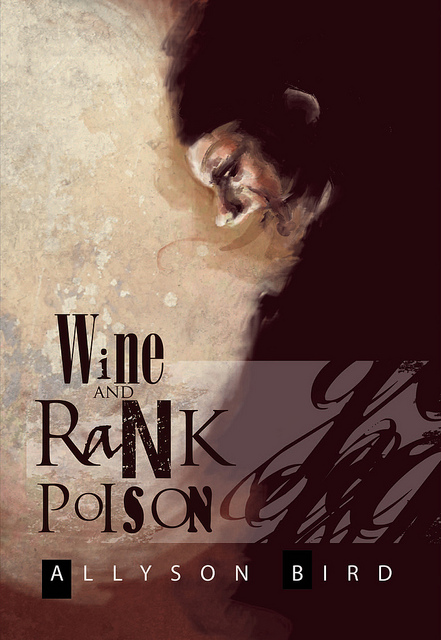
Review – “Wine and Rank Poison” by Allyson Bird

0

The smoky, ethereal artwork of Daniele Serra is the perfect face for this book: like the stories inside, it seems to become more unsettling with time.Like Allyson Bird’s last collection, the award-winning Bull Running For Girls, there’s drama, horror, dark fantasy and everything in between. A couple of the stories left me somewhat confused, but the evocation is extremely well done and the author favours a more succinct prose style to transport us to these strangely-peopled places.

First up, “The Black Swan of Odessa” takes us to a harsh 1920s Ukraine winter. We meet hard-up playwrights, Petrov and Ilf, who hear that a legendary chair stuffed with treasure might be closer than they thought. The period detail is good – I feel as though I’ve actually visited their bleak little flat – and it’s brought to life with prickly comic touches to the dialogue, although the finale felt somewhat out of the blue.

Next is “The 12th Chair”, which refers to the aforementioned treasure: all stories pleasingly link the previous one in some way. Here it’s present day and we find a nobody called Theo Bitter on his way to Odessa to round up his wayward internet bride. It’s a colourful trip with a wry sense of humour that doesn’t lessen the impact of a fiery conclusion.

One of the peaks is the wonderfully-titled “Vulkodlak”. A searing tale of extreme Serbian nationalism and lycanthropy, it reflects on the failings of our primitive tribal natures and brings a strong sense of place to horrors both imagined and real.

“Atalanta” is the first of 2 stories of heavy mythology. An inventive tale, it jumps between the eponymous heroine and her adventures with Jason and the Argonauts, and Vesna, an oppressed woman who meets a powerful witch. When the two timelines link, the tale becomes much more than the sum of its parts.

Next we meet Cleopatra and plenty of mythological creatures in the erotically charged, dreamlike “Beauty and the Beast”. Although a fun ride, by the end, I had no idea what was going on.

“The Convent at Bazzano” returns us to the present, following a young family staying at an old convent near Rome. It has a palpable holiday feel and a pensive supernatural flavour that smirches every scene, but again I found myself baffled by the conclusion.

A couple of solid stories follow. “The Legacy” takes us into the Roman catacombs of St. Callixtus in which a mob guy is the focus for a violent apocalypse that I would’ve liked to have seen expanded.

“The Last Supper” introduces a dysfunctional family troubled by copperhead snakes: a relationship piece set around a funeral with a couple of visceral twists.

The final duo ensure the collection ends on a high. I’ve always been partial to macabre tales of the sea, and “Coney Island Green” opens with the intriguing concept of a dead woman who can’t remember who she is, but is spiritually lured by the ocean. A mature, melancholy story, it paves the way nicely for “For You, Faustine”. This is a tale of a sea-serpent-esque creature who braves the perils of New York to avenge her daughter’s death, befriending a young tattooist along the way. It’s a modern folk-tale with a grisly finale and plenty of simple empathy.

While there’s plenty of fascinating history, mythology and geography layered into the tales, I felt that at times the detail cluttered the flow. Some very nicely turned phrases are jolted by infodumps, and there are occasional moments of awkward point-of-view and repetition.

Nevertheless, the book is infused with a strange darkness: the rank poison trickled into your glass of wine. It’s a great title, both as a metaphor for the coldly-served revenge in the tales, and also for what you are being subjected to as reader.

While a more uneven read than Bull Running For Girls, I’ve quite enjoyed the haunting after-images left behind after reading these slightly-askew mood pieces. It’s like having watched a good foreign film. Caught off-guard from the unfamiliarities, but moved by the experience and resolved to visit again.

Dark Regions Press

Allyson Bird