Review: “Space Brides LLC” edited by Dana Bell

0

“Tired of those lonely dark nights? No one in your settlement suitable? We are here to help! We will help you find the bride or husband to keep you company, raise your children, and be your partner building a dream together.”
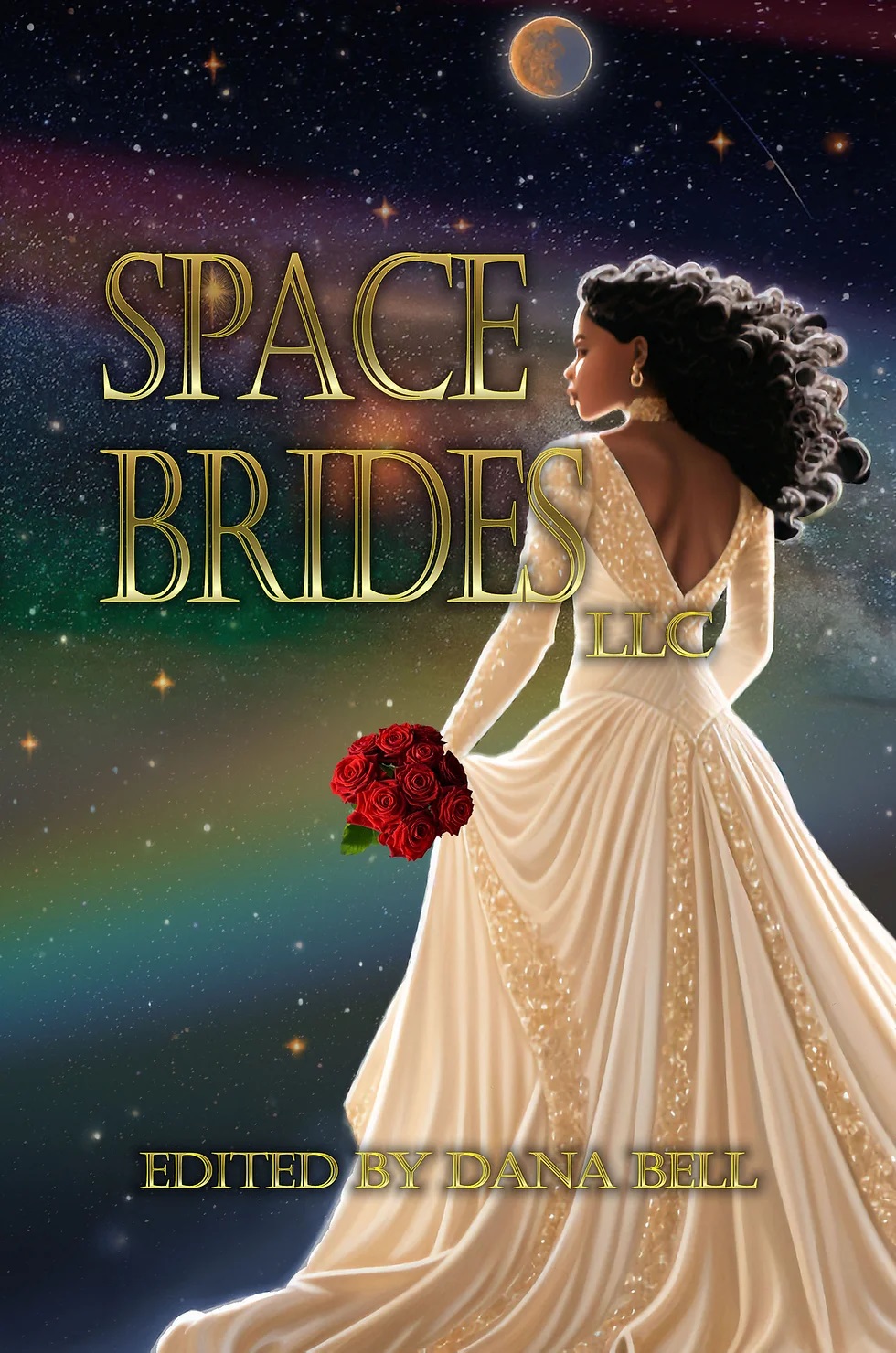
The concept of this anthology from Wolfsinger Publications caught my eye. The idea of Space Brides LLC – a matchmaking agency designed to help people find love on the frontier of space – has great science fiction potential.

This book of 15 mini romantic space operas, edited by Dana Bell, certainly delivers on that. We visit moons, asteroids, caverns, planetary installations and digital worlds. We travel on warp starships and space trains. We meet humans, aliens, vampires and clones. It’s a feast of imagination, and while all of the tales bring something to this colourful party, there are a handful of stories that lingered in my memory after reading.

“Gravity” by Sage Kelly features Jake, a man whose sister has died. He is taking her three lively children (and their pet ferrets) to Mars in the hope of marrying into a farming family to secure them a stable future. Upon arrival however, he is devastated to discover that his betrothed has bailed on the arrangement, leaving her furious dad and brother to sort out the mess.
This is a warm story, thick was pathos, and perfectly evokes the rewarding chaos of domestic life, pets, children and family dynamics.

I loved “Runaway Bride” by Harriet Phoenix. It’s narrated by a skilled and adventurous young woman, Kasih, who is on the run and carrying a mysterious bag of which she’s very protective. She signs up with Space Brides and discovers an interesting prospect on the Saturn moon of Titan: a society where everybody is married to each other as one big collective.
This is one of my favourites of the anthology. It’s well written with a tight plot, full of interesting cultural concepts and fully-rounded characters, and delivers a superb pay-off regarding the contents of Kasih’s bag.
As Harriet Phoenix’s story was also one of my favourites in the recent Terrors from the Toy Box from Phobica Books, she is definitely a writer to watch.

I also loved “A Spectrum of Secrets” by Eric Taveren. This is the tale of Alice, a woman who works for Genetech – a cash-strapped genetics company – and whose young son is terminally ill with cancer. When she sees the profile of Jake, a brilliant scientist, on the Space Brides database, she realises that he might have the skills to cure her son.
With no intention of marriage, Alice travels to stay with Jake in a remote installation deep beneath the ice-crusted sea of the Jupiter moon Europa, and immediately starts to feel guilty about the deception. Especially when she realises she has genuine feelings for him.
This piece shines with slick storytelling, and draws us in immediately. The development of Alice and Jake’s awkward relationship is convincing, and the plot saves some eerie reveals before culminating in a taut and surprising finale.

I really enjoyed “Lapin Chasseur” by Jennifer Roberts. Here we find lunar-dweller Clarissa, who travels all the way to Pluto as part of a holiday trip. But upon arrival, she discovers with horror that she’s been cunningly set up by her horrible twin sister: Clarissa’s journey is a one-way ticket, and she’s actually there to marry a Plutonian mushroom farmer called Doug in the caverns deep beneath the planet.
After a tense start, this becomes a sweet and life-affirming tale that easily draws us into Clarissa’s plight. It has a strong sense of place, a weaving plot, and very relatable attention to detail despite the sf setting. Several of the characters shine with humanity, contrasting the villainous elements, and it saves some twists to conclude on a satisfying note.

The bulk of “Hope Among the Stars” by Luke T. Barnett is in the form of correspondence between Agnes, a previously rich but now impoverished woman from Ganymede, and William, a successful businessman on Mars. They are very much the traditional lady and gentleman, so their written courtship gushes with manners and etiquette. But when disaster strikes during Agnes’ space journey to him, the story takes a surprising and dark turn in which most unladylike behavior will be required for Agnes to survive.
This story stands out with its epistolary structure, quaint characters and drama. We are gently guided into rooting for Agnes and William, and the story constantly keeps us guessing as to how it’s all going to pan out.

The last story – “She’s a Bit Green” by Bogna Jordan – finishes the book on a high. Here we meet Voymir, a soldier who undertakes dangerous missions in a flying suit of armour. After he is seriously injured after an attack on a pirate base, his Space Brides match turns up in the form of Nimfa: a winged and green-skinned woman who is used to a life of racism and rejection.
Both broken in very different ways, the characters and their mutual reticence are believable, and their feelings really power this hopeful tale of recovery and longing.

Special mention also goes to Dana Bell for “Had My Reasons”: an immersive piece that shows us the potentially dangerous side of love with a not-quite-human on an asteroid.
And G.A. Babouche’s “The Titan and the Princess” is a fun and compulsive read that asks if love can flourish between a spirited, jaded princess and a proud alien king.

Of the stories with strong conceptual approaches, credit to Laura Hilse for the clever romantic thriller “Romance of the Algorithm” which shows us the Space Brides process, and explores how the AI used by such agencies could pinpoint things that mere humans might miss.

Despite the niche theme, Space Brides LLC has plenty of variation and we meet all manner of characters looking to find their soul mate. As well as all the above, we meet a Venusian witch,  a troubled clone who is running out of chances, and a purple-eyed alien general. We see collapsing Neptune mines, exclusive lunar hotels, virtual realities, and a shootout in a Martian tomato farm. Niche themes can become samey, but this anthology deftly avoids that pitfall.

As I usually read horror, and the darker and more bleak side of science fiction, Space Brides LLC was a pleasant and refreshing change of tone. The clashes of culture and creed make for some colourful romances and thrillers, and there are several heartwarming stories that show love against the odds. And while that might be a well-beaten trope, it’s a harmless one to indulge sometimes.

A neat concept thoroughly explored, this an enjoyable escapist book.

Available from Wolfsinger Productions here, and through Amazon Kindle stores.

Review: “We Were Seen” by Mark West

2

It’s been a few years since I read a Mark West story, and this novel from The Book Folks made me glad that I’d decided to revisit and also wonder why I’d left it so long.

“We Were Seen” is narrated by Kim Morgan, a lecturer and councillor in the fictional English coastal town of Seagrave. As the story begins, we find her attending a public meeting to protest the development of a golf course and hotel that will steamroll some local marshland. A fight breaks out, and after she is rescued from the violence by a young man, the pair enjoy a spontaneous one night stand. But it transpires that he’s a student at the college where she teaches and someone has taken photographs of their encounter, soon beginning an upsetting campaign of blackmail.

After the excitement of the opening chapters, in which Kim and her protector escape the meeting and are pursued by thugs, the pace cools to an atmosphere of building tension. Despite the stress of being blackmailed, Kim attempts to go about her normal daily life. But as the days go by, she is stalked by an intimidating and obnoxious man, and worries about who she can trust.

Kim assumes, quite reasonably, that her blackmailer is something to do with the proposed golf course she opposes, but the threatening letters that keep dropping on her doormat don’t seem to demand anything specific and serve only to unsettle. Then a dead body turns up on the beach, and the mystery – and the fear – really starts to escalate.

This is a slick and addictive novel. Kim is investable in her normality – a likeable and self-aware everywoman – and the way she is torn between rationality and paranoia is convincing. I love the way the unease is slowly stoked, and Kim starts to see menace in even the most benign locations of sunny Seagrave’s promenades, streets and bars. The small town vibes become very oppressive as the book progresses, especially as further disquieting mysteries are trickled into the mix.

Although a modern psychological thriller, “We Were Seen” has fun shades of a traditional whodunit. Just like our unfortunate protagonist, we suspect that the blackmailer is someone she knows – or has at least met – and there are a great cast of well-written players to choose from.
As well as the obviously nefarious characters such as Glover – the unethical tycoon wanting to build the golf course – and the creep stalking her, we wonder who else might be involved. Her social circle includes several lecturers and staff at the college, her grandfather and his photographer protégé, as well as other councillors, locals, and friends from the golf course protest group. They’re all fully-rounded, but often just enigmatic enough so that we can’t completely eliminate them from suspicion.
This is what I enjoyed. Kim’s paranoia, even though perfectly justified, is infectious. As readers, we start to be wary of everything and everyone; the sinister in the mundane is a great tool and perfectly applied here.

This novel is easy to read with lucid prose and a well-gauged pace, and very compulsive; I found it very easy to lose myself to just one more chapter. This is all the more impressive in that its page-turning quality doesn’t need to come from chapter cliffhangers or sudden jeopardy. It instills a desire to read on purely from the mounting insidious tone.

After this ratcheting of baleful atmosphere throughout the book, the finale is breathtaking and dark. The last few chapters are grim, exciting and genuinely unputdownable. I was gripped, hunched over the page and unblinking as the real world faded to irrelevance around me, which is not something that happens very often.

“We Were Seen” left me satisfied – as everything falls neatly into place – and also in need of a breather from the twist and reveal. It’s also credit to Mark West’s mastery of the writing craft that I was left with the feeling I’d actually been to Seagrave and met all these people, thanks to his knack for characterisation and creating a palpable sense of place.

It definitely won’t be as long as last time before I read another of his books. In fact, his list of thriller novels on The Book Folks site is calling out to me right now. If this review has piqued your interest, you could certainly do a lot worse than visiting it yourself.

Mark West

The Book Folks

Review: “Triptych: Three Tales of Frontier Horror” by Richard Beauchamp

0

I’ve never been a particular fan of traditional or mainstream Westerns, but the tropes of scorched plains, dusty towns, gunslingers and frontier justice provide a great canvas for a pulp horror story.

Having read Richard Beauchamp’s superb dystopian “War Born” last year (my favourite in the “Heavy Metal Nightmares” anthology), I thought his textured prose and talent for conjuring unforgiving wastelands would make him an ideal writer to smash these two genres together. Reading Triptych certainly proved that to be the case.


It opens with “The Courier” in which Jeremiah – the titular character – meets a sinister man in a snow-covered tavern. He is tasked with transporting a strange artifact across several states, in time for solstice eve, and delivering it to a known practitioner of the dark arts.

His journey takes him into the harshest of blizzards during which Jeremiah is stalked and attacked by men who try to warn him of what he carries. Townspeople – and even mountain lions – shy away from his presence, and what begins as a professional dedication to his job soon becomes a protective obsession. He regards the strangely-warm package as his talisman, and it seems to keep him going on his brutal journey long after any mortal should surely have perished.

This tale brings the classic setting of the loner traversing the American West on his trusty steed, but slowly morphs it into cosmic and visceral horror. I read it straight through, driven by a hungry curiosity that was masterfully stoked by the author, and the evocation of the frozen mountainous terrain is perfect. An intriguing and compulsive read with a devilish pay off, this is a sterling start to Triptych.

Following this is “Blood Gulch” which is by far my favourite piece of the three. It doesn’t hang around, immediately presenting an infestation of slug-like monstrosities that burrow into people’s spines and control them as hosts. Our protagonist is Maylene, a woman in search of her missing husband who has been taken by the foul creatures – along with countless others – to an ominous subterranean cave at Blood Gulch.

What awaits there is a wrenching vision of hell, and I wouldn’t dream of spoiling the surprise.

Maylene is a brilliant character – a gun-toting, sharp-tongued badass who will stop at nothing to look after herself and her own. Throw her into a story of revolting parasites against a backdrop of boiling sun, alcohol, blood and dust, and you’ve got an absolute winner.

It shines through its storytelling towards a satisfying epilogue, and the plentiful and gritty period language seems authentic, bringing a grounding realism to the sf/horror concept. With shades of Cormac McCarthy’s “Blood Meridian”, David Cronenberg, Calamity Jane and the Aliens mythos, “Blood Gulch” is worth the price of Triptych alone.

“It Comes For Us All” is the finale, co-written with Korey Dawson. Here we find a sharp-shooting indigenous bounty hunter called Sho’keh. He is transporting a dangerous criminal, Tom Dallion, across the bandit-populated desert and frontier towns of the Mojave to where he will finally meet justice.
But the wisecracking prisoner seems to be undergoing a strange transformation, and once the blood moon rises, pandemonium will be unleashed.

“Dallion’s eyes shone in the moonlight, somehow moving in the stillness of his smiling face, like silver coins in the bottom of a disturbed well.”

My complaint with this story is that I kept losing track of who was speaking, especially during the opening scenes, despite only two characters being present. This was mainly due to the overuse of character tags as well as their names (the older man said, the bounty hunter said, the man on the ground said…) which was confusing and unnecessary.

But the characters are solid, the dynamic between the two leads is convincing, and Dallion’s gruff retorts and escalating creepiness is a great foil for Sho’keh’s pragmatic patience. The foreboding tone slowly cranks up throughout their journey, building to a grisly “Splatter Western” showdown.

Richard Beauchamp has definitely climbed up my horror watch list with this release. Triptych brims with exquisite turns of phrase and slick dialogue, and he clearly makes an effort with historical attention to detail. The landscape becomes an integral part of the tales, essential with any quality Western, and the author’s knack for creating an immersive atmosphere is perfectly suited to this kind of fiction.

Merging the spooky eldritch with gore, it should please fans of both camps. As a devotee of both, I had a splendid time.

“Hell comes at High Noon” indeed.

Richard Beauchamp

Review: “Terrors from the Toy Box” – Phobica Books

1

Hot on the heels of their excellent Heavy Metal Nightmares, Phobica Books have produced another quality themed anthology in the form of Terrors from the Toy Box.

The blurb promised “devil dolls and terrifying teddies, abominable action figures and gruesome games all lying in wait for the opportunity to be free to wreak terror” and it certainly delivers on that.

Some of the tales are obviously supernatural whereas with others, the horror is of the non-magical variety and born from obsession or the darkness that lurks inside people. Sometimes it’s both, and I enjoyed being kept guessing as each story began, as well as wondering what horrors were about to be unleashed when a toy made its appearance.

There’s a good range of styles from the selected authors and the chills are delivered in different ways be that malevolent atmosphere, gruesome shocks or emotional clout. There are also some interesting and subtle concepts that throw shade on the wider world as a whole.

Although I enjoyed all the fiction in this book, here are a handful of those that really stood out for me.

“Faux Joe” by M.J. McClymont is narrated by Tommy, a man concerned about his old friend Joe: a lonely character obsessed with his immaculate and pristine action figure collection. Joe believes his plastic figures to be perfect in every way, and Tommy slowly realises that his troubled friend has concocted a grim plan to improve his life by achieving this supposed perfection for himself. Relatable feelings collide with body horror to create a very compulsive read, and the final line concludes it perfectly on a wry and ominous note.

“Pooky” by Tim Jeffreys concerns Bethany, a girl who cajoles her divorced parents into buying her an old but collectible teddy bear, and it’s not long before things take a spooky turn. A voice seems to be heard talking to Pooky from Bethany’s room, and the child herself speaks of another girl in the house. It has emotional depth for what is one of the shorter pieces in the anthology – merging the stressful domestic troubles of the family with the lurking supernatural – along with some very haunting moments, and a nicely gauged pay off.

In “A Decent Guy” by Wil Forbis, we meet Bennett: a successful family man whose son has a new action figure called Justice Man. But we soon learn that Bennett, who is a loving father and a “decent guy” around his family and community, has a dark and sadistic side that must be assuaged by violence of the most disturbing kind. An increasingly unpleasant descent, the story is crafted into something ultimately very satisfying, all neatly bookended by its own theme.

“Enid’s Dollhouse” by Harriet Phoenix begins with a fairly benign tone as we find young Enid, a girl who loves to collect dolls and play with them, rebuffing her parents’ gentle attempts to dissuade her from expanding her growing collection. This is a very cleverly structured piece. At first there are things that don’t quite seem to make sense, but then everything falls into place, and there’s a cold and terrifying moment of realisation for the reader. With shades of The Twilight Zone, I immediately re-read it and got to enjoy the subtle nuances and pre-reveal attention to detail in a completely different way. Brilliant stuff.

“Lillybet Lollipop” by Scotty Milder is a superb take on the old creepypasta theme. Here, a young man named Mark stumbles across a dusty and obsolete gaming console at a garage sale, along with the game of the title: an ultra-rare cartridge that was swiftly withdrawn from circulation after supposedly terrible things happened to the people who played it. This is a gripping and deftly structured read – switching between Mark’s experience with the malignant game and transcripts of an urban legend podcast about Lillybet Lollipop – as the author takes us on a dizzying and violent journey into madness.

“Kia stood a few steps behind the yellow line, clinging to her little brother’s hand, two over-stuffed rucksacks by her legs, and seriously considered letting go of him and walking out in front of the train that was rapidly approaching.”
Thus begins “A Sister’s Love” by Annie Knox, hooking me in from the start. Kia is a girl on the run with her younger brother Kevin after she has murdered their father for reasons that we don’t initially know. Desperate and out of her depth, she tries to protect him and find somewhere to stay, but is increasingly frustrated by how the young lad seems to talk to someone through various toys. A convincing portrayal of fragile and broken human psyches, this tragic spiral has pathos by the bucketload. It packs several heart-breaking punches, and is definitely the most memorable and powerful tale in the anthology for me.

Although these were my favourites, all the stories bring something to the party. For example, opener “Ma Gentry’s Dream Catcher” by Richard Beauchamp is thick with the evocative atmosphere of its rural witchcraft setting and “Little Red Case” by J Benjamin Sanders Jr has some masterful scenes of unnerving anticipation delivered by a haunted dollhouse. “Uncanny” by Mia Dalia nails the uncanny valley concept, and “A Toy For Zubin” by Galen Gower brings both dark humour and an insidiously nasty tone to the possessed toy trope.

There is much to like about Terrors from the Toy Box. The pieces are often character driven, which is something that can be overlooked elsewhere due to a prime focus on scares or ideas. Without investable or realistic protagonists, short fiction is difficult to care about, and Phobica Books clearly recognise that.

What I also enjoyed is that with such a childhood-related theme, nostalgic feelings inevitably abound, and some of the tales inspired wistfulness for times or toys that weren’t even mine which is a solid and impressive feat.

This is one of those books that I constantly wanted to get back to whenever forced to put it down because real life was dragging me away. Thanks to Phobica Books for the escapism, and I will definitely be keeping a close eye on their future output.

Phobica Books