Review: “Terrors from the Toy Box” – Phobica Books

1

Hot on the heels of their excellent Heavy Metal Nightmares, Phobica Books have produced another quality themed anthology in the form of Terrors from the Toy Box.

The blurb promised “devil dolls and terrifying teddies, abominable action figures and gruesome games all lying in wait for the opportunity to be free to wreak terror” and it certainly delivers on that.

Some of the tales are obviously supernatural whereas with others, the horror is of the non-magical variety and born from obsession or the darkness that lurks inside people. Sometimes it’s both, and I enjoyed being kept guessing as each story began, as well as wondering what horrors were about to be unleashed when a toy made its appearance.

There’s a good range of styles from the selected authors and the chills are delivered in different ways be that malevolent atmosphere, gruesome shocks or emotional clout. There are also some interesting and subtle concepts that throw shade on the wider world as a whole.

Although I enjoyed all the fiction in this book, here are a handful of those that really stood out for me.

“Faux Joe” by M.J. McClymont is narrated by Tommy, a man concerned about his old friend Joe: a lonely character obsessed with his immaculate and pristine action figure collection. Joe believes his plastic figures to be perfect in every way, and Tommy slowly realises that his troubled friend has concocted a grim plan to improve his life by achieving this supposed perfection for himself. Relatable feelings collide with body horror to create a very compulsive read, and the final line concludes it perfectly on a wry and ominous note.

“Pooky” by Tim Jeffreys concerns Bethany, a girl who cajoles her divorced parents into buying her an old but collectible teddy bear, and it’s not long before things take a spooky turn. A voice seems to be heard talking to Pooky from Bethany’s room, and the child herself speaks of another girl in the house. It has emotional depth for what is one of the shorter pieces in the anthology – merging the stressful domestic troubles of the family with the lurking supernatural – along with some very haunting moments, and a nicely gauged pay off.

In “A Decent Guy” by Wil Forbis, we meet Bennett: a successful family man whose son has a new action figure called Justice Man. But we soon learn that Bennett, who is a loving father and a “decent guy” around his family and community, has a dark and sadistic side that must be assuaged by violence of the most disturbing kind. An increasingly unpleasant descent, the story is crafted into something ultimately very satisfying, all neatly bookended by its own theme.

“Enid’s Dollhouse” by Harriet Phoenix begins with a fairly benign tone as we find young Enid, a girl who loves to collect dolls and play with them, rebuffing her parents’ gentle attempts to dissuade her from expanding her growing collection. This is a very cleverly structured piece. At first there are things that don’t quite seem to make sense, but then everything falls into place, and there’s a cold and terrifying moment of realisation for the reader. With shades of The Twilight Zone, I immediately re-read it and got to enjoy the subtle nuances and pre-reveal attention to detail in a completely different way. Brilliant stuff.

“Lillybet Lollipop” by Scotty Milder is a superb take on the old creepypasta theme. Here, a young man named Mark stumbles across a dusty and obsolete gaming console at a garage sale, along with the game of the title: an ultra-rare cartridge that was swiftly withdrawn from circulation after supposedly terrible things happened to the people who played it. This is a gripping and deftly structured read – switching between Mark’s experience with the malignant game and transcripts of an urban legend podcast about Lillybet Lollipop – as the author takes us on a dizzying and violent journey into madness.

“Kia stood a few steps behind the yellow line, clinging to her little brother’s hand, two over-stuffed rucksacks by her legs, and seriously considered letting go of him and walking out in front of the train that was rapidly approaching.”
Thus begins “A Sister’s Love” by Annie Knox, hooking me in from the start. Kia is a girl on the run with her younger brother Kevin after she has murdered their father for reasons that we don’t initially know. Desperate and out of her depth, she tries to protect him and find somewhere to stay, but is increasingly frustrated by how the young lad seems to talk to someone through various toys. A convincing portrayal of fragile and broken human psyches, this tragic spiral has pathos by the bucketload. It packs several heart-breaking punches, and is definitely the most memorable and powerful tale in the anthology for me.

Although these were my favourites, all the stories bring something to the party. For example, opener “Ma Gentry’s Dream Catcher” by Richard Beauchamp is thick with the evocative atmosphere of its rural witchcraft setting and “Little Red Case” by J Benjamin Sanders Jr has some masterful scenes of unnerving anticipation delivered by a haunted dollhouse. “Uncanny” by Mia Dalia nails the uncanny valley concept, and “A Toy For Zubin” by Galen Gower brings both dark humour and an insidiously nasty tone to the possessed toy trope.

There is much to like about Terrors from the Toy Box. The pieces are often character driven, which is something that can be overlooked elsewhere due to a prime focus on scares or ideas. Without investable or realistic protagonists, short fiction is difficult to care about, and Phobica Books clearly recognise that.

What I also enjoyed is that with such a childhood-related theme, nostalgic feelings inevitably abound, and some of the tales inspired wistfulness for times or toys that weren’t even mine which is a solid and impressive feat.

This is one of those books that I constantly wanted to get back to whenever forced to put it down because real life was dragging me away. Thanks to Phobica Books for the escapism, and I will definitely be keeping a close eye on their future output.
Phobica Books

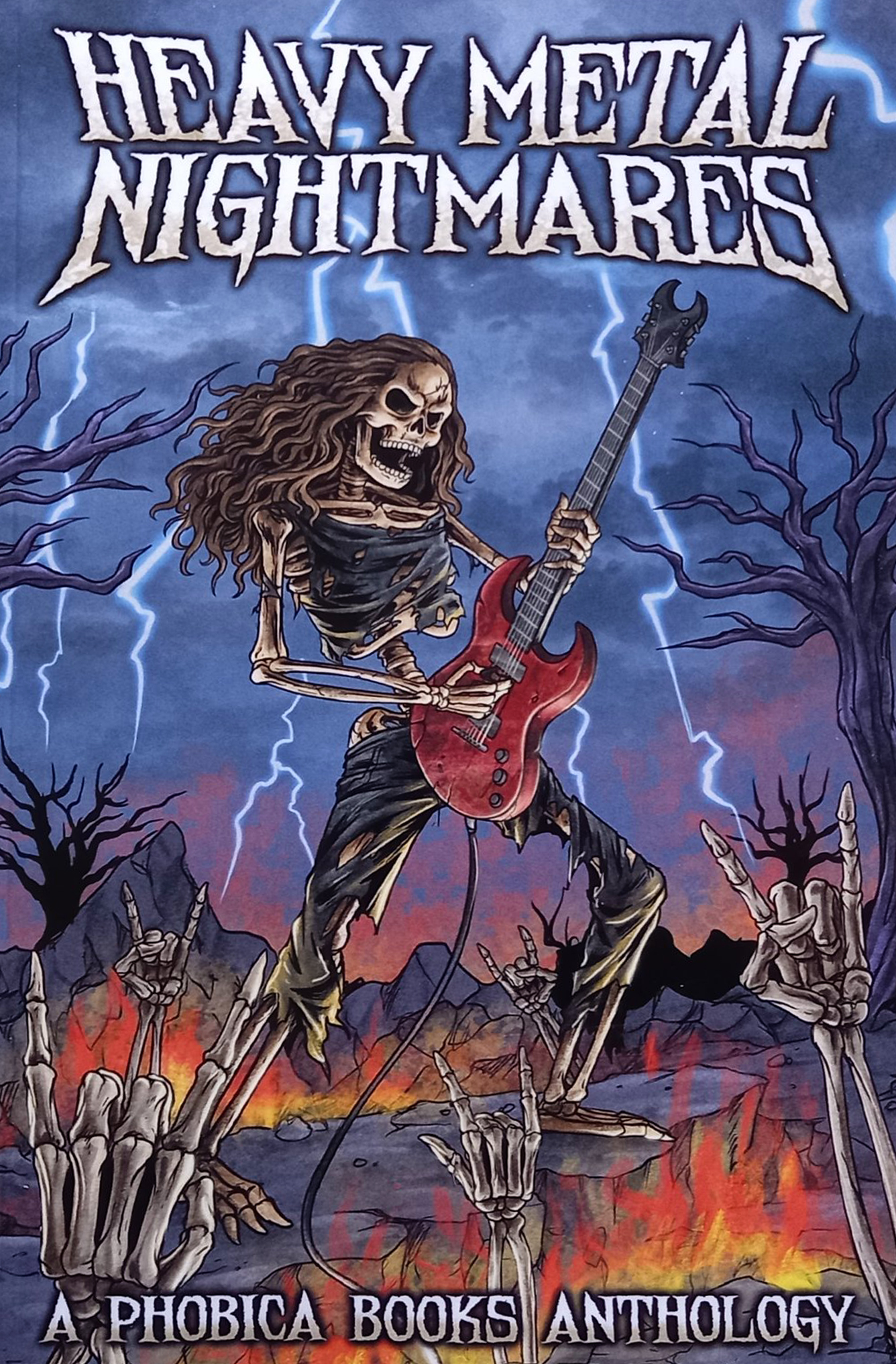
Review: “Heavy Metal Nightmares” – Phobica Books

0

I’ve been a fan of both horror fiction and heavy metal since I was a kid, so this release from Phobica Books was bagged and devoured the moment I clapped eyes on it.

I was pleased to find that beneath that perfect cover lurks a wild and varied selection of twenty stories. They feature the genre staples of monsters, ghosts, curses, possessions and dark whimsies of all kinds, but there are also nightmares of the non-supernatural variety and a couple that feature futuristic and grim speculative concepts.

Most importantly, the overall vibe of the book very much captures the different aspects of heavy metal and its many subgenres. The tone swings from bleak and haunting moods right through to horn-throwing, tongue-in-cheek horror shenanigans, and everything in between.

Heavy Metal Nightmares has an air of celebration. As you can imagine, the authors have a passion for the music – some of them being metal musicians themselves – and this love bleeds from the writing. And although there are song and band references scattered throughout that will delight the metalheads, they don’t intrude or overwhelm if this isn’t really your actual scene.

Here are a few of my standout favourites.

“Phantoms” by Tim Jeffreys is the muscular opening act of the anthology. It is told by the frontman of a rock band called Phantoms, who acquires an ancient song from a mysterious groupie, as well as a spooky picture of an old house. Both these things become instrumental in the band’s swift and almost overnight success, but bad things soon happen and people start to die. Riffing on the classic curse trope, it becomes compulsive, uneasy reading with a potent sense of inevitable doom.

I really enjoyed “Metal Bones” by Mia Dalia. A band called Cerberus decide to build a catacomb-styled ossuary of real bones in which to record their demo. They plunder graveyards for the skeletons with which to construct it, but their actions aren’t without consequence. Told with rich prose and smooth attention to detail, I particularly loved the unexpected, brutal yet emotively elegiac climax: possibly the best finale in the anthology.

Strap on your seatbelt for “War Born” by Richard Beauchamp: an epic and deafening slab of industrial cyberpunk horror that took my breath from its first page to its last. The setting is a radiation-drenched, dystopian nightmare that makes Mad Max look like a children’s fairytale. We follow guitarist Tjal setting off on tour with the War Born: the heaviest and loudest band in the world, who are feared and despised by the ruthless military powers that be.

The author builds an incredible world, full of superb imagination and textured prose, as we are dragged along on a nasty and colourful ride through a boozy, chemical wasteland of biomechanical mutants, twisted tech, atomic-powered subwoofers and vast speaker towers laying gruesome waste to all before them. The chaos is held together by a neat subversive theme as the band plan to play a literally city-wrecking gig on the doorstep of the world’s ruling magistrate. Never have scenes of visceral, apocalyptic hell been so exciting and enjoyable, and this was my favourite of the anthology.

In “Bloodlines” by Paul Sheldon, we meet Joe, a guitarist in a band who audition a new Flying V-wielding guitarist called Mike. Although he slays like a metal legend and seems like a nice bloke, Joe becomes jealous of Mike’s skills and realises something is not quite right about him: nobody in the scene has heard of him or seen him before. It keeps us guessing with “deal with the devil” type suggestions in a tale that has strong character dynamics and a wicked glint in its eye of which the metal gods would approve.

“Black-Metal Baker” by William J. Donahue is a very well crafted story about Jared, a croissant-master who runs a small, independent bakery, and has a black metal band as a side hustle. After he is interviewed by a local magazine, we realise that one of his band mates takes the whole satanic misanthropy mindset much more seriously than him. Written in an enjoyably sharp and evocative style, this is a satisfying piece full of horror and devilry (and baking) that never quite lets on about which direction it’s going to take, and concludes on a melancholy, pitch-perfect note.

“A Darker Sound” by M. J. McClymont features the plight of Angus, driving home, who ends up lost out in the middle of nowhere. He stops at an isolated farm, owned by an old man who is fascinated with the occult and extreme satanic metal, so of course it’s not long before things take an upsetting turn. Full of slick storytelling, deft turns of phrase, and thick with atmosphere, this is nice mixture of old-school quiet horror and the modern violent variety. It would make a great episode of “The Twilight Zone”.

“A Cold Slither Killing” by Angelique Fawns requires no gore or supernatural activity to pack its chilling punch. We meet Glenna and Michelle, two work colleagues who are both fans of a shock rock band called Cold Slither. After an incident with a snake in a river, in which Glenna saves Michelle’s life but only after some hesitation, their friendship is damaged. So they attempt to repair it by going to see Cold Slither perform live together. This story has a beautifully timed dark reveal that makes the early snippets of detail fall cleverly into place, and boasts a conclusion that neatly bookends the whole thing. All this combines with convincing characters and dialogue to make it a very powerful and memorable piece.

I’ll also mention “In Extremis” by Sally Neave. Here, the drummer for the eponymous band wakes up, terribly injured and locked in a storage room below the stage where his band are playing a very important gig. It’s an immediately engrossing, straightforward short with a stinging twist that I’d half-guessed by the end, but still thoroughly enjoyed due to the vivid writing and claustrophobic sense of desperation.

This is only a handful of what is on offer, just being those that particularly spoke to me, but there wasn’t a story in Heavy Metal Nightmares that didn’t bring something to the hellish party.

Given the theme, several of the stories naturally describe gigs in some detail and the lurid rock and roll lifestyle of groupies, drugs and booze. This can get a little samey occasionally, but there’s enough variation in the tales to break it up and I was never bored.

The protagonists and characters are generally well written, whether likeable or nefarious, and we often find ourselves in their corner despite their shortcomings. The stories tend towards strong finales, be them concrete or open, downbeat or gleeful, and there’s some pleasing classic shock twists.

If you like horror fiction or heavy metal, you’ll find something to enjoy in this anthology. If you like both, you’ll find plenty to love. They make excellent bedfellows.
I’ll leave you with the words of the back-cover blurb:

“Get in the mosh pit, rock your head, throw those devil horns in the air and get ready to turn your fear up to eleven!”

Review – “Darkest Minds” edited by Ross Warren and Anthony Watson

2

The third in a solid anthology series from Dark Minds Press, this book presents a dozen horror tales, eleven of which have not been published before. This time the theme is crossing a border, either literal or figurative, and the authors have provided some great riffs on the concept. Our protagonists struggle with mental and physical transitions, find themselves uprooted regarding location or tackling paranormal experience, and even cross time itself. In addition to the theme, I found that all the stories are thick with an askew atmosphere of darkness waiting to pounce, and this provides an enjoyable way to spend a couple of hours.darkest mindsThe fun starts with “Vacation” by Glen Krisch, the only reprint of the anthology. It’s narrated by Mr Callahan, a financial big hitter out of sync with life, who hands over a fortune to a strange facility for some kind of vacation. This is built up in a shroud of mystery, beginning with his immersion in a warm, gelatinous pool sunk into a lightless chamber, and I loved Mr Callahan’s reflective train of thought as his “journey” commences. The wild concept perfectly suits the theme, at one point nimbly changing from past to present tense with great effect. The conclusion rounds it off nicely and it’s one of those tales with a pleasing penny-drop moment that puts a smile on your face.

Much more grounded in bleak reality is “Refugees” by Robert Mammone. We find Grace, a woman who works at a refugee detention centre in Australia, dealing with the application of a Pakistani woman and her grandfather. The impeccable social realism soon gives way to creeps as we realise that something’s askew and some kind of dark magic is at play. A couple of things left me slightly confused, but this is an evocative, human tale that keeps the reader guessing.

Beginning in a grey, rain-lashed flat, “The Great Divide” by Clayton Stealback is told by Edd, a lone man left adrift after his wife has left him. A short mood piece with a twist, it’s a tight and emotional ride with a chilling conclusion.

Next up is one of the finest short stories I’ve read this year. In “The 18” by Ralph Robert Moore we are introduced to Nate, a gentleman who loses his wife Holly of many years. Having lived and worked together for so long, he is crushed by grief and tempers this with alcohol and alienating himself from life. But then he starts to glimpse Holly in different places – on television, around the neighbourhood – and although his rationality tries to explain it away, he can’t shake the feeling that something deeper is going on.

Nate is completely investable in his grief and we’re treated to plenty of truly touching moments. Not a single word is wasted in this story and I was wrapped around the author’s finger by page two. The eventual explanation for Holly’s repeated sightings is both brilliant and brave, and the finale beautifully rounds off this triumph of concept and heart.

“Time Waits” by Mark West is a slick, Twilight Zone-esque short in which Martyn – an ordinary married man going about his day – realises that time always seems short, sparse, and increasingly so. On his way to work, his perception of time and space really starts misfiring and it’s to the author’s credit that I got an eerie Langoliers vibe from the rewritten time-rules and the atmosphere of unspoken but impending doom.

In “The Catalyst” by Gary Fry we meet Emma, an ageing lady who lives with her chain-smoking grump of a husband. One day while digging in the garden of their new home, she finds a buried tin that turns out to be the grave of a pet mouse and although she’s spooked, the discovery prompts a change in outlook. With strong characters and place, this sobering tale crosses the thematic border with a bang.

Particularly memorable for its voice and storytelling is “Under Occupation” by Tom Johnstone. It’s narrated by Kev: one of two council workers retrieving the corpse of a desperate widow who committed suicide. But the boundaries between the two men’s personal and professional lives soon blur, especially as Kev’s guilt-troubled colleague had once goaded the deceased when previously meeting her as a bailiff. One particular element of this story baffled me towards the end, but it has humanity, a thorough social conscience and a convincing slippery slope feel as the anxiety ferments.

Benedict J. Jones presents one of his trademark dark Westerns in “Going South to Meet the Devil”. A modern day tale, we meet Whitey and Ignacio, two cowboys who venture out to hunt down a pack of wild dogs that have slaughtered some steers. They trail the pack into a canyon with grisly results, and plenty of great dialogue cements a tense read.

“When I wake I remember that I used to be. Someone.”

Thus begins “Bothersome” by Andrew Hook, a very immersive experience that initially seems rather surreal as we try to work out the whos, whys and wherefores. But the dreamlike confusion is actually a very concrete perspective and things fall cleverly into place as old memories jostle and collide. I know this is somewhat vague, but I don’t want to spoil anything and you should read it blind as I did. This is multi-layered writing that requires concentration and perhaps patience, but savour the reading and your time will be rewarded.

Another visit to Twilight Zone territory occurs in “The Sea in Darkness Calls” by David Surface. Here we find divorcee Jack, spending time at his brother’s seaside home and remembering the happier times he had there with his kids. Things quickly get strange when he notices a window across the road through which he can somehow see the ocean, even at night. An emotional tale, I like the way it fills in back story whilst simultaneously adding more mystery. There’s a great tone of displacement and the slow burning unease doesn’t relent until the powerful finale.

“Walking the Borderlines” by Tracy Fahey begins with a woman recalling a trip to Paris as a youth. Here she met a fellow “borderliner” –  those who can see and hear the paranormal – with whom she also shares a general interest in the darker, spiritual side of life. They end up in a haunted flat together, and the result is a spooky but modern piece, well placed between the more intense stories either side.

The final story – another of my favourites – is the longest in the anthology so stick the kettle on and settle in because you’re in for a treat. Stephen Bacon never fails to impress me and with “It Came from the Ground” he manages it with the opening line.

“We’d been in Rwanda for only a few days when we saw the child with the machete.”

This is a splendid teaser, and what follows doesn’t let it down. The story is narrated by a Pulitzer-dreaming photographer named Jason, recalling the story of his travels to militia-torn Rwanda. Accompanied by his partner, another colleague and a local guide, he was looking to snatch some shots of the aforementioned child, said to be a terrible warlord despite only being 12 years old. But while staying overnight at a convent before trekking to the warlord’s rural compound, talk of devilry, jinns, and superstition abounds.

The author keeps you wondering as to where the menace is going to manifest. There are many possibilities – his own group with its relationship troubles, the warlord child, or perhaps it is something else malevolent out there in the unfamiliar and dangerous African countryside. The account is perfectly paced – definitely the “page-turner” of the anthology – and boasts an immense sense of place and an appropriate sense of grim reality.

Although there are stark moments of fear and ghastly action, it’s the subtle touches that really notched it up for me. Sometimes a simple and deftly timed paragraph delivers an ominous chill, catching the reader with their guard down. One example is this line, which suddenly cranks the threat after Jason has posed for a casual group photograph at the convent:

“Just last week I was looking at the photo in my apartment, realising that it captured the final time we were all together before death swept in.”

We know it’s coming, and soon, but what is it? The author whisked me through Jason’s grim, exciting journey with some superb turns of phrase towards a monstrous showdown that I never saw coming, and it concludes the anthology on a very satisfying note.

I enjoyed Darker Minds. Ross Warren and Anthony Watson have created a colourful anthology, rich with imagination, and all the stories presented are well written. The numerous 1st person tales work well, testimony to the editors’ ability to spot an accomplished voice, and there’s plenty of social commentary and conscience to bring depth to the thrills and chills.

If you’re familiar with the contributors – a fine array of indie horror writers – then you’ll know what to expect. If not, this is a sound opportunity to add some new genre talents to your list.