Review: “To See Too Much” by Mark West

0

I’ve recently read all of Mark West’s dark thrillers from The Book Folks, and was happy to discover that his latest novel “To See Too Much” is up there with the best of them.
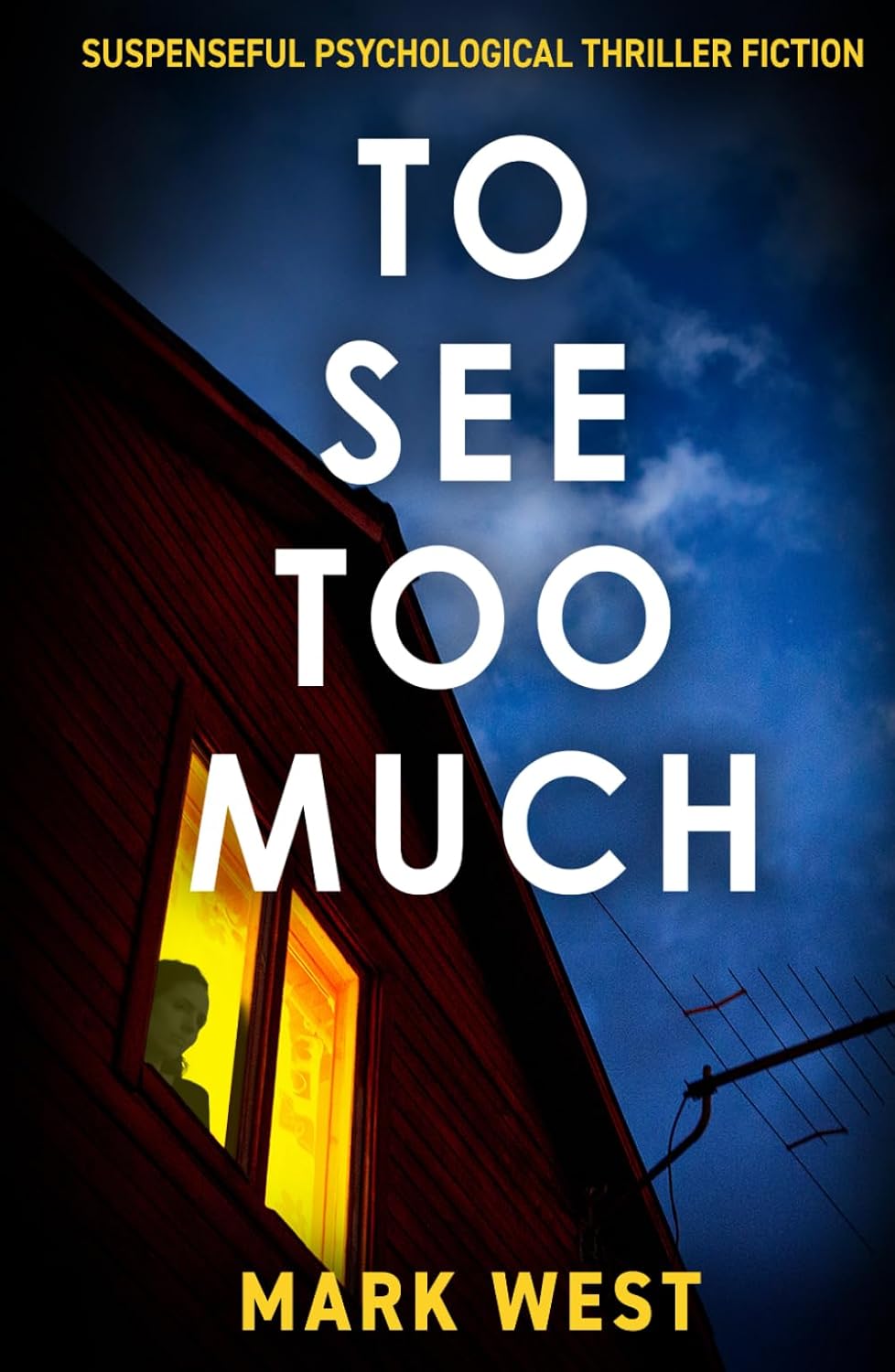

It’s narrated by Carrie: a social worker recovering from a heart attack. She heads to Miller’s Point – a small cluster of quaint cottages on the coast – to convalesce, planning a gentle time of sea air and walks on the beach, but the other residents turn out to be an intriguing and unsettling bunch.

She accidentally overhears a couple of heated exchanges, and somewhat bored and restless, becomes drawn into watching the lives of her temporary neighbours. Discovering broken marriages and professional scandals along the way, Carrie soon realises that Miller’s Point is full of tension and dark secrets. And some people are not happy with her watchful presence.

When a local woman goes missing and a corpse turns up on the beach nearby, Carrie realises that she’d be better off well away from all this, but feels bound to do the right thing and help some of the new acquaintances she has made.

Carrie is a great narrator: pleasant, strong and intelligent (like many of Mark West’s previous protagonists) so it’s easy to invest. Her social work background means she is an astute reader of the human condition, and also instinctive when it comes to perceiving threat. And she certainly sees plenty of that as we are carried along by her sharp curiosity and suspicions.

The author is a master of building menace and that is perfectly escalated here. The story begins with occasional and subtle moments of unease – the odd glance or awkward exchange – then slowly cranks the apprehension as unpleasant things start to happen.

The narrated prose is clean and effortless to read, dappled with lovely turns of phrase, and the dialogue always feels real. There’s a depth and fragility to the characters, and I love the way everyone has secrets and is a bit weird, broken or hard work in some way. Because, aren’t we all? The character dynamics and interactions are convincing and full of deft touches, which is a good job because “To See Too Much” is very much a character driven piece.

Miller’s Point is part of the traditional but faded British seaside resort of Seagrave: a fictional location of the author’s that has featured in several of his previous novels. Although I was pleased at the prospect of a revisit, it’s a little different this time. We don’t see much of the town, the tale concentrating upon the dysfunctional microcosm of Miller’s Point, and the book is all the better for this tight and somewhat claustrophobic focus.

There’s fun whodunitry to be had should you wish to try and deduce the real villains of the piece, and it all builds to a gripping, violent and satisfying finale that had me glued to the page as everything fell into place.

One of the many things I love about this author’s novels is that I can relax in the knowledge that I’m not going to be disappointed or feel cheated in any way. With touches of Rear Window, “To See Too Much” is a page-turner that requires no cheap shot fireworks to keep us hooked and I eagerly look forward to Mark West’s next work.

Mark West

The Book Folks

Review: “We Were Seen” by Mark West

2

It’s been a few years since I read a Mark West story, and this novel from The Book Folks made me glad that I’d decided to revisit and also wonder why I’d left it so long.

“We Were Seen” is narrated by Kim Morgan, a lecturer and councillor in the fictional English coastal town of Seagrave. As the story begins, we find her attending a public meeting to protest the development of a golf course and hotel that will steamroll some local marshland. A fight breaks out, and after she is rescued from the violence by a young man, the pair enjoy a spontaneous one night stand. But it transpires that he’s a student at the college where she teaches and someone has taken photographs of their encounter, soon beginning an upsetting campaign of blackmail.

After the excitement of the opening chapters, in which Kim and her protector escape the meeting and are pursued by thugs, the pace cools to an atmosphere of building tension. Despite the stress of being blackmailed, Kim attempts to go about her normal daily life. But as the days go by, she is stalked by an intimidating and obnoxious man, and worries about who she can trust.

Kim assumes, quite reasonably, that her blackmailer is something to do with the proposed golf course she opposes, but the threatening letters that keep dropping on her doormat don’t seem to demand anything specific and serve only to unsettle. Then a dead body turns up on the beach, and the mystery – and the fear – really starts to escalate.

This is a slick and addictive novel. Kim is investable in her normality – a likeable and self-aware everywoman – and the way she is torn between rationality and paranoia is convincing. I love the way the unease is slowly stoked, and Kim starts to see menace in even the most benign locations of sunny Seagrave’s promenades, streets and bars. The small town vibes become very oppressive as the book progresses, especially as further disquieting mysteries are trickled into the mix.

Although a modern psychological thriller, “We Were Seen” has fun shades of a traditional whodunit. Just like our unfortunate protagonist, we suspect that the blackmailer is someone she knows – or has at least met – and there are a great cast of well-written players to choose from.
As well as the obviously nefarious characters such as Glover – the unethical tycoon wanting to build the golf course – and the creep stalking her, we wonder who else might be involved. Her social circle includes several lecturers and staff at the college, her grandfather and his photographer protégé, as well as other councillors, locals, and friends from the golf course protest group. They’re all fully-rounded, but often just enigmatic enough so that we can’t completely eliminate them from suspicion.
This is what I enjoyed. Kim’s paranoia, even though perfectly justified, is infectious. As readers, we start to be wary of everything and everyone; the sinister in the mundane is a great tool and perfectly applied here.

This novel is easy to read with lucid prose and a well-gauged pace, and very compulsive; I found it very easy to lose myself to just one more chapter. This is all the more impressive in that its page-turning quality doesn’t need to come from chapter cliffhangers or sudden jeopardy. It instills a desire to read on purely from the mounting insidious tone.

After this ratcheting of baleful atmosphere throughout the book, the finale is breathtaking and dark. The last few chapters are grim, exciting and genuinely unputdownable. I was gripped, hunched over the page and unblinking as the real world faded to irrelevance around me, which is not something that happens very often.

“We Were Seen” left me satisfied – as everything falls neatly into place – and also in need of a breather from the twist and reveal. It’s also credit to Mark West’s mastery of the writing craft that I was left with the feeling I’d actually been to Seagrave and met all these people, thanks to his knack for characterisation and creating a palpable sense of place.

It definitely won’t be as long as last time before I read another of his books. In fact, his list of thriller novels on The Book Folks site is calling out to me right now. If this review has piqued your interest, you could certainly do a lot worse than visiting it yourself.

Mark West

The Book Folks

Review – “Drive” by Mark West

1

I’ve been enjoying Mark West’s fiction for several years now, and his brand of atmospheric, uneasy horror always has me coming back for more. He is one of those authors that brings such investable humanity and resonance to his fiction that genre is rendered almost irrelevant. I was therefore delighted to discover that with this new novella from Pendragon Press, he wanders outside his usual discomfort zone into white-knuckle territory, but still manages to deliver his most terrifying piece to date.DriveDavid Moore is a finance manager, away from his wife and home on a work-related course. Attempting to assuage the lonely boredom of an evening in the hotel, he grudgingly attends a house party held by a local course-mate. Here he meets Nat, a friendly divorcee, and as the night grows late, he offers her a lift home. But a black Audi full of drug-fuelled hoodies is terrorising the local population, and when David and Nat become their target on the lamp-lit, unfamiliar streets, things are all set for a breath-taking game of cat and mouse.

David is the perfect lead character for this story. It needed an unlikely hero, and as he is sensible, pleasant and tends towards gentlemanliness, we instantly invest. The same goes for Nat, who brings fire and intelligence to her classic role as “damsel in distress”. David’s courage is also amplified by his understandable fear and initial hesitation to act, so by the time the story has really got into gear, I was firmly in their corner.

In true Mark West style, he initially engages the reader through deft evocation of normal scenarios with which we can identify, then injects teasers of menace to draw us further in. And in this story, the menace is immense. The men in the black Audi are thoroughly nasty and dangerous, indiscriminate with their sadistic cruelty, and this threat is cranked up page by page. A particularly pleasing device is that their arrival is always heralded by pounding bass music from the car – the familiar epitome of anti-social aggression – which is used to great effect. It conjures an ominous and cinematic dread in the same way clanking chains precede the arrival of the cenobites in the Hellraiser films, or the slow, ground-shaking footfalls of an approaching T-Rex in Jurassic Park.

“Drive” is a simple chase story with a classic set-up. But it becomes so much more than the sum of its parts through superb writing and – once it kicks off – an adrenaline-soaked pace that doesn’t take its foot off the pedal for a second. The tension and fear are so palpable that there is nothing to take you out of the moment, right up until the intense finale. There are no clues as to how it will all pan out, or as to why David and Nat have been singled out as prey, forcing you to find out for yourself. And I wouldn’t dream of giving anything away.

Another element I loved is that despite the urban sprawl, David and Nat have nowhere to turn. This isn’t the traditional rural or isolated setting for such a tale – they are in the heart of civilisation – but the dark streets, petrol stations, and even the police offer no sanctuary as it becomes a matter of life and death. They are on their own, and this is skilfully achieved without any suspension of disbelief.

The moments of violence are stark and sometimes shocking. And these aren’t “fun” shocks either, like the gleeful scares of ghosts, deranged serial killers or monsters in the closet. This is bitter-tasting street violence of the kind that may well be lurking in an alleyway outside your house with a flick-knife and an erection.

If you can handle the darker stuff, I would recommend “Drive” regardless of your usual genre preference. Just be sure you have no plans for an hour or two, because you aren’t putting this rollercoaster of a novella down for anything. Except perhaps the arrival of a black Audi with pounding bass…

Highly recommended.

Review: “Anatomy of Death” edited by Mark West

1

Bacon, Mains, Probert, Volk and West. Now there’s five names I’m always happy to see and here they are, lured together to form this ghastly anthology of short stories from Hersham Horror. The binding theme is sleaze, which sounded splendid to me, and is born of editor Mark West’s fondness for the lurid films and gruesome paperbacks that exploded onto the scene during the early 70s.AODWriting for such a theme unshackles an author from any pesky constraints of morality and reality, so prudes and gentle souls bolt for the exits now. The gents don’t hold back and the pages bleed with sex, violence and all manner of unnatural monstrosities. And hurrah for that! But Anatomy of Death (In Five Sleazy Pieces) has much more to offer, and provides plenty of humour and substance along with the base thrills.

First up is “Pseudonym” by Stephen Bacon. One of the quieter tales, as expected, this concerns a childhood fan of a horror novelist, now grown up, who finally gets the chance to interview his old hero. The visit to the writer’s gothic mansion is a joy – straight out of Hammer – and there’s plenty of mood and a sobering shock. This tale reflects on how the past infiltrates the present, and also the evolution of horror; old school versus the new. Effortless to read, the author’s genre passion shines through, and perhaps we were all terribly wrong in thinking that those books we used to love were just intended to be a bit of fun…

A complete contrast follows, and Johnny Mains – editor, writer and general sage of this niche of horror – delivers with the gloriously titled “The Cannibal Whores of Effingham”. This about sums it up, concerning a brothel where men disappear, staffed as it is by beautiful carnivores. But they might’ve bitten off more than they can chew when somebody visits who’s even better at the art of murder. Shamelessly rude and gory but tongue-in-cheek with it, this tale has little characterisation, but that’s not the point and it’s carried instead by the possibilities of the premise. And although the shock value dwindles as the story progresses, the curiosity of how it will pan out just keeps growing. A cartoon nasty with a twist, the author also has a treat in store for readers familiar with his previous works.

“Out of Fashion” by the inimitable John Llewellyn Probert presents yet another change in tone. A shorter piece, it concerns a Victorian doctor who invents medical devices and is worried about current trends towards aesthetic plastic surgery. One night, he is called upon to perform a terrible operation, and the repercussions of the menace he discovers daren’t even be breathed. I had high hopes for this story and John ticks all the boxes with elegant surroundings, intrigue and monstrous horrors from the depths. His warm, educated style is perfectly suited to the content, and as Mark said in his introduction, it’s impossible not to imagine Peter Cushing as the lead.

Next up is my favourite. I can’t even write this without grinning and shaking my head at the gleefully offensive wedge of unpleasantness that is “The Arse-Licker” by Stephen Volk. It’s narrated by an underwhelming businessman who relies on shallow ingratiation rather than effort to succeed, but one day finds that a new staff member is threatening his carefully crafted web of bullshit. Immediately engaging and cleverly told, the author manipulates our sympathies back and forth to a drawn-out climax of cringe-inducing black comedy. This story is far better than it has any right to be. The ingredients are wrong – a protagonist lacking in investable traits, a plot that relies on its outrageously vulgar showdown – but the author refines it into a very impressive piece of fiction. And I still can’t get the taste out of my mouth. Cracking stuff.

Finally, Mark West neatly rounds of the book with a trip back to the long hot summer of 1976. In “The Glamour Girl Murders”, a London photographer is hunting the right model for a shoot with Penthouse magazine, but accidentally stumbles across a kidnapping that involves some kind of beast. The story opens bravely with a girl being chased, and manages to snare the reader despite not having yet had the opportunity for characterisation. The cast is strong, the dialogue and storytelling tight, and I loved the aura of sleaze that clings to the pages like the sweltering temperature; heat waves can be used to great effect to induce sticky claustrophobia in the reader, and Mark succeeds admirably. To me, it resembles a British version of Spike Lee’s “Summer of Sam”: the sweat, the paranoia, the cultural attention to detail. To quote the beast: “Lovely…”

I really enjoyed Anatomy of Death; in fact I demolished it in one sitting. “Just one more, then I’ll get up and do stuff…” was the repeated cry, but this slim, well-ordered volume had other plans. It’s deftly edited, the genre tropes are handled with affection, and there’s plenty of variation despite the specific theme. The stories shine with the quirks and particular strengths of each author, and if you’re not familiar, you could do worse than getting acquainted here.

This is a professional anthology for readers who like their horror sleaze delivered with a wry, self-aware wink.

Recommended.

Review – “Ill At Ease” by Stephen Bacon, Mark West & Neil Williams

1

Penman Press present this eBook collection of three short horror stories from a talented trio of British horror writers. The title sums it up. These tales ooze with an askew feeling, where even the most ordinary of situations becomes alien and sinister: the essence of any good macabre fiction.First to follow that vertigo-inducing cover is Stephen Bacon, and “Waiting for Josh” is one of his triumphs. Narrated by a man named Pete Richards, he revisits his hometown to see a dying childhood friend and discovers that there’s more to his lonely alcoholism than meets the eye. This author excels at first-person storytelling, and it works very well here, drawing us into the character’s mood and nostalgia as though it were our own. This also makes the chills more effective, and I defy anybody not to be moved by his haunting journey of guilt, loss and confronting horrible truths. This is poignant and mature writing, and I insist on a collection. Immediately.

Mark West maintains the standard with “Come See My House in the Pretty Town”. Here we meet David Willis, another man reconnecting with his past when he visits an old college friend who now lives the dream in a quaint country village. But as Mark West is writing this story, there’s to be no pleasure in the sunny, picture-postcard surroundings. Everything has a sinister edge, and he notches up the tension in small intriguing reveals about the character histories. When the real descent comes during a visit to the local fair, it’s a grim, breathless ride with a brilliant pay-off. Mark also scores extra for creating some truly scary clowns, whether they normally freak you out or not, and their first appearance is a simple but powerfully charged scene of lurking violence.

Although I wasn’t familiar with Neil Williams, he’s now a name I’ll remember.  With “Closer than you Think” we meet Dave, an ordinary family man. When he spots a perfectly good car seat being abandoned at a rubbish tip by a strange, dull-eyed woman, he decides to take it home. But when he starts to use it for his young daughter, a series of strange and disturbing occurrences ensue. As the supernatural increases, the story becomes a tense family drama with some tight dialogue and oily, nightmarish scenes. Although it has less depth and more formula than the others, it’s a real one-sitting read that grips from the off and doesn’t let go. For me, the supernatural has to be really good to give me a chill – Gary McMahon and Paul Finch spring to mind – and I was happy to discover that Neil Williams also has the knack.

It might be a relatively short book, but “Ill at Ease” rises way above the mire. The theme of horror in the mundane is perfectly realised, mouldering constantly beneath the text and infusing it with a sour sensation of impending doom. It’s modern horror that understands subtlety, full of real characters and plenty of shivers. These three authors clearly take pride in their work, all writing with lucid, thoughtful prose, and the time and effort shows. As reader, there’s no jarring, no creases – just an effortless, entertaining read. With interesting author notes, it’s a great package and well worth a couple of quid. Highly recommended.

Review – “Conjure” by Mark West

2

The cover of this recent offering from Rainfall Books didn’t lure me. While perfectly appropriate for the novel’s setting, and fair play for spurning cliché, it seemed rather bland. But within a couple of pages, I’d immediately warmed to Mark West’s literary world.

Conjure features Beth Hammond and her boyfriend Rob, a newly pregnant and cash-strapped couple from London who win a short break in the cheap, British seaside resort of Heyton. We meet Beth on her way home through the bustle of a London rush hour, and discover that she has a gift. She can see dead people.

The other characters are gradually introduced, their reassuringly average lives drizzled into the mix, which makes a pleasant change from books that bellow from the first paragraph, terrified that you might lose interest. But Mark has the cool confidence of a storyteller who doesn’t have to resort to tricks to snare a reader.

Once Beth and Rob travel to the coast, we soon learn that there is more to Heyton than the pier, the rides and the fish and chips. The town has a chilling history that quite literally won’t stay buried.

Despite the initial lack of action, Conjure fosters suspense from the outset and nudges it up as the novel  progresses. The back story of the malevolent spirit – a wronged and murdered woman – who threatens our pregnant protagonist  is presented in neat, almost teasing little doses, often in the form of visions that come alive from the page.

Mark excels at dialogue and characterisation – real people we come to know – and these unconnected folk slowly merge, at first barely brushing past each other in the plot until they are entwined. The setting is perfect, and reminded me of several faded resorts: old fashioned and hard-up, but soldiering on with a stiff but weary upper lip. I particularly enjoyed the gothic cinema. It’s a wonderful place that I would love to visit, and now actually feel as though I have.

Mark also has the knack of making relatively trivial things seem important – the way they are in real life – such as when a man driving a JCB accidentally damages an iconic war memorial in the centre of town. By making us care about lesser troubles, the moments of brutal horror that lurk around the corner have infinitely more impact.

Conjure flaunts some genuinely spooky moments. A scene in which Beth is trapped inside a toilet cubicle made me writhe and I could barely wait for her chance to escape. When a spontaneous holiday snapshot captures the ghost on film, it was descibed in such a way that it raised goose-pimples down my arms. The ghost uses mind control and amnesia, and the confusion of its unfortunate puppet – a tough, local family man – is expertly portrayed. It becomes difficult for the reader to judge the perpetrator, despite the depths of his crime. Overall, the supernatural element works so well because the author merges it with fears we understand such as abduction and infanticide.

This is a strong short novel written in sharp prose. The plot is somewhat generic, but it is well executed and avoids cheap twists. The tale builds up to a finale that manages to feel classic yet original at the same time and concludes with a tasty uppercut, just in case you’d forgotten who was in charge.

At only 140 pages, it’s possible to finish in one sitting, which is a good job. Just one more chapter, then it’s time to get some sleep, I kept saying to myself as the night advanced. But Conjure had other ideas.

Mark West

Rainfall Books