Review: “Triptych: Three Tales of Frontier Horror” by Richard Beauchamp

0

I’ve never been a particular fan of traditional or mainstream Westerns, but the tropes of scorched plains, dusty towns, gunslingers and frontier justice provide a great canvas for a pulp horror story.

Having read Richard Beauchamp’s superb dystopian “War Born” last year (my favourite in the “Heavy Metal Nightmares” anthology), I thought his textured prose and talent for conjuring unforgiving wastelands would make him an ideal writer to smash these two genres together. Reading Triptych certainly proved that to be the case.


It opens with “The Courier” in which Jeremiah – the titular character – meets a sinister man in a snow-covered tavern. He is tasked with transporting a strange artifact across several states, in time for solstice eve, and delivering it to a known practitioner of the dark arts.

His journey takes him into the harshest of blizzards during which Jeremiah is stalked and attacked by men who try to warn him of what he carries. Townspeople – and even mountain lions – shy away from his presence, and what begins as a professional dedication to his job soon becomes a protective obsession. He regards the strangely-warm package as his talisman, and it seems to keep him going on his brutal journey long after any mortal should surely have perished.

This tale brings the classic setting of the loner traversing the American West on his trusty steed, but slowly morphs it into cosmic and visceral horror. I read it straight through, driven by a hungry curiosity that was masterfully stoked by the author, and the evocation of the frozen mountainous terrain is perfect. An intriguing and compulsive read with a devilish pay off, this is a sterling start to Triptych.

Following this is “Blood Gulch” which is by far my favourite piece of the three. It doesn’t hang around, immediately presenting an infestation of slug-like monstrosities that burrow into people’s spines and control them as hosts. Our protagonist is Maylene, a woman in search of her missing husband who has been taken by the foul creatures – along with countless others – to an ominous subterranean cave at Blood Gulch.

What awaits there is a wrenching vision of hell, and I wouldn’t dream of spoiling the surprise.

Maylene is a brilliant character – a gun-toting, sharp-tongued badass who will stop at nothing to look after herself and her own. Throw her into a story of revolting parasites against a backdrop of boiling sun, alcohol, blood and dust, and you’ve got an absolute winner.

It shines through its storytelling towards a satisfying epilogue, and the plentiful and gritty period language seems authentic, bringing a grounding realism to the sf/horror concept. With shades of Cormac McCarthy’s “Blood Meridian”, David Cronenberg, Calamity Jane and the Aliens mythos, “Blood Gulch” is worth the price of Triptych alone.

“It Comes For Us All” is the finale, co-written with Korey Dawson. Here we find a sharp-shooting indigenous bounty hunter called Sho’keh. He is transporting a dangerous criminal, Tom Dallion, across the bandit-populated desert and frontier towns of the Mojave to where he will finally meet justice.
But the wisecracking prisoner seems to be undergoing a strange transformation, and once the blood moon rises, pandemonium will be unleashed.

“Dallion’s eyes shone in the moonlight, somehow moving in the stillness of his smiling face, like silver coins in the bottom of a disturbed well.”

My complaint with this story is that I kept losing track of who was speaking, especially during the opening scenes, despite only two characters being present. This was mainly due to the overuse of character tags as well as their names (the older man said, the bounty hunter said, the man on the ground said…) which was confusing and unnecessary.

But the characters are solid, the dynamic between the two leads is convincing, and Dallion’s gruff retorts and escalating creepiness is a great foil for Sho’keh’s pragmatic patience. The foreboding tone slowly cranks up throughout their journey, building to a grisly “Splatter Western” showdown.

Richard Beauchamp has definitely climbed up my horror watch list with this release. Triptych brims with exquisite turns of phrase and slick dialogue, and he clearly makes an effort with historical attention to detail. The landscape becomes an integral part of the tales, essential with any quality Western, and the author’s knack for creating an immersive atmosphere is perfectly suited to this kind of fiction.

Merging the spooky eldritch with gore, it should please fans of both camps. As a devotee of both, I had a splendid time.

“Hell comes at High Noon” indeed.

Richard Beauchamp
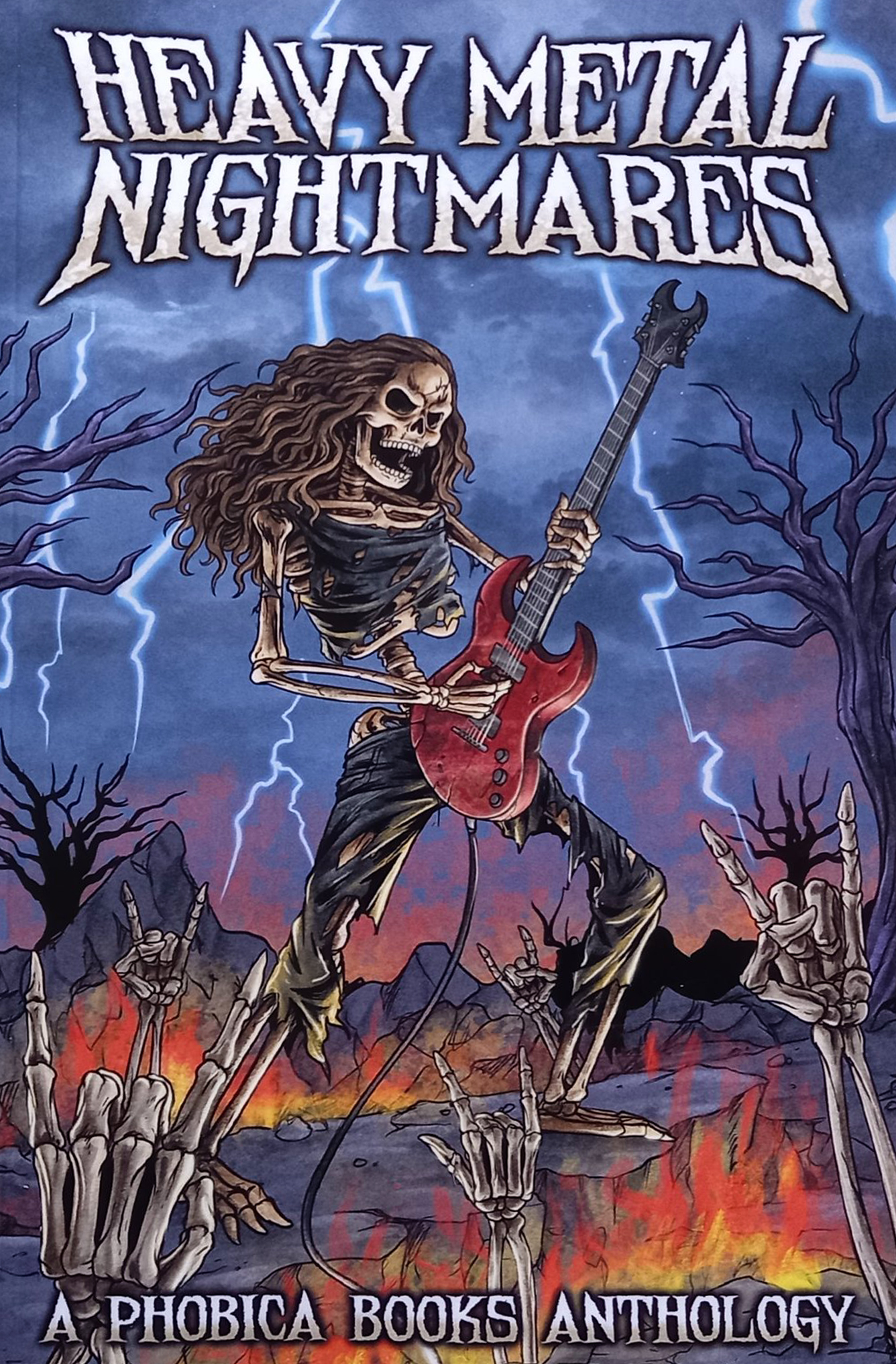
Review: “Heavy Metal Nightmares” – Phobica Books

0

I’ve been a fan of both horror fiction and heavy metal since I was a kid, so this release from Phobica Books was bagged and devoured the moment I clapped eyes on it.

I was pleased to find that beneath that perfect cover lurks a wild and varied selection of twenty stories. They feature the genre staples of monsters, ghosts, curses, possessions and dark whimsies of all kinds, but there are also nightmares of the non-supernatural variety and a couple that feature futuristic and grim speculative concepts.

Most importantly, the overall vibe of the book very much captures the different aspects of heavy metal and its many subgenres. The tone swings from bleak and haunting moods right through to horn-throwing, tongue-in-cheek horror shenanigans, and everything in between.

Heavy Metal Nightmares has an air of celebration. As you can imagine, the authors have a passion for the music – some of them being metal musicians themselves – and this love bleeds from the writing. And although there are song and band references scattered throughout that will delight the metalheads, they don’t intrude or overwhelm if this isn’t really your actual scene.

Here are a few of my standout favourites.

“Phantoms” by Tim Jeffreys is the muscular opening act of the anthology. It is told by the frontman of a rock band called Phantoms, who acquires an ancient song from a mysterious groupie, as well as a spooky picture of an old house. Both these things become instrumental in the band’s swift and almost overnight success, but bad things soon happen and people start to die. Riffing on the classic curse trope, it becomes compulsive, uneasy reading with a potent sense of inevitable doom.

I really enjoyed “Metal Bones” by Mia Dalia. A band called Cerberus decide to build a catacomb-styled ossuary of real bones in which to record their demo. They plunder graveyards for the skeletons with which to construct it, but their actions aren’t without consequence. Told with rich prose and smooth attention to detail, I particularly loved the unexpected, brutal yet emotively elegiac climax: possibly the best finale in the anthology.

Strap on your seatbelt for “War Born” by Richard Beauchamp: an epic and deafening slab of industrial cyberpunk horror that took my breath from its first page to its last. The setting is a radiation-drenched, dystopian nightmare that makes Mad Max look like a children’s fairytale. We follow guitarist Tjal setting off on tour with the War Born: the heaviest and loudest band in the world, who are feared and despised by the ruthless military powers that be.

The author builds an incredible world, full of superb imagination and textured prose, as we are dragged along on a nasty and colourful ride through a boozy, chemical wasteland of biomechanical mutants, twisted tech, atomic-powered subwoofers and vast speaker towers laying gruesome waste to all before them. The chaos is held together by a neat subversive theme as the band plan to play a literally city-wrecking gig on the doorstep of the world’s ruling magistrate. Never have scenes of visceral, apocalyptic hell been so exciting and enjoyable, and this was my favourite of the anthology.

In “Bloodlines” by Paul Sheldon, we meet Joe, a guitarist in a band who audition a new Flying V-wielding guitarist called Mike. Although he slays like a metal legend and seems like a nice bloke, Joe becomes jealous of Mike’s skills and realises something is not quite right about him: nobody in the scene has heard of him or seen him before. It keeps us guessing with “deal with the devil” type suggestions in a tale that has strong character dynamics and a wicked glint in its eye of which the metal gods would approve.

“Black-Metal Baker” by William J. Donahue is a very well crafted story about Jared, a croissant-master who runs a small, independent bakery, and has a black metal band as a side hustle. After he is interviewed by a local magazine, we realise that one of his band mates takes the whole satanic misanthropy mindset much more seriously than him. Written in an enjoyably sharp and evocative style, this is a satisfying piece full of horror and devilry (and baking) that never quite lets on about which direction it’s going to take, and concludes on a melancholy, pitch-perfect note.

“A Darker Sound” by M. J. McClymont features the plight of Angus, driving home, who ends up lost out in the middle of nowhere. He stops at an isolated farm, owned by an old man who is fascinated with the occult and extreme satanic metal, so of course it’s not long before things take an upsetting turn. Full of slick storytelling, deft turns of phrase, and thick with atmosphere, this is nice mixture of old-school quiet horror and the modern violent variety. It would make a great episode of “The Twilight Zone”.

“A Cold Slither Killing” by Angelique Fawns requires no gore or supernatural activity to pack its chilling punch. We meet Glenna and Michelle, two work colleagues who are both fans of a shock rock band called Cold Slither. After an incident with a snake in a river, in which Glenna saves Michelle’s life but only after some hesitation, their friendship is damaged. So they attempt to repair it by going to see Cold Slither perform live together. This story has a beautifully timed dark reveal that makes the early snippets of detail fall cleverly into place, and boasts a conclusion that neatly bookends the whole thing. All this combines with convincing characters and dialogue to make it a very powerful and memorable piece.

I’ll also mention “In Extremis” by Sally Neave. Here, the drummer for the eponymous band wakes up, terribly injured and locked in a storage room below the stage where his band are playing a very important gig. It’s an immediately engrossing, straightforward short with a stinging twist that I’d half-guessed by the end, but still thoroughly enjoyed due to the vivid writing and claustrophobic sense of desperation.

This is only a handful of what is on offer, just being those that particularly spoke to me, but there wasn’t a story in Heavy Metal Nightmares that didn’t bring something to the hellish party.

Given the theme, several of the stories naturally describe gigs in some detail and the lurid rock and roll lifestyle of groupies, drugs and booze. This can get a little samey occasionally, but there’s enough variation in the tales to break it up and I was never bored.

The protagonists and characters are generally well written, whether likeable or nefarious, and we often find ourselves in their corner despite their shortcomings. The stories tend towards strong finales, be them concrete or open, downbeat or gleeful, and there’s some pleasing classic shock twists.

If you like horror fiction or heavy metal, you’ll find something to enjoy in this anthology. If you like both, you’ll find plenty to love. They make excellent bedfellows.
I’ll leave you with the words of the back-cover blurb:

“Get in the mosh pit, rock your head, throw those devil horns in the air and get ready to turn your fear up to eleven!”