Review – “Hell Train” by Christopher Fowler

1

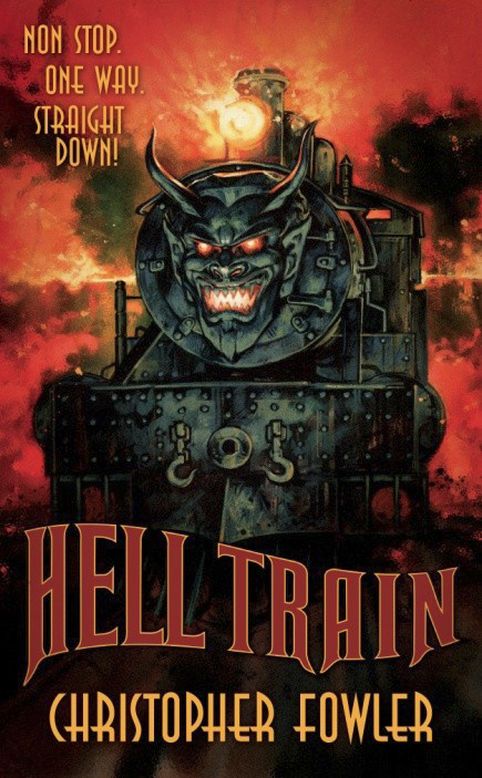
This new novel from Solaris charmed me before I’d even bought it. Firstly because it was championed as the greatest supernatural chiller that Hammer never made. Secondly, it combines hell and trains, both of which are personal favourite canvasses for a yarn. And lastly, it sports a deliciously loud and cinematic cover by Graham Humphries.

Behold.Like many horror fans, I’m deeply fond of Hammer, and I hoped that this would turn out to be a worthy homage. “Hell Train” certainly is, and also keeps a few surprises up its sleeve.
The tale begins with Shane Carter, a recently dismissed Hollywood scriptwriter, who arrives in England hoping to find work. He visits the home of Hammer Studios – an oak-beamed 17th century mansion – for an interview with the boss. After a rather jovial and tea-infused chat, he is given just a few days to write a script with one polite requirement. “We rather liked the idea of a train.”

This forms a wraparound for the novel, and having being introduced to the existence of an old board game by the name of Hell Train, the internal story begins.

War is spreading across 1916 Eastern Europe, and two lively couples find themselves out of their depth in the sinister village of Chelmsk in the Carpathian region. And where else? Thomas is a stuffy vicar, whose holiday with his wife Miranda has gone somewhat awry and Nicholas is an awol lothario with designs on a local village girl, Isabella. The English protagonists struggle with the aggression and ill manners of these farming peasants, to some amusing effect, and are soon forced to escape. But the only way out is a mysterious train, of which locals will only speak in suitably hushed and nervous tones, which arrives at the dark village station at midnight.

They inevitably board, and meet plenty of other rum folks as the train begins its journey into the rural night. The supporting cast includes a beautiful Hungarian Countess with a pack of tarot, a dead aristocrat in a coffin, and the grim and authoritative conductor. The protagonists begin to be tested in some way, but do they have a chance at redemption? And where exactly is the train’s destination, strangely blotted out on all the maps? As if we didn’t know. Hehe.

The author’s prose is sharp and clear, bringing to life a strong bunch of characters. They are understandably motivated despite their varied backgrounds, and perfectly resemble the cast of a classic Hammer outing while still being investable individuals. It’s also a nice touch that we are gently nudged into envisioning the train’s conductor as the “terribly tall and grave” Christopher Lee.

The thundering train itself is also perfectly evoked as it cuts through the ravines and wolves of the landscape, indeed a character itself. And while this is never a desperately scary novel, the pace never lags, and there are some tense and cruel scenes to balance the lurid fun. The wraparound story supplies much fond nostalgia and humour, and shovels in plenty of wry references to the film industry, censorship, Hammer’s rivalry with Amicus, and the familiar actors we know and love. And it isn’t afraid to play with stereotypical 60s Englishness: the essence of the studio.

I struggled to find fault. There are a couple of typos, and one of the main character’s tests aboard the train wasn’t quite as interesting as the others, but I’m being picky. This has all the satanic ritual and heaving cleavage you could hope for, along with clever stalemates, breathless action and generous spurts of modern gore. The cinematic tone is well evoked throughout, lending theatre to the peril, and merging with the classic novel stylings. And although it embraces many genre tropes in homage, this book avoids the pitfalls of a cliched finale. Does good triumph over evil, or is there some kind of diabolical punchline? Is it happy or bleak? Relax. Christopher Fowler’s got you.

If you’re familiar, “Hell Train” is a glorious tribute to the 60s horror cinema of Hammer. If you’re not, it’s still a gruesome and delightful ride that completely blows the budget.
Review – “The End of the Line” edited by Jonathan Oliver

1

The city undergrounds of the world have always been a great canvas for horror. Everybody’s been on one, breathed the stale air, rattled through those labyrinths of long, black tunnels. Whether deserted late at night, or in the middle of a packed rush-hour, it’s possibly to feel completely alone amid all that indifference, both human and mechanical. And who doesn’t remember that truly great scene from An American Werewolf in London?

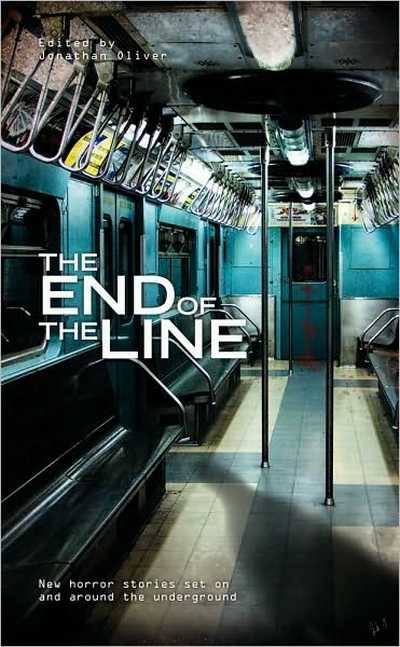
The End of the Line, an anthology from Solaris Books and edited by Jonathan Oliver, promises new horror set on and around the underground. It’s a solid slab of modern gothic that takes us to London, Paris, New York and Prague amongst many other cities, and also to some fictional transport systems. And although by the end of the book an inevitable familiarity had started to take away the edge, the potential of this theme certainly isn’t wasted.My favourite tales included “The Girl in the Glass” by John L. Probert: a nerve-tingling story a bitter ghost trapped in limbo on the tube. It’s classic JLP – old-school horror meets contemporary – and told with true finesse and a grim pay-off.

“The Lure” by Nicholas Royle takes us on a trip around the Paris Metro, concerning a young teacher’s affair with an older woman. It has an elegant French flavour, bringing the city to life around a plot of intrigue, sexual tension and shivers.

In “23:45 Morden (via Bank)”, Rebecca Levene presents a brilliantly nightmarish reality breakdown. A drunk young man catches a strangely-empty late train home, and soons finds his world has become cruel and vitriolic. It snared me from the off, forcing me to share his powerfully real and horrible plight.

And speaking of stories that grab your lapels and won’t let go, there’s “The Roses That Bloom Underground” by Al Ewing. A mayor manages to completely refurbish the London Underground in less than 3 weeks, and the inevitable exploration of how this was achieved gives great, gruesome reward to your curiosity.

“Exit Sounds” by Conrad Williams finds a recording engineer who wants to capture the hubbub of an aging cinema, and ends up wandering into the tunnels beneath the old building. It has incredible voice, attention to detail and keeps the reader guessing.

I particularly enjoyed “Fallen Boys” by Mark Morris. This is a slightly different setting, more specifically a miniature railway, as we follow an initially boisterous school trip into an old Cornish tin mine. It’s perfectly evocative, with sharp dialogue and characterisation, and plenty of chills.

Steven Volk’s “In The Colosseum” delivers unapologetic horror: a lust-charged downward spiral of a TV editor who tags along to a late party somewhere in the London Undergroud. It’s shocking, ultimately quite depressing, but worth every second.

I also loved the ghastly “Siding 13” by James Lovegrove, which describes an artist on route to an important meeting. His journey becomes more unpleasant on the increasingly packed tube train, and the last few lines are certainly the most horrifying and truly memorable that this book has to offer.

There weren’t any stories in this book that I disliked, although I found the dimensional nightmare of Jasper Bark’s “End of the Line” and the layered grief of Pat Cadigan’s “Funny Things” slightly confusing upon the first read. There were also several tales that didn’t quite capture the true essence of the underground, and it just seemed to be an arbitrary stage for a sequence of events which could’ve easily been set somewhere else.

And although all these stories are well written and interesting, by the end, the anthology starts to suffer from familiarity. There’s a lot of protagonists wandering about and getting lost in the subterranean dark, and many of them seemed to be ill, injured or hungover. Michael Marshall Smith’s excellent “Missed Connection” strongly reminded me of two previous stories, lessening its impact. This is no fault of the author, and it would have fared much better in another collection of tales, or if it had been placed closer to the beginning of the book. When the contents of a niche anthology are commissioned, I suppose common tropes or clashes are inevitable.

This sometimes means that the stories that wander furthest from the theme shine particularly bright. Gary McMahon’s “Diving Deep” is a good example: a spooky and subtle tale of Antarctic divers who discover a tunnel bored deep into the ice.

But despite the déjà vu, this is a strong anthology full of imagination and professional writing. There’s a nice mix of the haunting and the visceral, and the underground itself plays many roles, such as a lair for monsters,  a breeding ground for madness, or a device for political atrocity.

Each story has a pleasant editorial introduction by Jonathan Oliver, so if you like claustrophobic fiction, and especially horror that emerges from the everyday mundane, then give it a try. You could always minimise the risk of over-familiarity by reading it in small doses. Such as while travelling on the underground, for example…