I’m a bit late with this Gray Friar Press book review, but I enjoyed it too much to merely slot it back onto the shelf without fanfare.
 Where The Heart Is promises an alternative tour of Great Britain, in which the 19 British contributors wrote about what they know best… home. From faded northern industrial towns, violent urban sprawls of the south, and the bleak and sublime countryside in between, this promising TOC delivers a convincing journey through the sinister side of this sceptred isle.
Where else to start but the capital? The opener is “Ticker” by Allen Ashley, which transports us through the tube lines, streets and pubs of London from the perspective of a man who’s recently lost his father. He’s drawn into an urban “clothes war” in this clever presentation of modern urban behaviour, both tribal and cynical. This is a well written, multi-layered tale with pathos and menace in equal measures.
Next, “A Killing in the Market” by Stuart Young takes us to Romford and introduces Dave, an ill man deeply suspicious of the medical community. And for good reason. Another expert pen delivers plenty of seamlessly real dialogue, but don’t be lured by the reassuring humour and warmth, because you’re in for a real horror finale.
If you haven’t read any of the inimitable DF Lewis, then this is a good place to start. “So” (referring to the local pronunciation of “sea”) is a mood piece set in the traditional resort of Clacton-on-Sea. As everything closes down at the end of the holiday season, there’s an overwhelming atmosphere of ebbing time, transience and final journeys. It gives such a flavour of the place that it feels like I’ve been, even though I haven’t. Norfolk is the stage for “The Onion Code” by Andrew Hook: a remarkably original tale of a woman who can read onions, and manages to predict an earthquake. Told in a distinctive style, it has a wry sense of humour, and a less concrete finale than expected, the satisfaction of which will depend upon your taste. It has memorable moments, including an entertaining good cop/bad cop duo, and scores extra for a deeply chilling moment in a fashion shop changing room.
Following is “Easter” by Stephen Volk. Here we visit a quiet Bristol suburb and meet Martin – a middle-aged unconfrontational man – and his frustrated wife, Cheryl. The council arrive to conduct some work, and soon they have a crucified man in their front garden. “Easter” has a very English flavour, and despite the strange and slightly nightmarish content, it’s rendered normal by the couple’s believable relationship and their extraordinary diffidence: the essence of the tale. Very pleasingly tied up, this is one of my favourites.
Next we cross the border into South Wales. In “The Cuckoos of Bliss” by Rhys Hughes, Swansea is the canvas for this wild tale in which a jobless man is selected to be safety officer in heaven. Full of stunning turns of phrase, this extraordinary fantasy bursts with colour. Managing to be fun, then suddenly deeply disturbing in turns, this is a razor sharp piece of fiction, if perhaps slightly overlong.
From Swansea, our tour heads west into the mist-shrouded marshes of the Welsh Gower Peninsula. “Summerhouse” by Mike O’Driscoll begins with a wall of descriptive text, which initially put me off, but I was soon drawn into the mood. A married man revisits the location of childhood love, and the result is a triumph: nostalgia, ritual and loss collide to deliver a powerful conclusion.
After this sobering piece, we head back into England for “The Last Witness” by Joel Lane. Set in the hulking city of Birmingham, it features a nefarious property developer who’s no stranger to violence and murder, and a derelict house with dark forces at work. The tale made me feel for even the minor characters – the author has a talent for conjuring real people from a sentence or two – and it’s a solid meld of crime, noir and horror that keeps us guessing. More urban clautrophobia follows in the excellent “The City in the Rain” by Mark West in which he paints a sagging, rain-lashed Leicester. A master of empathy, the author introduces Andrew, a man who recently lost his wife and is lured into an alleyway after hearing cries for help. Despite being ever-so slightly marred for me by that old trope of a glimpsed figure from the past that then slips away and invites pursuit (just a personal irritation), at least here it was an important part of the plot. Andrew’s grief is palpable, and forms the spine of a good old-fashioned horror story and another of my favourites in this anthology. And the final sentence made me grin.
Another treat is “Last Summer” by Stephen Bacon. Set in an old colliery village near Sheffield, this is a moving piece that harks back to the miner’s strike of 1984, the Margaret Thatcher years and the distinct troubles of the time. The plot concerns missing children, possibly by the hand of a serial killer, and there are moments of horrible realisation but no punchlines: this is understated storytelling with no exclamation marks, but it packs more punch than the loudest scream of a tale. The narrator is reflective and gentle, seamlessly switching between childhood past and present, and this perfectly constructed descent into darkness brims with nostalgia. Bittersweet and memorable, “Last Summer” is the book’s crowning glory for me, and I would recommend it to anybody whether they like horror/dark fiction or not.
“Winter’s End” by Simon Bestwick presents both the urban and rural landscapes of Greater Manchester. A man begins a relationship with a girl in a band, falls in love, but then to his frustrated dismay, she starts to drift away from him. The story really captures that heartbreaking feeling of clutching at smoke, and is full of characterisation and style. But although I enjoyed the grisly showdown, I had the feeling that I’d missed something.
A stretch of ex-colliery wasteland in Wigan is the scene for “The Daftie” by the ever-reliable Paul Finch. Here, a young lad on a school cross country run is exhausted and left behind. He decides to take a short cut, despite the risk of bumping into the Daftie: a mentally disturbed man said to haunt that bleak and lesser-travelled route. His ill-advised decision soon descends into terror, and becomes a real adrenaline kick of a story. It has a sharp pay off, and is certainly the most tense page-turner of the anthology. Then we head east to Wakefield for “A Victim of Natural Selection” by John Travis. This sums up the author’s askew take of the world, concerning a man named Crocus who lives in abandoned urban desolation. To reveal any more would either spoil it, or not give sufficient credit to the weird and wonderfulness of it all. So I won’t. Just read, and enjoy this extraordinary vision.
We travel just a few miles to Dewsbury for “Ways Out” by Mark Patrick Lynch. This is a solid tale that presents colour and individuality amid an ambitionless, deprived populace. Brought to life by sharp dialogue and a pleasant yet strong ethnic narrator, it’s less depressing than it initially seems, and has the air of a modern fairy tale and much to digest for a story so short.
Lingering in Yorkshire, we visit Leeds for “Quarry Hill” by Michelle James. This is a modern ghost story featuring a couple of theatrical friends, and some modern buildings constructed on a site that once held flats in which people lived in terrible squalor. More light-hearted than many of the stories here, it begins well with a bit of mystery and gentle deliberate confusion. But it really starts to impress when you twig what’s happening through the clever structure of tense-switching, and it all falls nicely into place at the end.
Set near Morecambe Bay, “Scale Hall” by Simon Kurt Unsworth brings child abduction and hellfire to a gentle Lancashire conurbation. Although perhaps a little too wordy for my taste, the tale is bookended perfectly by the narrator’s troubled reflection. There’s a tremendous sense of location, and the aura of the evil supernatural is just as ice-cold and malevolent as it should be, which is no mean feat.
It’s back out into the sticks for “The Welcoming” by Gary Fry, specifically the wind-swept North Yorkshire Moors. Here we find that old cliche of a man breaking down in the middle of nowhere, which might have been a problem in the hands of a lesser writer, but not here. Parker, our unfit protagonist, trudges through the night to discover an isolated house of warm, welcoming folk, but is suspicious of their open arms. The author delivers educated prose, injected with humour and feeling, and plenty of metaphor that manages to not be invasive in the slightest. Also remarkable is the escalating threat, achieved in subtle ways that one can’t quite pin down, before a delightfully pan-esque finale. Some people scoff when anthology editors include a piece of their own, but when they’re more than good enough to rub shoulders, I’m not seeing a problem. Continuing north, we find ourselves in a snow-flurried Sunderland for “We Are The Doorway” by Gary McMahon. This has the author’s stamp of a bleak urban stage and exquisite attention to detail, as we follow Sangster: a drunk miserable man who carries a literal door to something inside him. It’s an odd but beautifully told tale, and thoughtfully explores the true concept of home.
Last of all, we head into the heart of Scotland for “Stamping Ground” by Carole Johnstone. Set in the bustling centre of Glasgow, it tells the increasingly desperate plight of a man stalked by homeless people. As the weeks go by, it masterfully evokes that grim feeling of being alone in a crowd, and also helpless despite the presence of those who might assist, including the police. The tale kept me guessing throughout before delivering a climax that I though I’d predicted, but it managed to wriggle free at the last moment. A quality finale to the book.
The tour concluded, I was happy to discover that there isn’t a poor contribution. The locales all have a firm grounding and flavour, presented as they are by natives. Some also explore the very nature of home, yet even when the physical stage is arbitrary, it doesn’t detract from the enjoyment. En masse, the geographical description can intrude slightly, but that’s the nature of the theme and a location-based anthology inevitably has scenes to set.
The editor Gary Fry has selected a great bunch of strong voices here. Despite the odd spelling mistake, the stories are well written, staffed by believable characters and true motives, and even the supernatural elements seem tangible. Several are 1st person tales, which all work well, lending them a traditional storytelling vibe.
If you’re British, then you’ll no doubt recognise much in location, character and tone. If you’re not, then this is a fascinating journey through the darkness of the country’s heart via the prose of some of its finest dark fiction authors. Highly recommended.
Where The Heart Is is available from Amazon and the like, as well as direct from Gray Friar Press here.




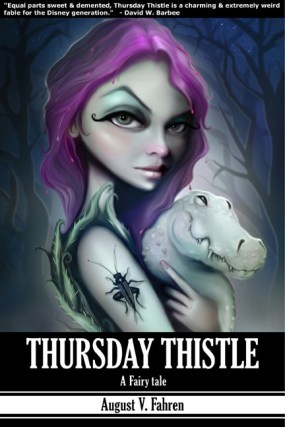 The title refers to our heroine: a downtrodden Cinderella-esque misfit who lives with her sneerful stepsisters and likes drawing robotic mermaids. Her humdrum life is interrupted one day when she’s led into the land of Lethe by a two-headed talking mouse, and discovers that a cannibal witch queen is destroying the paranormal princesses, each named after a day of the week. Like herself.
 Welcome to the Hellforge