The city undergrounds of the world have always been a great canvas for horror. Everybody’s been on one, breathed the stale air, rattled through those labyrinths of long, black tunnels. Whether deserted late at night, or in the middle of a packed rush-hour, it’s possibly to feel completely alone amid all that indifference, both human and mechanical. And who doesn’t remember that truly great scene from An American Werewolf in London?
The End of the Line, an anthology from Solaris Books and edited by Jonathan Oliver, promises new horror set on and around the underground. It’s a solid slab of modern gothic that takes us to London, Paris, New York and Prague amongst many other cities, and also to some fictional transport systems. And although by the end of the book an inevitable familiarity had started to take away the edge, the potential of this theme certainly isn’t wasted.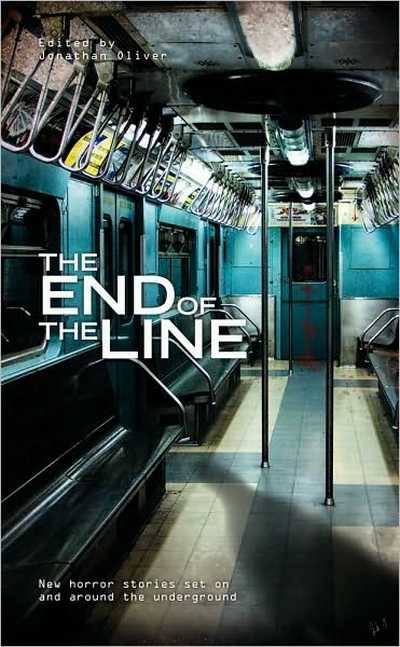 My favourite tales included “The Girl in the Glass” by John L. Probert: a nerve-tingling story a bitter ghost trapped in limbo on the tube. It’s classic JLP – old-school horror meets contemporary – and told with true finesse and a grim pay-off.
“The Lure” by Nicholas Royle takes us on a trip around the Paris Metro, concerning a young teacher’s affair with an older woman. It has an elegant French flavour, bringing the city to life around a plot of intrigue, sexual tension and shivers.
In “23:45 Morden (via Bank)”, Rebecca Levene presents a brilliantly nightmarish reality breakdown. A drunk young man catches a strangely-empty late train home, and soons finds his world has become cruel and vitriolic. It snared me from the off, forcing me to share his powerfully real and horrible plight.
And speaking of stories that grab your lapels and won’t let go, there’s “The Roses That Bloom Underground” by Al Ewing. A mayor manages to completely refurbish the London Underground in less than 3 weeks, and the inevitable exploration of how this was achieved gives great, gruesome reward to your curiosity.
“Exit Sounds” by Conrad Williams finds a recording engineer who wants to capture the hubbub of an aging cinema, and ends up wandering into the tunnels beneath the old building. It has incredible voice, attention to detail and keeps the reader guessing.
I particularly enjoyed “Fallen Boys” by Mark Morris. This is a slightly different setting, more specifically a miniature railway, as we follow an initially boisterous school trip into an old Cornish tin mine. It’s perfectly evocative, with sharp dialogue and characterisation, and plenty of chills.
Steven Volk’s “In The Colosseum” delivers unapologetic horror: a lust-charged downward spiral of a TV editor who tags along to a late party somewhere in the London Undergroud. It’s shocking, ultimately quite depressing, but worth every second.
I also loved the ghastly “Siding 13” by James Lovegrove, which describes an artist on route to an important meeting. His journey becomes more unpleasant on the increasingly packed tube train, and the last few lines are certainly the most horrifying and truly memorable that this book has to offer.
There weren’t any stories in this book that I disliked, although I found the dimensional nightmare of Jasper Bark’s “End of the Line” and the layered grief of Pat Cadigan’s “Funny Things” slightly confusing upon the first read. There were also several tales that didn’t quite capture the true essence of the underground, and it just seemed to be an arbitrary stage for a sequence of events which could’ve easily been set somewhere else.
And although all these stories are well written and interesting, by the end, the anthology starts to suffer from familiarity. There’s a lot of protagonists wandering about and getting lost in the subterranean dark, and many of them seemed to be ill, injured or hungover. Michael Marshall Smith’s excellent “Missed Connection” strongly reminded me of two previous stories, lessening its impact. This is no fault of the author, and it would have fared much better in another collection of tales, or if it had been placed closer to the beginning of the book. When the contents of a niche anthology are commissioned, I suppose common tropes or clashes are inevitable.
This sometimes means that the stories that wander furthest from the theme shine particularly bright. Gary McMahon’s “Diving Deep” is a good example: a spooky and subtle tale of Antarctic divers who discover a tunnel bored deep into the ice.
But despite the déjà vu, this is a strong anthology full of imagination and professional writing. There’s a nice mix of the haunting and the visceral, and the underground itself plays many roles, such as a lair for monsters, a breeding ground for madness, or a device for political atrocity.
Each story has a pleasant editorial introduction by Jonathan Oliver, so if you like claustrophobic fiction, and especially horror that emerges from the everyday mundane, then give it a try. You could always minimise the risk of over-familiarity by reading it in small doses. Such as while travelling on the underground, for example…
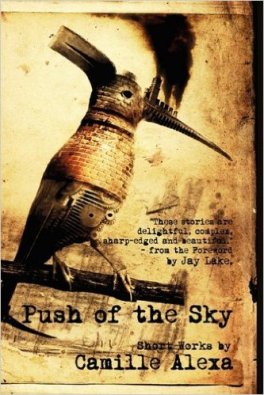 “The Butterfly Assassins” is a colourful tale about an assistant necro-alchemist’s attempts to create a flying human using butterfly ichor. He’s a nervous gentle soul, and his journey into the splendid Dragonswood makes for a pleasant opener.
 It would be difficult and unecessary to break down the plot, but I’ll briefly mention the characters. First we meet the recently hospitalised Gregory Mummerset, a sufferer of the fantastic dream-sickness, and his girlfriend Suzie. There’s a Victorian cat-meat vendor called Blasphemy Fitzworth, and Modal Morales, a black rosette-wearing clown with the Circus of the Tourettes. And not to forget Padgett Weggs, a homeless man who just might be writing this story in his head.
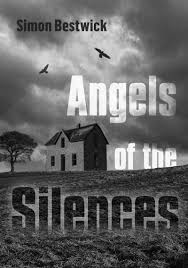 The tale concerns our narrator, Emily, and her best friend Biff. They’re likeable goth girls full of attitude and heart, and fairly normal other than the fact that nine months ago they were brutally murdered. They try to keep their other friends from harm, but it soon becomes clear that even undead guardians can’t control the darkness in the world.
 It kicks off with one of the shorter stories: “The Old North Road”. Here we find a down-on-his-luck historian travelling to a ruined abbey for a project on the legendary Green Man. He meets a suspicious couple out in the quiet countryside, and the unease notches up slowly towards a terrifying climax in which the supernatural almost takes a back seat to the three human characters. But only almost.
 As with all Gary’s previous publications, the characters are strong right down to the cameos. I expected to become weary of Usher’s grief-stricken self-flagellation, but the pathos is such that I discovered myself right in his corner, and the other characters – including an old romantic interest and a cancer-addled police colleague – also force your investment. And you won’t forget the menacing figure of Mr. Shiloh and his plastic, soulless smile.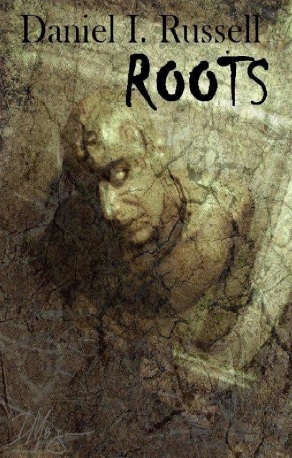
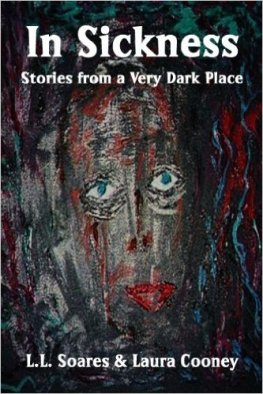 “In Sickness” is divided into 3 parts: a solo selection of stories from each author, followed by a collaboration. Laura Cooney is up first, and “Wasps” is a powerful curtain-raiser. Here we meet Clint, a young boy who can’t shake off the ghost of a slightly odd and embarrassing girl he’d been forced to play with before her brutal death. It evokes the guilty frustrations of childhood with an uncomfortable poignancy, and concludes with an ice-cold blow.
 The wild opener “Pyjamarama” gives a great taste of what’s to come, the title referring to a dimension of punishment where naughty children are supposedly sent when they refuse to sleep. Reading this tale is like watching a nightmarish animation, but it packs a sobering pay-off.
 Welcome to the Hellforge