Review – “The End of the Line” edited by Jonathan Oliver

1

The city undergrounds of the world have always been a great canvas for horror. Everybody’s been on one, breathed the stale air, rattled through those labyrinths of long, black tunnels. Whether deserted late at night, or in the middle of a packed rush-hour, it’s possibly to feel completely alone amid all that indifference, both human and mechanical. And who doesn’t remember that truly great scene from An American Werewolf in London?

The End of the Line, an anthology from Solaris Books and edited by Jonathan Oliver, promises new horror set on and around the underground. It’s a solid slab of modern gothic that takes us to London, Paris, New York and Prague amongst many other cities, and also to some fictional transport systems. And although by the end of the book an inevitable familiarity had started to take away the edge, the potential of this theme certainly isn’t wasted.My favourite tales included “The Girl in the Glass” by John L. Probert: a nerve-tingling story a bitter ghost trapped in limbo on the tube. It’s classic JLP – old-school horror meets contemporary – and told with true finesse and a grim pay-off.
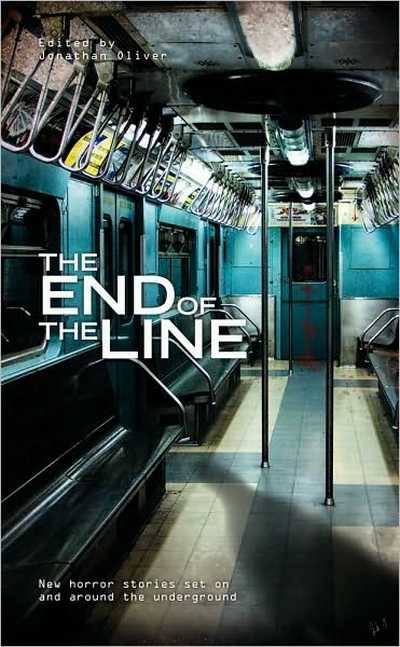
“The Lure” by Nicholas Royle takes us on a trip around the Paris Metro, concerning a young teacher’s affair with an older woman. It has an elegant French flavour, bringing the city to life around a plot of intrigue, sexual tension and shivers.

In “23:45 Morden (via Bank)”, Rebecca Levene presents a brilliantly nightmarish reality breakdown. A drunk young man catches a strangely-empty late train home, and soons finds his world has become cruel and vitriolic. It snared me from the off, forcing me to share his powerfully real and horrible plight.

And speaking of stories that grab your lapels and won’t let go, there’s “The Roses That Bloom Underground” by Al Ewing. A mayor manages to completely refurbish the London Underground in less than 3 weeks, and the inevitable exploration of how this was achieved gives great, gruesome reward to your curiosity.

“Exit Sounds” by Conrad Williams finds a recording engineer who wants to capture the hubbub of an aging cinema, and ends up wandering into the tunnels beneath the old building. It has incredible voice, attention to detail and keeps the reader guessing.

I particularly enjoyed “Fallen Boys” by Mark Morris. This is a slightly different setting, more specifically a miniature railway, as we follow an initially boisterous school trip into an old Cornish tin mine. It’s perfectly evocative, with sharp dialogue and characterisation, and plenty of chills.

Steven Volk’s “In The Colosseum” delivers unapologetic horror: a lust-charged downward spiral of a TV editor who tags along to a late party somewhere in the London Undergroud. It’s shocking, ultimately quite depressing, but worth every second.

I also loved the ghastly “Siding 13” by James Lovegrove, which describes an artist on route to an important meeting. His journey becomes more unpleasant on the increasingly packed tube train, and the last few lines are certainly the most horrifying and truly memorable that this book has to offer.

There weren’t any stories in this book that I disliked, although I found the dimensional nightmare of Jasper Bark’s “End of the Line” and the layered grief of Pat Cadigan’s “Funny Things” slightly confusing upon the first read. There were also several tales that didn’t quite capture the true essence of the underground, and it just seemed to be an arbitrary stage for a sequence of events which could’ve easily been set somewhere else.

And although all these stories are well written and interesting, by the end, the anthology starts to suffer from familiarity. There’s a lot of protagonists wandering about and getting lost in the subterranean dark, and many of them seemed to be ill, injured or hungover. Michael Marshall Smith’s excellent “Missed Connection” strongly reminded me of two previous stories, lessening its impact. This is no fault of the author, and it would have fared much better in another collection of tales, or if it had been placed closer to the beginning of the book. When the contents of a niche anthology are commissioned, I suppose common tropes or clashes are inevitable.

This sometimes means that the stories that wander furthest from the theme shine particularly bright. Gary McMahon’s “Diving Deep” is a good example: a spooky and subtle tale of Antarctic divers who discover a tunnel bored deep into the ice.

But despite the déjà vu, this is a strong anthology full of imagination and professional writing. There’s a nice mix of the haunting and the visceral, and the underground itself plays many roles, such as a lair for monsters,  a breeding ground for madness, or a device for political atrocity.

Each story has a pleasant editorial introduction by Jonathan Oliver, so if you like claustrophobic fiction, and especially horror that emerges from the everyday mundane, then give it a try. You could always minimise the risk of over-familiarity by reading it in small doses. Such as while travelling on the underground, for example…

Review – “Roots” by Daniel I Russell

0

I’ve been reading more and more e-books recently, lured by the price, immediacy and sheer number of titles available. I particularly like the opportunity to casually download single novelettes or novellas, which during the days of print-only publishing, would’ve been part of a larger and more expensive collection.

One such particular pleasure is “Roots” by Daniel I Russell. In this standalone novelette, we meet Richard, a regular copper frustrated by an increasing number of missing person cases in the neighbourhood. Unbeknownst to him, the murderous culprit lives right across the street, and has been using the butchered corpses to fertilise his garden. But there’s a very hungry and dangerous bit of greenery in that garden, a plant that absorbs the memories of the dead. And it’s growing stronger…RootsThere are no crime procedural elements to this story: this is proud horror and all the better for it. It throws the tropes of serial killers, the undead and monster vegetation together and the results are a crisp and well constructed tale. Roots has the air of a chapter in a television show, like an episode of Masters of Horror or a particularly lurid Tales from the Crypt. The author’s matter-of-fact prose style helps, letting the dialogue and actions speak for themselves and making for an effortless read.

There’s plenty of threat lurking throughout, both subtle and immediate, so even moments of domestic normality seem shadowed and askew. The violence is realistic, and one particular assault from the monster induced an actual writhe. But the author understands there can be as much horror in a footstep echoing down an empty street or a rustle in the trees, and uses such atmosphere and tone to great effect.

My only complaint was an odd situation involving a lift home from a nightclub during which a woman ended up wandering the deserted streets alone. It didn’t quite add up, and felt like she had been shoehorned into jeopardy for the purposes of a scare. But it’s my only complaint, and that scene is still pretty terrifying once it gathers momentum.

Give it a shot. Roots delivers half an hour or so of monstrous fun and is certainly worth the price.

Daniel I Russell

Necrotic Tissue #10

0

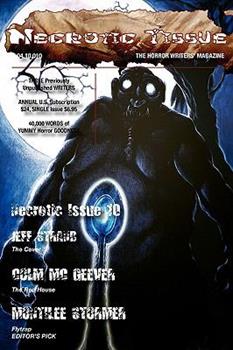
The latest issue is available and contains my story “The Bunker”, a story inspired by (and utterly humbled by of course) Stephen King’s “Apt Pupil”.nt 10There’s also juicy stuff courtesy of the brilliant Jeff Strand, MontiLee Stormer, Colm Mc Geever and plenty of others.
I love the neat, digest format and pulpy layout of this magazine. Hopefully it’s a stayer.

Bag one at their website here.

Nekropolis – Tim Waggoner

0

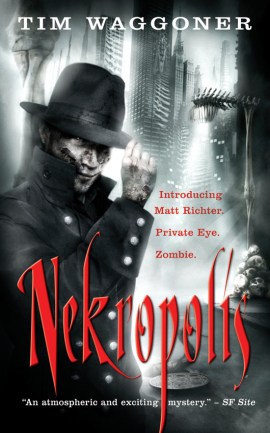
Meet Matt Richter. He’s a zombie ex-cop who does favours for people.

His turf is the Nekropolis, a dangerous and shadowed city of the dead. When a powerful artefact is stolen from one of the vampire darklords that rule the city, Matt teams up with Devona, a beautiful half-blood, to recover the artefact before its legendary powers can be unleashed.NekropolisI had high hopes for this book, partly because it seemed like an intriguing genre blend, but mainly because I’m a huge fan of stories with grim, urban settings. I’m happy to report that this novel more than does its premise justice.
The Nekropolis is a vast, pentagram-shaped city populated with all manner of creatures. There’s ghoul restauranteers, vampire punks, randy demons, a police force of golems, and nobody will forget the terrifying Silent Jack and his Black Rig. Now there’s a cab you don’t want to take you home.

Our protagonist’s case takes us to the Tim Burton-esque Gothtown, the spooky calm and vast foundries of the Boneyard, the brothels and bars of the murderous Sprawl. Elements of the supernatural are merged seamlessly with modern earthly technology – this is the work of an imagination that refuses to be restricted – and any genre cliches are self-aware, presented with a subtle wink. Nekropolis also has the cultural and social trappings of  a China Mieville novel, but is much more streamlined and less political.

Matt Richter is a delightful narrator. He is witty, pragmatic but jaded like any good city cop. His personal journey brings a human touch to the fantasy, and we wonder – along with him – if his dead zombie heart can ever be roused to true feeling. Devona proves to be an equally likeable sidekick. Although strong-willed, she is initially naive and sheltered, and serves as a mirror for our own wonder and disgust at the city’s nightmares. I really warmed to the duo on their adventure and the potential for genuine poignancy amid the fun is not wasted.

I could only find two minor things about which to complain. Firstly, there are occasional errors in the text, which always annoyingly leap from the page. Secondly, in the first few pages, a lot of information and description almost (only almost) distracted me from the dialogue and tension of an otherwise perfect opening gambit. But other than that, I found it a blissfully effortless reading experience.

Nekropolis is structured like a detective thriller, and has all the shadowed alleyways, skullduggery and razor-sharp noir banter you could want. The cinematic quality would lend itself to a classic cult film, and if I won the euromillions lottery tomorrow, I’d fund it myself without hesitation.

I love the frightening and wild world that Tim Waggoner has created. Dead Streets, the next installment, is in the mail and I can’t wait to tuck in.

Tim Waggoner

Angry Robot books

“Terrible Beauty, Fearful Symmetry” Anthology Released

0

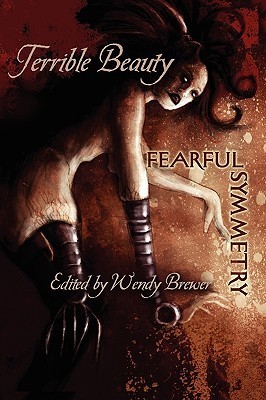
After various delays, this Darkhart Press anthology (Edited by Wendy Brewer) is available. It contains my story Reverend Cheshire and the Brimstone Package.tbfs

“Beauty can seduce you. Beauty can deceive you. Beauty can also be cruel, otherworldly and downright deadly. Explore the fearful symmetry of beauty’s dark side with the genre’s most-terrifying storytellers.”

TABLE OF CONTENTS:

  • Introduction – David Thomas Lord
  • The Rutting Time – James A. Moore
  • I Bought – Marcy Italiano
  • In Memoryum – John Everson
  • Valentines for the Dead – Corrine De Winter
  • When Lucy Falls – Scott T. Goudsward
  • Picture Perfect – Matthew Warner
  • Of the Flesh – J.L. Comeau
  • Part-by-Part – T. Rex Armes
  • Reverend Cheshire and the Brimstone Package – Matthew Fryer
  • Psyche’s Mark – Jeffrey Rice
  • Perversion and Channel 78 – Peter N. Dudar
  • Mosquito Story – A.M. Muffaz
  • Small Crimes – Charles Coylott
  • The Grass is Always Greener – Sephera Giron
  • Pumpkin – Ron Clinton
  • The Ossuary – Gregory L. Norris
  • Exile – April Grey
  • Pray – R.E. Gofstein
  • Be Mine – Jason Palmer
  • Written in the Stars – Dennis M. Cummins
  • When the Music Dies – David Simms
  • Mercy – Gord Rollo and Everette Bell
  • An Artist in Still Life – Weston Ochse
  • Skin Deep – Angeline Hawkes
  • The Fine Art of Self-Mutilation – Harrison Howe
  • Eleanore’s Leftovers – Wendy Brewer
  • Scripture Girl – Edward Lee

It’s great to be in such company!

The book is available from Amazon, Amazon UK and Barnes & Noble