Review – “Ill At Ease” by Stephen Bacon, Mark West & Neil Williams

1

Penman Press present this eBook collection of three short horror stories from a talented trio of British horror writers. The title sums it up. These tales ooze with an askew feeling, where even the most ordinary of situations becomes alien and sinister: the essence of any good macabre fiction.First to follow that vertigo-inducing cover is Stephen Bacon, and “Waiting for Josh” is one of his triumphs. Narrated by a man named Pete Richards, he revisits his hometown to see a dying childhood friend and discovers that there’s more to his lonely alcoholism than meets the eye. This author excels at first-person storytelling, and it works very well here, drawing us into the character’s mood and nostalgia as though it were our own. This also makes the chills more effective, and I defy anybody not to be moved by his haunting journey of guilt, loss and confronting horrible truths. This is poignant and mature writing, and I insist on a collection. Immediately.

Mark West maintains the standard with “Come See My House in the Pretty Town”. Here we meet David Willis, another man reconnecting with his past when he visits an old college friend who now lives the dream in a quaint country village. But as Mark West is writing this story, there’s to be no pleasure in the sunny, picture-postcard surroundings. Everything has a sinister edge, and he notches up the tension in small intriguing reveals about the character histories. When the real descent comes during a visit to the local fair, it’s a grim, breathless ride with a brilliant pay-off. Mark also scores extra for creating some truly scary clowns, whether they normally freak you out or not, and their first appearance is a simple but powerfully charged scene of lurking violence.

Although I wasn’t familiar with Neil Williams, he’s now a name I’ll remember.  With “Closer than you Think” we meet Dave, an ordinary family man. When he spots a perfectly good car seat being abandoned at a rubbish tip by a strange, dull-eyed woman, he decides to take it home. But when he starts to use it for his young daughter, a series of strange and disturbing occurrences ensue. As the supernatural increases, the story becomes a tense family drama with some tight dialogue and oily, nightmarish scenes. Although it has less depth and more formula than the others, it’s a real one-sitting read that grips from the off and doesn’t let go. For me, the supernatural has to be really good to give me a chill – Gary McMahon and Paul Finch spring to mind – and I was happy to discover that Neil Williams also has the knack.

It might be a relatively short book, but “Ill at Ease” rises way above the mire. The theme of horror in the mundane is perfectly realised, mouldering constantly beneath the text and infusing it with a sour sensation of impending doom. It’s modern horror that understands subtlety, full of real characters and plenty of shivers. These three authors clearly take pride in their work, all writing with lucid, thoughtful prose, and the time and effort shows. As reader, there’s no jarring, no creases – just an effortless, entertaining read. With interesting author notes, it’s a great package and well worth a couple of quid. Highly recommended.
Review – “Wine and Rank Poison” by Allyson Bird

0

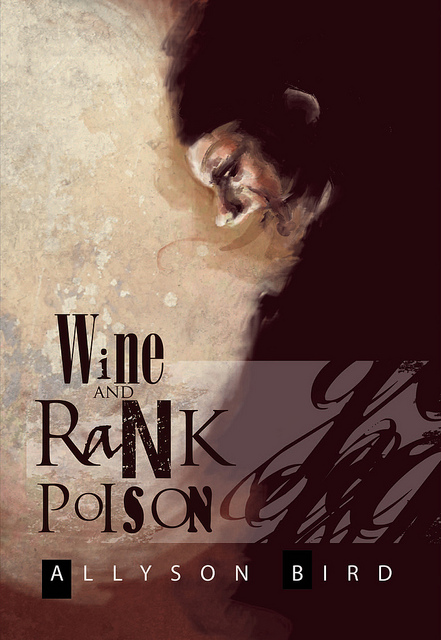
The smoky, ethereal artwork of Daniele Serra is the perfect face for this book: like the stories inside, it seems to become more unsettling with time.Like Allyson Bird’s last collection, the award-winning Bull Running For Girls, there’s drama, horror, dark fantasy and everything in between. A couple of the stories left me somewhat confused, but the evocation is extremely well done and the author favours a more succinct prose style to transport us to these strangely-peopled places.

First up, “The Black Swan of Odessa” takes us to a harsh 1920s Ukraine winter. We meet hard-up playwrights, Petrov and Ilf, who hear that a legendary chair stuffed with treasure might be closer than they thought. The period detail is good – I feel as though I’ve actually visited their bleak little flat – and it’s brought to life with prickly comic touches to the dialogue, although the finale felt somewhat out of the blue.

Next is “The 12th Chair”, which refers to the aforementioned treasure: all stories pleasingly link the previous one in some way. Here it’s present day and we find a nobody called Theo Bitter on his way to Odessa to round up his wayward internet bride. It’s a colourful trip with a wry sense of humour that doesn’t lessen the impact of a fiery conclusion.

One of the peaks is the wonderfully-titled “Vulkodlak”. A searing tale of extreme Serbian nationalism and lycanthropy, it reflects on the failings of our primitive tribal natures and brings a strong sense of place to horrors both imagined and real.

“Atalanta” is the first of 2 stories of heavy mythology. An inventive tale, it jumps between the eponymous heroine and her adventures with Jason and the Argonauts, and Vesna, an oppressed woman who meets a powerful witch. When the two timelines link, the tale becomes much more than the sum of its parts.

Next we meet Cleopatra and plenty of mythological creatures in the erotically charged, dreamlike “Beauty and the Beast”. Although a fun ride, by the end, I had no idea what was going on.

“The Convent at Bazzano” returns us to the present, following a young family staying at an old convent near Rome. It has a palpable holiday feel and a pensive supernatural flavour that smirches every scene, but again I found myself baffled by the conclusion.

A couple of solid stories follow. “The Legacy” takes us into the Roman catacombs of St. Callixtus in which a mob guy is the focus for a violent apocalypse that I would’ve liked to have seen expanded.

“The Last Supper” introduces a dysfunctional family troubled by copperhead snakes: a relationship piece set around a funeral with a couple of visceral twists.

The final duo ensure the collection ends on a high. I’ve always been partial to macabre tales of the sea, and “Coney Island Green” opens with the intriguing concept of a dead woman who can’t remember who she is, but is spiritually lured by the ocean. A mature, melancholy story, it paves the way nicely for “For You, Faustine”. This is a tale of a sea-serpent-esque creature who braves the perils of New York to avenge her daughter’s death, befriending a young tattooist along the way. It’s a modern folk-tale with a grisly finale and plenty of simple empathy.

While there’s plenty of fascinating history, mythology and geography layered into the tales, I felt that at times the detail cluttered the flow. Some very nicely turned phrases are jolted by infodumps, and there are occasional moments of awkward point-of-view and repetition.

Nevertheless, the book is infused with a strange darkness: the rank poison trickled into your glass of wine. It’s a great title, both as a metaphor for the coldly-served revenge in the tales, and also for what you are being subjected to as reader.

While a more uneven read than Bull Running For Girls, I’ve quite enjoyed the haunting after-images left behind after reading these slightly-askew mood pieces. It’s like having watched a good foreign film. Caught off-guard from the unfamiliarities, but moved by the experience and resolved to visit again.

Dark Regions Press

Allyson Bird

Review – “The End of the Line” edited by Jonathan Oliver

1

The city undergrounds of the world have always been a great canvas for horror. Everybody’s been on one, breathed the stale air, rattled through those labyrinths of long, black tunnels. Whether deserted late at night, or in the middle of a packed rush-hour, it’s possibly to feel completely alone amid all that indifference, both human and mechanical. And who doesn’t remember that truly great scene from An American Werewolf in London?

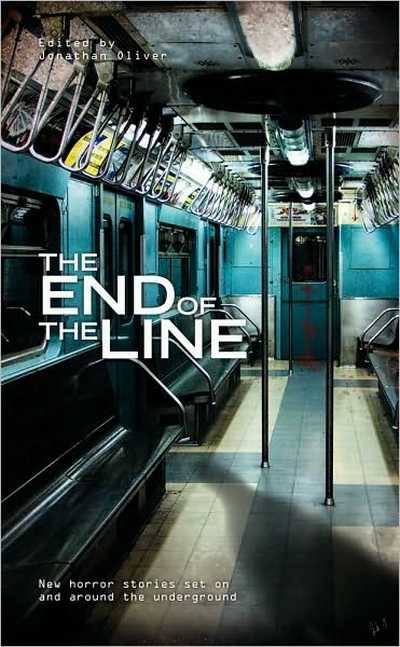
The End of the Line, an anthology from Solaris Books and edited by Jonathan Oliver, promises new horror set on and around the underground. It’s a solid slab of modern gothic that takes us to London, Paris, New York and Prague amongst many other cities, and also to some fictional transport systems. And although by the end of the book an inevitable familiarity had started to take away the edge, the potential of this theme certainly isn’t wasted.My favourite tales included “The Girl in the Glass” by John L. Probert: a nerve-tingling story a bitter ghost trapped in limbo on the tube. It’s classic JLP – old-school horror meets contemporary – and told with true finesse and a grim pay-off.

“The Lure” by Nicholas Royle takes us on a trip around the Paris Metro, concerning a young teacher’s affair with an older woman. It has an elegant French flavour, bringing the city to life around a plot of intrigue, sexual tension and shivers.

In “23:45 Morden (via Bank)”, Rebecca Levene presents a brilliantly nightmarish reality breakdown. A drunk young man catches a strangely-empty late train home, and soons finds his world has become cruel and vitriolic. It snared me from the off, forcing me to share his powerfully real and horrible plight.

And speaking of stories that grab your lapels and won’t let go, there’s “The Roses That Bloom Underground” by Al Ewing. A mayor manages to completely refurbish the London Underground in less than 3 weeks, and the inevitable exploration of how this was achieved gives great, gruesome reward to your curiosity.

“Exit Sounds” by Conrad Williams finds a recording engineer who wants to capture the hubbub of an aging cinema, and ends up wandering into the tunnels beneath the old building. It has incredible voice, attention to detail and keeps the reader guessing.

I particularly enjoyed “Fallen Boys” by Mark Morris. This is a slightly different setting, more specifically a miniature railway, as we follow an initially boisterous school trip into an old Cornish tin mine. It’s perfectly evocative, with sharp dialogue and characterisation, and plenty of chills.

Steven Volk’s “In The Colosseum” delivers unapologetic horror: a lust-charged downward spiral of a TV editor who tags along to a late party somewhere in the London Undergroud. It’s shocking, ultimately quite depressing, but worth every second.

I also loved the ghastly “Siding 13” by James Lovegrove, which describes an artist on route to an important meeting. His journey becomes more unpleasant on the increasingly packed tube train, and the last few lines are certainly the most horrifying and truly memorable that this book has to offer.

There weren’t any stories in this book that I disliked, although I found the dimensional nightmare of Jasper Bark’s “End of the Line” and the layered grief of Pat Cadigan’s “Funny Things” slightly confusing upon the first read. There were also several tales that didn’t quite capture the true essence of the underground, and it just seemed to be an arbitrary stage for a sequence of events which could’ve easily been set somewhere else.

And although all these stories are well written and interesting, by the end, the anthology starts to suffer from familiarity. There’s a lot of protagonists wandering about and getting lost in the subterranean dark, and many of them seemed to be ill, injured or hungover. Michael Marshall Smith’s excellent “Missed Connection” strongly reminded me of two previous stories, lessening its impact. This is no fault of the author, and it would have fared much better in another collection of tales, or if it had been placed closer to the beginning of the book. When the contents of a niche anthology are commissioned, I suppose common tropes or clashes are inevitable.

This sometimes means that the stories that wander furthest from the theme shine particularly bright. Gary McMahon’s “Diving Deep” is a good example: a spooky and subtle tale of Antarctic divers who discover a tunnel bored deep into the ice.

But despite the déjà vu, this is a strong anthology full of imagination and professional writing. There’s a nice mix of the haunting and the visceral, and the underground itself plays many roles, such as a lair for monsters,  a breeding ground for madness, or a device for political atrocity.

Each story has a pleasant editorial introduction by Jonathan Oliver, so if you like claustrophobic fiction, and especially horror that emerges from the everyday mundane, then give it a try. You could always minimise the risk of over-familiarity by reading it in small doses. Such as while travelling on the underground, for example…

Necrotic Tissue #14

0

The latest, and sadly final Necrotic Tissue horror magazine is now available. It contains my story “The Narcslaag” which was chosen as editor’s pick for issue #14: an unpleasant tale set in the Red Light District of Amsterdam.

There is also new fiction from Fran Friel, Angel McCoy, M.P. Johnson, Robert Essig, Damien Walters Grintalis and many others. And I love Patrick McWhorter’s vicious and feral Easter bunny on the cover.

It’s available direct from the link above (and other back issues) and the usual places like Amazon and Amazon UK.

I’m very sad to see it go, this being my third publication with NT. Cheers to the editor R. Scott McCoy for creating a quality, paying magazine and persevering for as long as he did in such a tough market. Fortunately, his Stygian Publications is going to continue with the occasional release, one of which will be a Best of Necrotic Tissue anthology in which “The Narcslaag” will also feature.

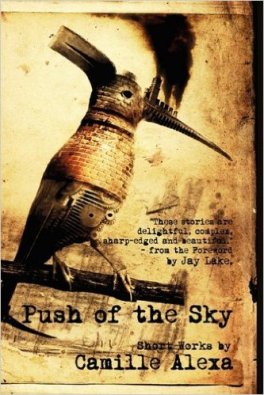
Review – “Push Of The Sky” by Camille Alexa

1

I bought this title impulsively, simply because it caught my eye, and although that’s not the most advisable way to judge a book – as we all know – this time it paid off.

This collection is a real mixed bag. There’s SF and fantasy, gender politics and whimsy, romance and horrors. And while some of the stories are forgettable, plenty are exciting in an almost childlike way, even if the subject matter is adult. There are too many to review individually, so instead I’ll briefly discuss my favourites.Push of the Sky“The Butterfly Assassins” is a colourful tale about an assistant necro-alchemist’s attempts to create a flying human using butterfly ichor. He’s a nervous gentle soul, and his journey into the splendid Dragonswood makes for a pleasant opener.
“The Taste of Snow” presents a future of catastrophic global-warming and tells of a woman and her old, dependent aunt with whom she shares their desert home. It’s an evocative piece, and the taste of dust and grit nicely contrasts with touches of nostalgia.

The book has a couple of enjoyable space westerns starting with “The Clone-Wrangler’s Bride”. The star is Matty Johnson, here found wandering the domed cities of Mars looking for her husband, accompanied by a fussy “mandroid”. The relentless heat of the red planet seems to radiate from the pages, and its follow-up “Droidtown Blues” allows the mandroid’s POV to bring mirth to a gritty scenario.

In “Kingdom at the Edge of Nowhere”, we meet Gil, a lonely space-worker who whiles away the days playing holocards with his dead cryogenic family. But his loneliness is interrupted in a lunar city when he finds himself falling for a moth girl who plays the flute. Almost a fairytale romance, this story has real resonance and fragility.

The cleverly titled “Paperheart” concerns a dragon charged with protecting a rustic community, until one day the villagers decide she’s an unecessary relic and attack her. Terribly wounded, she meets an origami witch, who might be both her saviour and her destruction. This story creates an actual spirituality out of fire, and ponders themes of survival and the essence of true existence. It also has a real upper-cut of a finale.

“Shades of White and Road” is told by somebody travelling a spiralling road who is beset and pestered by inanimate objects. It’s a nice whimsy with some deft linguistic wordplay.

“Flaming Marshmallow and Other Deaths” is a real stayer. We meet Carolyn, a teenaged girl who lives in a world similar to our own, except that they learn how they’ll die on their 16th birthday. Is she destined to die a boring death such as old age or suicide, or be able to join the ranks of the cool kids like a “crasher” or “burner”? A great concept that explores schoolyard politics, it’s ghoulishly intriguing from the off, darkly humorous, and ties up with a truly poignant scene.

Other honourable mentions include “They Shall Be As they Know” – a kind of zombie-twist meets Orwell’s 1984 – and “Observations of a Dimestore Figurine” which is exactly that. An intense version of  Toy Story, it managed to be witty but ultimately horrific.

The final almost-title story in the collection is “The Pull of the World and the Push of the Sky”. Following a sensitive misfit of a caveman who has a cunning idea for the use of a pterodactyl’s corpse, it concludes the collection on a pleasing note.

The above is only a fraction of what’s on offer: this book is a cauldron of characters, wild settings, and some interesting concepts of aliens. We meet a blackmailed siren, interplanetary archeologists, a lost astronaut, a woman who sees through an exatraordinary nanotech veil, and some human kudzu. The book is also sprinkled with poetry and much of the prose has a poetic feel too, with deliberate rhythm and style.

This isn’t quite a perfect collection. A few of the stories I felt had more style than substance, and some of them felt inappropriately inconclusive. But overall, this is a strong book: a tour through a very sharp but delightful imagination. There’s comic timing when required, and none of the infodumping often found in fantasy when the author has whole worlds to convey. Camille Alexa trickles in the important parts and lets your subconscious paint the bigger picture itself, switching between sub-genres with ease.

The foreword by Jay Lake concludes with “Spread the word.” It would’ve been impossibly rude not to.

Camille Alexa

Hadley Rille Books

Of Midnight and Murky Depths

0

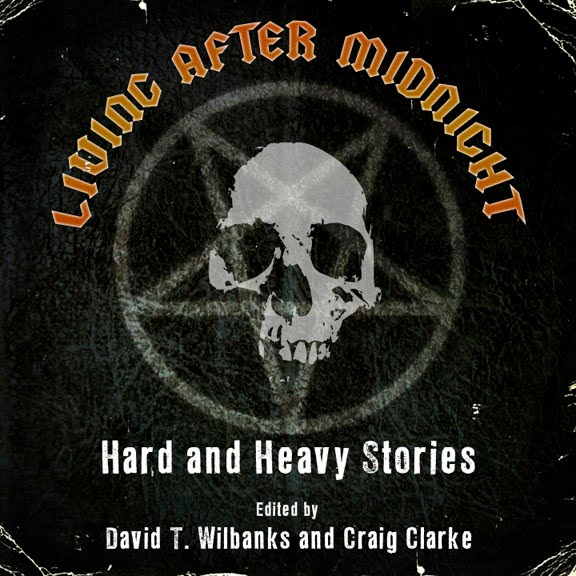
Just a couple of writing-related things to report.First, a very positive review of Living After Midnight has gone up here at Hellnotes. Darkeva says “Metalheads rejoice! This is a fantastic anthology that will leave you wanting more.”

They also say rather lovely things about my novella “Iron Maiden” including: “If you think sirens are lame or overused, you definitely won’t after reading this story” and “The emotional connection that I felt to the characters was the one of the strongest I’ve had”.

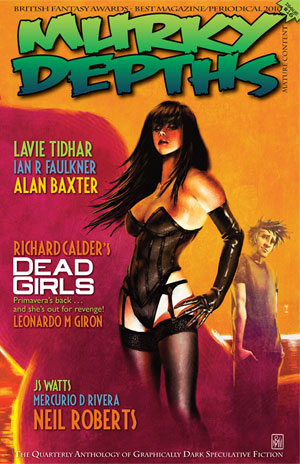
Wow! Thanks, Darkeva.Secondly, a new short story of mine has been accepted by the wonderful and graphic-novelesque Murky Depths. “Honest Harry’s Budget Boneyard” is a wry, apocalyptic tale, and I’m very pleased it’s found a home there. I’ve been reading this magazine for years, and appearing within those shiny, lurid pages has long since been a goal. Please humour me politely while I make a fist and yell “Score!”

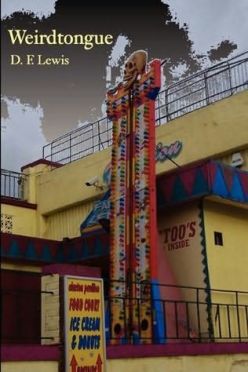
Review – “Weirdtongue: A Glistenberry Romance” by D.F. Lewis

12

“I come here,” the Weirdmonger roared, “to sell Weirds, and Weirds are merely Words that materialize into all sorts of true existence the moment I release them from between my lips…”

I’d put off reading this book, concerned that it would be over my head, or that I’d see nothing but waffle. I was pleased to discover that the former was only partly the case, the latter not at all.

This isn’t a traditional story, it’s more a book of wordplay. It does have structure and plot, of course, but I’d describe it more as an album of exquisitely linked ideas and visions, almost presented as a linguistic piece of art. But is it any good? While I was often lost with the narrative thread, the text is so rich that it satisfied an itch I didn’t even know I had.It would be difficult and unecessary to break down the plot, but I’ll briefly mention the characters. First we meet the recently hospitalised Gregory Mummerset, a sufferer of the fantastic dream-sickness, and his girlfriend Suzie. There’s a Victorian cat-meat vendor called Blasphemy Fitzworth, and Modal Morales, a black rosette-wearing clown with the Circus of the Tourettes. And not to forget Padgett Weggs, a homeless man who just might be writing this story in his head.
We follow their entwining adventures, but the essence of Weirdtongue lies in the metaphors, the tricks with language and rhyme, the narrative interjections. I was going to give a few examples, but there are too many to choose from, and to pull them from context would lessen the accumulative effect.

The concepts here are intricate, sometimes lucid, other times baffling: themes of identity, reality and the transcience of memory. The Glistenberry Romance of the subtitle refers to a parallel of the Glastonbury festival, and this element is evocative and contains some rather poignant scenes between the characters, which is something I wasn’t expecting.

Reading this book made me feel tired but refreshed, almost like the endorphin rush of a work-out, which is probably because that’s exactly what it is. Weirdtongue certainly demands patience and effort from the reader, but plenty of realistic and sometimes amusing dialogue balances the semantic exuberance. D.F. Lewis is an extraordinary narrator and storyteller, and one is swept away by the feast of words, or weirds as the Weirdmonger itself would call them: the nemophile wordsmith who ties the chapters together.

At times I felt frustrated, and found myself becoming lost in the ever-changing textures, not to mention needing to reach for a dictionary. This author doesn’t pause to let the stragglers catch up. But I pressed on and found that such moments just heightened the rewards, and the whole experience just left me wanting more. I intend to read it again as I suspect there are nuances of fantasy and humour that were missed (or misunderstood) the first time around.

It is quite short in length, but this is balanced by the time it takes to read it, and a longer work of this type would have been imposing. After all, you don’t sprint through the Louvre. You amble, pausing to reflect and analyse the layers, and should you find yourself confused or lost, you can just shrug, sit back and bask in the deeply colourful wonderland of language that D.F. Lewis has presented.

Weirdtongue is very immersive and subjective: I don’t believe that any two people would read it and have the same experience. It’s certainly not for everyone, and there will be those who actively dislike it. But if my attempt to review it has piqued your interest, then perhaps give it a shot. This peculiar and elusively satisfying book deserves it, and so do you.

D.F. Lewis

We’re Gonna Need a Bigger Boat!

0

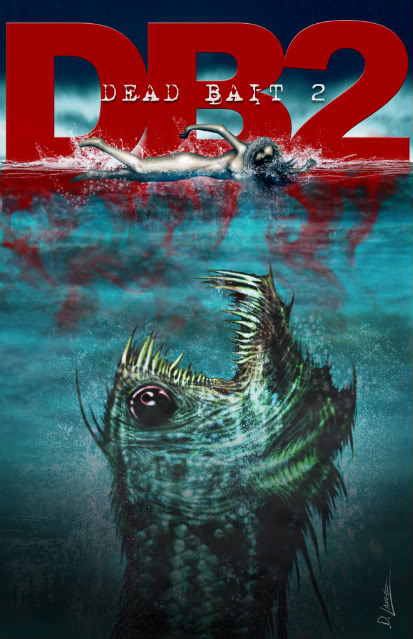
A wee bit of self-pluggery, but the Severed Press anthology Dead Bait 2 containing my story “Ternskull Point” is now available.It also contains stories by Ramsey Campbell, Guy N. Smith, Steve Alten, Tim Curran, Cody Goodfellow, Murphy Edwards, James Robert Smith, Anthony Wedd, Paul Freeman, Raleigh Dougal, James Harris and Michael Hodges.

The blurb promises “horror tales of the deep including a haunted ice fishing trip, vicious mer-monkeys, sickening shark attacks, deranged walruses and many more terrors from beneath the surface.”

The deranged walruses might have been my fault. Hehe.

It’s available from Amazon and Amazon UK amongst other places, and the publisher’s site above.

Living After Midnight for 99 cents

0

Yep, throughout the month of April, this ebook of hard rockin’ stories from Acid Grave Press is just 99 cents, or 71 pence. A book of horror and dark fantasy with a metal twist, it contains my novella “Iron Maiden” and has been favourably received so far.“One of the things that make having an e-reader worthwhile.” – Dead in the South

“Heavy metal horror heaven.” — Ginger Nuts of Horror

“A good variety pack of scary stories … an easy read, and a satisfying one.” — author Patrick D’Orazio

It also got another positive review here from Martel Sardina at Dark Scribe Magazine

Grab your bargain here at Amazon, Amazon UK and Smashwords.