Review – “Depraved 2” by Bryan Smith

0

The original Depraved is a masterpiece among its particular kind (my old review here), and I was looking forward to another fix of depravity and madness. The sequel certainly steps into the dock with a machete in one hand and its erection in the other, and while less lurid in tone and not quite as much fun (if that’s the right word), this is an ice-cold and intense read.depraved 2Four years have elapsed since the events of the first book, which concerned a family of perverted mutants in the rural community of Hopkins Bend. We meet Jessica again, the heroine and survivor of the first story, who managed to escape their microcosm of rape, murder and religious sacrifice. Having been ignobly discharged from the military, she finds herself on the run having being framed for a murder set up by powers much bigger than her. Drawn back to Hopkins Bend, now a ghost town having being cleaned out in some hush-up sweep by the army, she discovers that it’s not quite deserted as it initially seems.

The story also follows Sienna and Jodi, sisters from the old family, who are now living in nearby Bedford and no less fond of torture and all things nasty. While Jodi attempts to keep her wild and crumbling family together, Sienna fancies herself a witch and wants to bring her monstrous father back from the grave.

The other main player is Daphne, a gutsy but entitled girl who falls foul of Hopkins Bend on a country drive with her lover. Having been captured and imprisoned by a pair of murderous rednecks, she realises that unless she can think fast, her fate looks like being a life of sex-slavery or becoming the main course for a cannibal feast.

Like the first, this is a very slick and well paced novel. There’s no padding before the action gets going and while it’s not quite the breathless rollercoaster of Depraved, it gives you time to take stock.

The prose is seamless and unintrusive, and one of Bryan Smith’s talents is to make the reader care immediately about people in jeopardy, even if we’ve only just met them. While that is the case here, things aren’t clear-cut and the actions of some characters really tests our loyalties. Perhaps this might be too much for some readers, but it’s well handled, and riffs on the old human-capacity-for-atrocity idea. The descent of some characters still seems a little swift, but I personally liked how it forces us into an experience devoid of comfort zones.

Speaking of which, although the original Depraved is more gruesome and sick, I found its nastiness to have a knowing twinkle. The horrors of Depraved 2 are darker, more sobering, and its very rare that this extreme horror veteran is rattled. There are several powerful scenes of sexual violence and psychotic cruelty, and although any graceless hack can write a no-holds-barred torture scene, it takes a skilled scribe such as Bryan Smith to make it really hit home. I’ll never look at a commercial restaurant grill the same way again.

This is superbly evocative writing and the menace of the backwoods is nailed, providing the familiarity you want from a sequel. I also liked the gentle conspiracy theory angle. It’s not rammed down our throats, but with larger forces at work regarding both Hopkins Bend and the price on Jessica’s head, it allows us to wonder who watches the watchers? It suggests that anything might happen next and that nobody is safe, lead protagonist or otherwise.

I don’t really have any complaints. At first, I found the character of Sienna – although a pleasingly sociopathic villain – to be rather out of place with her black magic and goth teen angst. Perhaps this is because the novel harbours a primitive, rural vibe: the kind that doesn’t normally flirt with either the supernatural or “street” kids. But I was still carried by her story and she provides some of the twists that the later chapters have in store. The finale itself is somewhat bleak, but there’s a definite shade of black humour which serves to temper the grim tone and allows you to close the book with a wry smile.

If you enjoyed the first instalment, then get your blood-sticky palms on Depraved 2. While perhaps not quite scaling those ghastly heights overall, I’m very glad this isn’t just a franchise-style rehash. There’s a refreshing lack of predictability, it moves the plot in new directions, and still finds time to pile on the mood and forcefeed us horror by the bucketload.

The story notes mention that Depraved 3 is a possibility. Although this sequel is nicely tied-up (don’t worry, no annoying cliffhangers or blatant dangling threads to see here) I’d be more than happy to see another. Hopkins Bend can’t have exhausted its potential for degradation and debauchery just yet. Those folks are just too damned good at it.

Review – “Clusterfuck” by Carlton Mellick III

0

You know you’re in for plenty of warped humour and weird horror with Carlton Mellick III, and Clusterfuck is no exception. Loosely following on from the excellent Apeshit – that followed a bunch of jocks and cheerleaders being stalked by a crazed mutant in the woods – Clusterfuck has a similar hook. But this time it’s fratboys and college chicks on a caving weekend, and while not quite as outrageously gruesome, it piles on the claustrophobia and the laughs.ClusterfuckAs the author explains in the foreword, frat boys are both “the worst human beings on the face of the planet, and the funniest human beings on the face of the planet”. And that’s certainly true of this crowd. The “alpha-bro” of the group is Trent, who along with his gloriously stereotypical buddies – beer-guzzling, insensitive, sexist pricks – decides to stock up on booze and go caving with a trio of girls in tow, undeterred by his lack of experience and the fact that two of the girls can’t even stand him.

So after some pre-trip shenanigans and a journey into the wilds, with shades of Deliverance and The Texas Chainsaw Massacre, they head off underground. Naturally, things start to go bad pretty quick. The cave network starts to flood, and if this wasn’t enough, they soon realise they’re not alone down there. Yes, there are cannibal mutants to contend with and as we have a bizzarro master at the helm, some brilliant and sick imagination is on the way.

It’s the characters that drive this story. A couple of them seem fairly normal at the outset, such as squeaky-voiced Lauren, who simpers around Trent, and Selena, who’s intelligent and completely unimpressed by bro-culture. And of course the quiet and sensible Lance, dragged on the trip without really wanting to be any part of it. But as we find out more, they’ve all got serious issues: some just weird, others monstrous. These are deftly teased into the plot, and I found myself delighted every time some back story made an appearance, wondering what perversion or beastly childhood trauma was going to surface next.

Lance – who suffers from human proximity anxiety and entrapment nightmares from his past – also forms the foundation of some intense claustrophobia. When he gets firmly wedged upside-down in a descending, pipe-thin tunnel, his panic beneath the pressing rock made me short of breath. This is expert writing, and also tempers the comedy and impending gore.

I ended up being quite fond of main player “Extreme Dean”, despite him being the most irritating, high-fiving, whooping, hooting bellend you could imagine. As the book progressed, his view of everything as awesome and extreme – no matter how unpleasant and tricky the situation might be – became rather infectious. But while his eternal optimism and complete lack of self-awareness is endearing, he’s still a dick, and capable of some pretty callous violence. I suppose it’s because “THAT’S WHAT YOU GET FROM MESSING WITH EXTREME DEAN, THE ULTIMATE ASS-KICKING MACHINE!”

The first half of the book is atmopsheric adventure-horror of a familiar tone, but the author’s gloves really come off for the second. The promised family of subterranean cannibals don’t disappoint, there’s gross-out moments involving male lactation, mutant sex and consumption of vomitus, and plenty of bone-crunching physical trauma. And although some of this causes a wince, it’s played for gory slapstick too. One scene involves Extreme Dean using poor Lance as a human shield to defend himself from a deranged butcher with a knife. The argument that ensues between the two fraternity bros during the attack made me laugh out loud.

It builds to a blackly comic finale, but harbours a nasty sting regarding the fate of one particular character. Although only hinted at in a couple of lines, it left a sour taste in my mouth as well as a smile on my face. Which is no bad thing.

Overall, this is a wild read, and the witty narration just rolls off the page. It’s not essential to have read Apeshit first (click for my review), despite the threads and references, as this is very much a standalone novel. But should you start here with Clusterfuck, it just means that you’ll have an extra “What the fuck?” moment that readers of the first book have already enjoyed. If “enjoyed” is the right word.

I think this is one of Carlton Mellick III’s finest works so far, and have to recommend this bad trip of horror, entrapment, douchebaggery and twisted humour. Because “This is gonna be the most EXTREME FUCKING WEEKEND EVER!”

Review – “Alien: Out of the Shadows” by Tim Lebbon

3

Being a huge fan of the whole mythos, and knowing Tim Lebbon is a safe bet, my expectations were high for this release from Titan Books. But what really snagged my curiosity was discovering that Out of the Shadows is set between the events of the Alien and Aliens movies and features a certain 80s science fiction heroine who should’ve surely been in hypersleep that whole time. So with the plot already intriguingly thick, I settled down into what turned out to be a very slick adventure of mood and menace.out-of-the-shadowsThe main protagonist is Chris “Hoop” Hooper, engineering officer aboard the Marion: a deep-space mining ship orbiting the remote, storm-blasted planet of LV178. His daily routine is suddenly upset when two dropships full of shrieking miners come careering up from the planet’s surface, overrun with something that’s been found hibernating deep beneath the planet’s surface. Hoop is left dealing with a damaged ship stuck in decaying orbit, a depleted crew, and of course our favourite oil-black, chitinous killers. But some surprise help might be at hand when an escape shuttle automatically docks with the Marion. It contains none other than the last survivor of the Nostromo, Ellen Ripley, and Hoop soon realises that she’s just the kind of personality that he needs to get through this hell.

I fell straight into this book. It opens with the camaraderie and grind of regular space life, perfectly capturing the tone of deep space industry that we are accustomed to from the films. It’s not long before the grisly action kicks off, and Ripley and the crew are forced into planning a dangerous expedition down into the labyrinth of the nest-infested mine.

It wouldn’t be Alien without characters we care about, and I was pleased to discover that the crew are a solid mix of jaded and driven space veterans. Sharp dialogue brings them to life and so the inevitable violent deaths pack quite a punch. I also liked that because this is a mining operation and not military, the crew are not trained for battle and forced into using practical equipment – bolts, acid sprays, plasma torches – to fight off the horde. The presentation of the technology is also a strong point. The science of the films can seem outdated in our digital world, and the author has done a solid job of gently updating the technology so that it seems real to our 21st century sensibilities, but doesn’t lose any of its clunky industrial charm.

And of course we want a degree of nostalgia and familiarity when visiting an old favourite mileu. There’s plenty of references in theme and setting, but I quite like the subtle touches too. For example, a moment when Ripley thinks that an impregnated crew member about to give birth “seemed fine” put me in mind of her exact words in Aliens.

Speaking of whom, Ripley’s character is realised to a tee. I heard and saw Sigourney Weaver with every word and mannerism, and cheered her every step of the way. Tim Lebbon’s Ripley is the woman at the outset of Aliens – fresh out of hypersleep and troubled by nightmares and memories of her daughter – and we see her resolve, feelings and fragilities evolve in a pleasingly similar way here. And naturally, she get to kick some serious ass.

We’re treated to some startling action sequences, both down in the mines and aboard the Marion. They’re delivered with such aplomb by the author that we feel every blast of heat, crunching bone and razor snap of an alien’s jaws, and the attacks are as vicious as they should be. There are also sections of intense suspense when the crew are being stalked. One haunting scene describes four static aliens waiting with insectile focus for some airlock doors to open, watched by the fearful crew on CCTV. It gave me a genuine chill and I was right there with the crew and their unease, not reassured by the multiple sealed doors between them.

The book also ties in thoughtfully with the “space jockey” aliens from the derelict ship in original story, and of course it just wouldn’t be right without “the company”. As the story unfolds, we discover that the most nefarious employer in the galaxy – Weyland-Yutani – have a familiar role to play. This is delivered through ice-cold mission protocols and another insidious and cleverly realised presence that I won’t spoil here.

But anyway, on to the question everybody asks. What happened to Ripley’s memory of these events in the “Aliens” film? Of course it’s a tough job for a writer to account for this, and while the trope that explains it does feel somewhat convenient, I was satisfied enough. Given the circumstances, I don’t think it could have been handled better, and there’s plenty of other things to engage us at the conclusion. There’s a good old race against time, a chilling “murder” that really goes against all we believe, and still plenty of room for some very poignant and elegiac scenes.

Overall, Out of the Shadows is a superbly paced blend of all the good elements of the first two films. Fans will have a blast meeting Ripley again, not to mention immersing themselves once again in the bleak, claustrophobic atmosphere of this unique mythos.

Happily, this is the first instalment in a new trilogy. Sea of Sorrows by James A. Moore and River of Pain by Christopher Golden are due later this year, and I’m eager to see where they take it from here.

New story releases

0

It’s been a bit quiet on the publications front of late, but this month sees a couple of new ones. First of all, my speculative flash piece “Zero” presents the dark side of a modelling agency in Plasma Frequency #11.

Secondly, Space and Time #120 contains my story “Scars” which features fallen angels, a whale and the devil getting beaten up by a girl. I first read an issue of that magazine about 20 years ago, so it’s splendid to finally be a contributing author. Cheers!

sf covers

Review – “Bone Splintered Asphalt (The Game Book 2)” by John A Burks

0

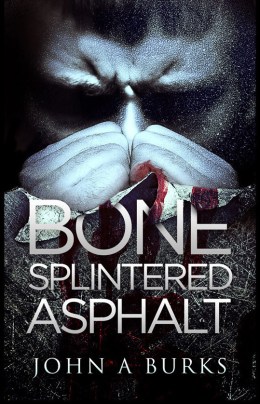
This is a direct sequel to “Flesh Worn Stone” so if you haven’t done so already, read that first. My Hellforge review of it can be found here.BSA

But for those of us who have seen and survived the Game, I will briefly recap. The first book followed the ghastly plight of Steven Alexander, who after the murder of his young sons, found himself trapped in a cave on an island. Along with hundreds of others, he was plunged into a world of murder, rape and cannibalism in a savage arena – the Game – all at the whim of some unseen rich elite.

“Bone Splintered Asphalt” picks up exactly where we left our broken and gore-drenched hero, escaping the island on a cruise ship with a mute child named Mia.

This novel doesn’t hang about, and Steven immediately finds himself hiding from the ship’s staff who seem to be under the command of the “Court”: a centuries-old organisation that run the whole thing. A hunted man, Steven must think fast and kill quick to survive, and once he gets to the ship’s destination, he begins to realise that the Court’s power reaches further than he realised.

Also drawn into the darkness is Marcus Dillard, a regular FBI agent, and both men spiral into the Court’s chilling web that has influence across the globe, from media to law enforcement.

Although this has a different vibe to “Flesh Worn Stone” – dabbling with conspiracy thriller as well as extreme horror – there’s plenty of familiarity to make us feel at home. We’re treated to a variation of the Game played in a dilapidated mall and also meet Darius again, a champion back from the ravages of the island’s Cave. While a shadow of his former physique, he’s still as vicious and fearless as ever.

The main players are strong and I was along with Steven and Marcus all the way as they sink deeper into danger, the action deftly switching between the two. I was less impressed with the character of Lulu – who runs the mall – as she seemed rather comic book and not particularly frightening despite her sociopathic cruelty. But while some of the minor players are somewhat one-dimensional, it usually just adds to their Laymonesque brutality.

I liked the development of Mia, the child rescued from the hell of the Cave, who knows nothing else. She proves to be Steven’s Achilles’ heel by giving him somebody to care about, and also provides moments of dark humour regarding her casual approach to cannibalism.

My main grumble, as was the case with the first instalment, is that this book has far more than its fair share of typos, spelling mistakes and other errors that cause confusion. It’s a shame, as a thorough edit would’ve smoothed out all these superficial niggles, but at least I kept reading which is testament to the strength of the story. I would’ve bailed on lesser pieces over this.

I also felt a lag in pace about two thirds of the way through, but generally, this is a well structured novel. It begins at a tight sprint then allows the pieces to fall into place before some high-octane action paves the way for the finale.

It’s not as beautifully nightmarish as “Flesh Worn Stone”, lacking the same depths of visceral darkness and reflection on the base human condition. As I said, it wanders into conspiracy thriller territory, but by doing this presents menace of a grander scale. I found the philosophy of the Court intriguing and perhaps there’s a degree of satirical reflection regarding our own governments and cultures.

I was carried by our unwitting hero’s weary frustration, sadness, fear and hate. The finale is unexpected but appropriate, mercifully devoid of any cheap shots that such stories can suffer, and it brings a distinct level of pathos to the table as well as satisfying the inner ghoul.

It does require a hefty suspension of disbelief, much more so than “Flesh Worn Stone”. There’s a fine line between brilliance and nonsense with this kind of plot, and it happily manages to err the right side most of the time, and delivers some helpless desperation in the vein of “Rosemary’s Baby” along with the adrenaline.

If you enjoyed the first book of the Game, then there’s no reason why you won’t lose yourself in “Bone Splintered Asphalt”. A third chapter is apparently on the way, and this is pleasing news indeed. John A. Burks is running with a superb and pitch-black concept, and it’ll be interesting to see where he takes it next.

Review – “Samurai and other stories” by William Meikle

0

I’d read a couple of William Meikle stories before, but this was the first time I’d tackled them en masse. Crystal Lake Publishing have presented 16 recent tales from this prolific author’s catalogue, and it turned out to be just the kind of book I’d hoped. A melting pot of SF, fantasy, hardboiled, historical fiction and horror, Samurai… is a colourful ride and presents plenty of wry humour and derring-do along with the blood and chills.Samurai-and-other-stories-FB-sizeThere are no weak tales, but here I’ll mention a few of my particular favourites. One of those is the title – and opening – story in which we meet the Scottish survivors of a shipwreck on Japanese shores. They find an ancient temple, deserted yet strangely hospitable, and are tempted by the treasure it holds despite the suspicious lack of security. I was immediately drawn into this period piece by the action and witty dialogue – delivered as it is by strong characters – and it all kicks off before long, the action cemented by themes of honour and deft clashes of culture. I particularly like how the author introduces sudden violence with such elegance that it made me do a double take, matching the confusion of the protagonists. Stylishly written and building to a double-twist finale, this is a muscular start to the collection.

“Rickman’s Plasma” is a wild but self-aware B-movie about a man’s disastrous attempt to create music using his own dreams. And by disastrous, I mean carnage of international armageddon proportions. I liked the repetitious style of the escalating threat, and despite the casual gore, it still has a light tone and a pay-off that inspires a grin.

I especially enjoyed “The Toughest Mile”, a breathless fantasy in the style of “The Running Man”. We meet Garn – a successful gladiator owned by a witch queen – who is allowed a stab at freedom by facing the Challenge: a 10-mile dash along a tunnel, pursued by the queen’s terrifying bred-to-kill female assassins. Garn’s plight is made more interesting by his sexual relationship with the witch queen overseeing his ordeal, and as this author has a real knack for inspiring anticipation and tension, we’re very much along for the adrenaline-fuelled ride. Faultless in structure and sense of place, this cinematic blast builds to a surprisingly elegant conclusion.

It’s back to 1605 for “The Havenhome”: a ship visiting a colonial outpost in which everybody has been frozen, apparently by some malevolent evil force. The captain’s journal entry style works well, the 17th century language rings true, and I enjoyed the pervading sense of peril as the crew become trapped in the remote outpost and menaced.  We’re treated to some very dark moments, and the God-fearing attitudes add to both the supernatural unease and the historical milieu. An exciting contribution that’s ultimately rather elegiac.

The lights are turned down for “Living the Dream”, a moody modern story about a disturbed man who has grim nightmares and becomes obsessed with a woman from the factory where he works. Sexual, nasty and visceral, this piece draws you in whether you like it or not, and a sharp finale ties it together.

This collection boasts several solid ghost stories, but “The Haunting of Esther Cox” is the best of the bunch. We visit the 1870s to find our eponymous heroine narrowly avoiding rape, after which her attacker mysteriously goes missing. Cleverly told through the diary entries of Esther and her brother in law Daniel, it soon descends into a clamour of poltergeists and possession of the noisy hellfire variety. A scary experience that succeeds with the required suspension of disbelief.

“Dancers” stuck in my mind, beginning with an old man showing us the ghost of his lost love. Through his gentle voice, we learn of a bitter wartime romance that involved murder, jealousy and guilt, and this perfectly-crafted tale manages to fit in a huge of amount of plot and feeling for its short length.

Referencing Sir Walter Scott’s 19th century poetry, “The Young Lochinvar” introduces Julia, a young woman on a train journey through a dark and windy Scottish night. Stuck with her father and the ghastly bore to whom she is unwillingly betrothed, she meets an enigmatic and alluring stranger who might be the answer to her disillusionment. I didn’t quite understand the conclusion, but nevertheless found this a superbly evoked journey and my sympathies were very much snared.

Finally, I’d like to make special mention of the two stories that present an old creation of the author. Derek Adams is a droll and weathered Glaswegian PI with all the gallows humour, attitude and unhealthy habits that a hardboiled hero requires. In “Home is the Sailor” we find him investigating a cursed seaside hotel and in “A Slim Chance”, he tackles a case involving a fatal diet pact and a parasitic monster. Our ascerbic protagonist carries both 1st-person tales as the macabre mysteries unfold, and as “A Slim Chance” is the last story in the book, the conclusion ends things on a very wicked and pleasing note. I’ll be sourcing more tales of PI Adams and their seamless hybrid of crime and horror.

I rather enjoyed Samurai and other stories. The humour and horror temper each other to the right degree, and rarely have I come across such a breadth of imagination in one publication. From fantastic realms to the world of the Spanish Inquisition, from the high seas to haunted Appalachian mines, there’s swashbuckling and spinetingling aplenty in equal measures. The writing is crisp and unintrusive, often letting the characters and dialogue do the driving, and the period voice and place is without fault throughout.

Although a couple of the conclusions didn’t quite work for me, there’s no true disappointments, and it’s also pleasant to hear an authorial presence through the Scottish culture and folklore he drizzles into the mix. Overall, this book put me in mind of the adventure collections I used to read as a boy, albeit with the addition of adult themes and grisly shenanigans. This makes it a rip-roaring read for those of us who might have grown older, but still like a bit of intrepid charm with our darkness.

If you’re not familiar with William Meikle, this is a pretty good place to start.

Hellforge Horror Picks of 2013

3

There’s been some great releases this year, particularly on the small press anthology front I think, but here’s a couple of each category that won’t be forgotten in a hurry.

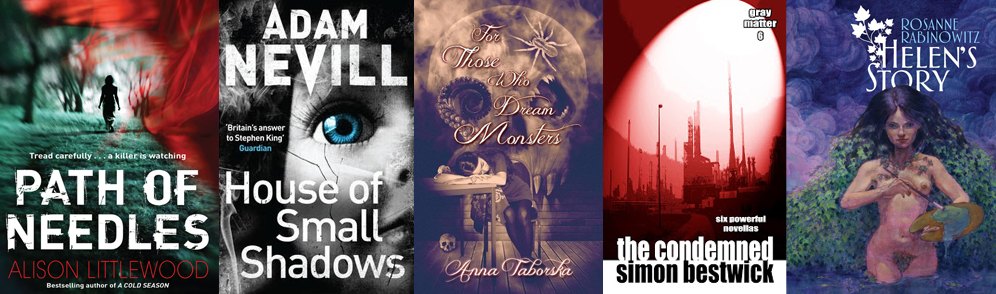
Regarding novels, I’m glad I picked up Alison Littlewood’s Path of Needles. Essentially an English crime thriller featuring a fairy-tale obsessed serial killer and set in the moody landscape of West Yorkshire, it’s compelling and exquisitely told. I also loved Adam Nevill’s House of Small Shadows. It’s the claustrophobic and creepy story of a troubled auctioneer of oddities, and the eponymous house is a perfectly sinister creation.

Special mention also goes to the lustrous Helen’s Story by Rosanne Rabinowitz. Functioning as an update/sequel for Arthur Machen’s “The Great God Pan”, it will please anybody who enjoys a thoughtful reworking and fresh point-of-view on a classic.

Hellforge Best of 2013 1

For single author collections, two spring immediately to mind. These are For Those Who Dream Monsters by Anna Taborska and The Condemned, a book of novellas by Simon Bestwick. Both deeply evocative storytellers, they’re on top form here, bringing humanity, cruelty and chills in stories that leave their ghosts with you long after reading.

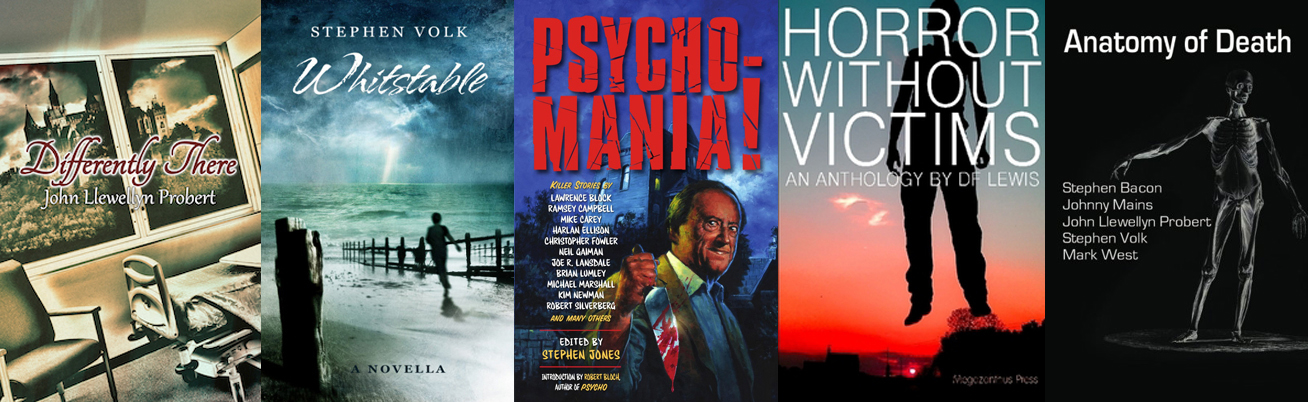
I’ve read a lot of single novellas this year, and again, there are two that particularly stood out. Firstly, the beautiful and poignant Whitstable by Stephen Volk stars horror legend Peter Cushing, mourning the death of his wife and becoming involved in a very human drama. Second is Differently There by John Llewellyn Probert: the dignified tale of a man about to undergo major surgery. Despite both authors being masters of the macabre, here they use extensive research and experience to go for the heart rather than the stomach, and produce essential reading whether you care for genre fiction or not.

On to anthologies, my favourite overall was the hefty and superb Psycho-Mania! edited by Stephen Jones. Themed around murderers of all kinds, it has no passengers and contains a couple of my favourite short stories of the year. It was quite difficult to pick a second, as there were several muscular contenders for the slot. But because it forced authors to really earn their place with a tricky concept, I have to go with Horror Without Victims edited by DF Lewis.

Hellforge Best of 2013 2

The last category is single stories from anthologies or collections. The School House by Simon Bestwick (The Condemned) blew me away: a story of madness, bullying, and ghosts from the past that has shocks and feeling in droves. I’m not sure if it should count, it being a reprint from a BFS anthology in 2008. But as it’s the finest story I read this year, the rules can hang.

Of the new 2013 tales, the two that really stuck were both from Psycho-Mania! Firstly, Essence by Mark Morris is the engrossing tale of an ageing couple of serial killers patiently luring a new victim. Fun yet genuinely disturbing, its characters linger as though I’ve actually met them. Secondly, Let My Smile Be Your Umbrella by Brian Hodge is the incredibly immersive dialogue of somebody planning to murder a miserable blogger, and subtly layers in themes and reflections without it once becoming anything less than slick.

And that’s almost your lot. I’d just like to add a special mention for Anatomy of Death, edited by Mark West, for two reasons. It was a strong contender for best anthology, and it contains Stephen Volk’s ultra-sharp The Arse Licker: the most darkly humorous and unpleasant thing I’ve read all year.

Keep reading and writing the dark stuff in 2014, folks.

Cheers!

Review – “Demons & Devilry” edited by Stuart Young

0

Everyone has things that stoke a warm familiarity, and the cover (and title) of this book from Hersham Horror made me nostalgic.D&DNot only does a similar image adorn many a beloved metal album, but it also reminds me of big white smocks, suspicious chanting and Peter Cushing looking terribly serious.

This niche of horror isn’t as popular nowadays, as the focus has shifted and demonic chills are rarely sought from the likes of Dennis Wheatley. But quaint though it may seem, there’s nothing finer than a bit of gleeful devilry (I love that word) whether you have fond memories of it or not. I was pleased to discover that this solid line-up have done diabolism proud and brought plenty of new tricks to keep the concept fresh.

Kicking things off is “The Abhorrent Man” by Peter Mark May. This colourful tale takes us back to the sacking of Carthage in 146BC and a search of the “Eye of Hannibal”, a treasure said to contain a djinn. One that may well cause terrible trouble years later when the site is subject to an ill-advised excavation by Dr Marsden and his supernatural researchers. With exotic locales, powerful talismans and all kinds of hellfire, this is an appropriate opening to such a book, and the theatrical dialogue and knowing pay-off made me smile.

Next up, childhood chills abound in “Little Devils” by Thana Niveau. We meet Arabella and her younger sister Pippa exploring a building site with friends. It’s forbidden fun and scares at first, but things start to get out of hand when they find dead rats and a campfire strewn with bones. And even more so when one of them suddenly starts to speak Latin. The characterisation is crisp, the pecking order and peer politics of children are spot on, and I felt rather sorry for the tag-along Pippa. Very well written, this piece descends into a black magic spectacle, full of all the blood and goat-horns you could wish for.

The relentlessly superb John Llewellyn Probert is up next with the “The Devil in the Details”. This begins with a subtly humorous description of a Welsh coastal house – at midnight naturally – that’s been modified for satanic sacrifice. We then meet our heinous protagonist, Maxwell Chantry, who with the help of an equally nefarious surgeon and torturer, is repeatedly attempting to raise the devil and failing. Or has he failed? This splendid piece brims with ivory-handled sacrificial daggers, naked virgins, and amusing dialogue, but don’t be fooled into relaxing too much by the tone. There’s plenty of nastiness and a definite chill beneath the playful twist.

David Williamson’s “The Scryer” introduces Dan, who lives in a council flat with his low income family. After inheriting a manor house in the countryside from a distant relative, he finds an ornate mirror in the enormous cellar along with some black mass paraphernalia. I love an evil mirror story, and this one is pleasingly Pan-esque and features a great aura of malevolence and nails the corruption of the susceptible. Dan’s not the nicest of people anyway, and his descent into darkness– and the hesitant unease of his previously confrontational wife and daughter – is well presented. Although the tale has a fairly standard finale for this kind of thing, it’s a well crafted and enjoyable piece.

Last up before the black velvet curtain closes is Stuart Young’s “Guardian Angel”. This is the longest tale – a novella no less – involving Becky and Sajid, a shelter and youth worker. Having being led to believe they’re meeting clients to secure funding, they find themslves caught up in some horrific satanic shenanigans in a seedy S&M stripclub. This is a sexually charged piece that doesn’t hold back, featuring some wild and trippy scenes that involve raped angels, airbourne detached septums, and the most ghastly and original use of a scorpion I’ve ever encountered. The scenes of violence are striking and written with flair, and the tension is built through some deft scene-switching between earthly and hellish realities. The characters are tangible, particularly ex-pimp and converted Muslim Sajid, whose internal conflicts ring true. And I loved his prison/street demeanour, especially when confronted with a demon and deciding that the “fucker was all front”. The pace was occasionally dulled by some confusing religious lore, which seemed unnecessarily complex and included details not crucial to the plot. But the story is full of sharp phrases, vivid description and twists, and it concludes the anthology with a flourish.

If Demons and Devilry sounds like your particular chalice of virgin’s blood, then you’ll find plenty to satisfy here. Despite the old-school theme, these tales aren’t dated or stale, they’re contemporary homages to the cause of all things arcane and infernal. And with such a stark appearance and title, it’s also a fun book to brandish in public. Dig out the black candles and enjoy.

Review – “Psycho-Mania!” edited by Stephen Jones

0

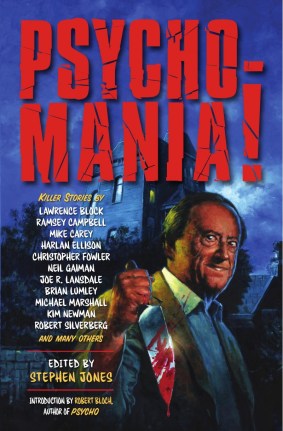
This highly anticipated tome arrived on my doormat with a thud that made the cat jump. An appropriate entrance for a book of over 500 pages that promised “twisted tales of psychos, schizoids and serial-killers, many with a supernatural twist.” And that it is. Psycho-Mania! is a splendid mix of old and new stories, and if my finger-counting is correct, contains 34 altogether (not including the framework pieces), more than half of which are brand new to this collection.psycho-maniaIt begins with a pleasant previously-unpublished introduction from Robert Bloch, before John Llewellyn Probert kicks off with a fun and creepy scene. I love a good framework story, and if you need one to transform your anthology, he’s your proven man. With much experience of portmanteau fiction, asylums and all things ghastly, he’s the perfect choice with his lauded talent for merging classical and contemporary styles and themes. It concerns Dr Stanhope, a medical journalist, visiting a Victorian asylum to collect information for an article. But he finds that the mischievously sinister Dr Parrish has other ideas, and wishes to play a game involving the cases of his patients, these being the individual stories of the anthology. Full of masterful dialogue and attention to detail, these framework segments are scattered throughout and tie it all together nicely.
On to the tales themselves, I found no passengers in this anthology – all deserved their place – but the following are those that particularly stood out for me and still linger after the book was closed.

Reggie Oliver’s “The Green Hour” is a sumptuous period piece that resurrects Poe’s detective C. Auguste Dupin (of Murders in the Rue Morgue fame). We are treated to an absinthe-themed murder mystery with shivers, a tight plot and a twist. The author has done a splendid job of capturing the detective’s manner – in fact the introduction in which he puts an enquiring police commissioner in his place made me laugh out loud – and Poe would’ve approved of his sense of place.

Steve Rasnic Tem’s “The Secret Laws Of  The Universe” begins with a man having a conversation with a toaster. Yes, you read that right. What follows is the superb descent of a precise and polite man planning to kill his wife for strangely benevolent reasons, who engages in dialogue with inanimate objects in his home. The black humour lends whimsy to what is actually quite a dark and sad tale.

I had read Basil Copper’s “The Recompensing Of Albano Pizar” many years ago, and it took me right back to my childhood. A stylish 70s classic, it concerns the wealthy widow of a writer who plans spectacular revenge upon the agent that duped her. I enjoyed the educated prose even more this time around, and while the plot seems somewhat familiar now – as is the case with several of the older stories gathered here – it’s important to remember that they did it first, and it’s rewarding to see how genre tropes started out.

I loved “Let My Smile Be Your Umbrella” by Brian Hodge. This piece is the gripping dialogue of somebody deeply upset with the narcissistic doom and gloom generation. He seeks out a particular blogger for her refusal to embrace life and its generosity, and plans murder. Somehow depressing yet uplifting, this story has powerful voice, a blinding conclusion and plenty of layers regarding opportunity, entitlement and disillusion for readers to get their teeth into.

Scott Edelman’s “The Trembling Living Wire” introduces a meticulous choirmaster who believes that his talented pupils really shine when suffering deep personal tragedy. He takes it upon himself to provide that for them, and the results are an elegant and chilling piece with plenty of tricks up its sleeve.

I imagine Robert Silverberg had quite a glint in his eye when he penned “The Undertaker’s Sideline”. It’s exactly that, featuring a town mortician with an additional and highly nefarious use for corpses. Naturally, things get way out of hand, and I loved the traditional prose and the gloriously cold villainy of our protagonist.

Another favourite was read with sadness, for it’s the work of Joel Lane who passed away earlier this year. “The Long Shift” presents a disgruntled employee seeking late night revenge on an old boss in the Welsh countryside. I love this author’s prose – “gulls scream like fading pornstars” and “local beers called to him in melodic accented tones, the optics added their higher voices to the choir”. There’s amazing evocation of the surroundings, and also of human ugliness – terror, rage, bitterness – which makes for a slick read cemented with a strong pay-off. RIP, sir.

Lisa Morton’s “Hollywood Hannah” is the 1st person account of a film school graduate who lands the job of assistant to a notoriously tough female producer. With tangible characters and an inventive surprise at the end, this tale is a reflection on how Hollywood and backstabbing businesses in general can sap the souls of anybody. Lured by its disarming voice and sense of humour, I enjoyed how this tale ultimately became much darker than the sum of its contents.

Even darker is Paul McAuley’s “I Spy”. It’s the engrossing account of an intense and voyeuristic man who had an abusive upbringing and now has a defining passion for spying on other people’s lives. This is vivid and muscular storytelling, delivered via matter-of-fact prose that suits our storyteller’s mindset, and I loved the suckerpunch halfway through when we realise what we’re actually dealing with here.

If you will pardon the film reference, Mike Carey presents what felt like a cross between the Saw franchise and Theatre of Blood in “Reflections On The Critical Process”. Here, a deranged critic seeks homicidal and ostentatious revenge on our eloquent and unruffled narrator. I tore through this story without pause.

Introduced by one of John Llewellyn Probert’s links regarding ripper syndrome is “The Gatecrasher” by R. Chetwynd-Hayes in which a séance leads to blood. A spooky and visceral piece, it shows the old school can still rock it with the kids – even with something that seems hokey and quaint at face value – and the conclusion is a pleasing bookend.

In Robert Shearman’s “That Tiny Flutter of The Heart I Used To Call Love”, two odd souls come together: a quiet downtrodden man and a young woman who has an unhealthy relationship with dolls and sacrifice. Fully fleshed characters make this study of damaged psyches shine, and with themes of belonging and love, it’s also quite poignant beneath the creeps.

“Essence” by Mark Morris is one of my favourites. A horribly engrossing piece, we find a murderous middle-aged couple patiently hunting a young girl in a nondescript British pub. The attention to detail in their manipulative technique is genuinely disturbing, and just when you think it might have unfortunately all got a bit familiar, it jacknifes from your grip with a cackle. World class horror.

Ramsey Campbell maintains his standard with “See How They Run”. This is an exceptionally written account of a multiple murder trial – and its aftermath – from the point of view of a juror. With plenty of mood and palpable emotion, it soon becomes a claustrophobic descent of obsession and misery.

Conrad Williams is on fine form with “Manners”: a short about a strange loner who lives in an abandoned farm hut and scavenges for food. It’s deceptively gentle and rustic at first, but the finale is anything but that. I had to reread the last few paragraphs again, just in case I was mistaken as to what had happened. I wasn’t. Brilliant stuff.

Christopher Fowler brings back a couple of his old characters from the peculiar crimes unit in “Bryant & May And The Seven Points”: a humorous yet nasty tale of shady Russian politics and a sideshow carival dwarf. Although I guessed the gist of the finale before it came, I think I was supposed to, and certainly didn’t want it to end. It’s got fine narrative voice, entertaining dialogue and all the twists, malevolent criminals and jeopardy you want from a murder mystery.

I don’t think I’ve read any Rio Youers before, but certainly will again after the grim and gripping experience that is “Wide Shining Light”. A man on the brink of divorce meets old school friend at a reunion, reignites their friendship, but it turns out he’s not all that he seems. A nimble and layered piece, it riffs on opportunity, life, trust and betrayal, and paces towards a tense finale.

Neil Gaiman provides a quirky change of tone with “Feminine Endings” – a stalky loveletter with a beautifully chilling finale – before Peter Crowther puts us back on the edge of our seats with “Eater”. Here, we meet a jaded New York City cop one late night with the unenviable job of babysitting a captured cannibal in a quiet precinct. He becomes paranoid, and the skilful prose ensure we share his well-founded unease in this genuinely unnerving thriller.

Michael Marshall dabbles with his old straw men conspiracy in “Failure”, which concerns a parent worried about the behaviour of his son towards women. Don’t be the least bit put off by what seems like much infodumping at the outset, as I initially was. This is an engaging and troubling tale that plays with perceptions and loyalties towards a sour reward.

Kim Newman presents a wonderfully irrevent piece starring Alfred Hitchcock in “The Only Ending We Have”. We meet the fed-up shower scene body double from Psycho, who makes off with a film negative and ends up staying in a motel run by a dysfunctional mother and son. With plenty of resourceful parallels and film references, this is a very nicely tied-up package.

There’s also flair aplenty in Richard Christian Matheson’s “Kriss Kross Applesauce” which takes the form of a family’s annual Christmas letter. A fun and original little piece, it keeps us guessing, and doesn’t pan out the way we might think.

Finally, special credit also goes to John Llewellyn Probert for his epilogue. It’s back to Dr Parrish’s asylum for “A Little Piece Of  Sanity” which concludes both the anthology and the framework story of Dr Stanhope in gleefully ghoulish style. Despite us knowing full well it isn’t going to end well for our ill-advised medical journalist, it still manages a few surprises, and never has extreme villainy been so delightful.

Its no exaggeration to say that this is my favourite anthology of 2013. Also including reprints by Joe Lansdale, Harlan Ellison, Brian Lumley, Dennis Etchison, Lawrence Block, Robert Bloch and Poe, and solid new pieces from David A. Sutton, David J. Schow, Jay Russell and Michael Kelly, Psycho-Mania! is a winner. There’s haunting mood, lurid nastiness, and everything in between. Regardless of the genre, Stephen Jones has gathered some very talented writers – each at the top of their game – which makes for extraordinary value and an essential buy for any fan of the macabre.

Highly recommended.
Review – “Ill At Ease 2”

1

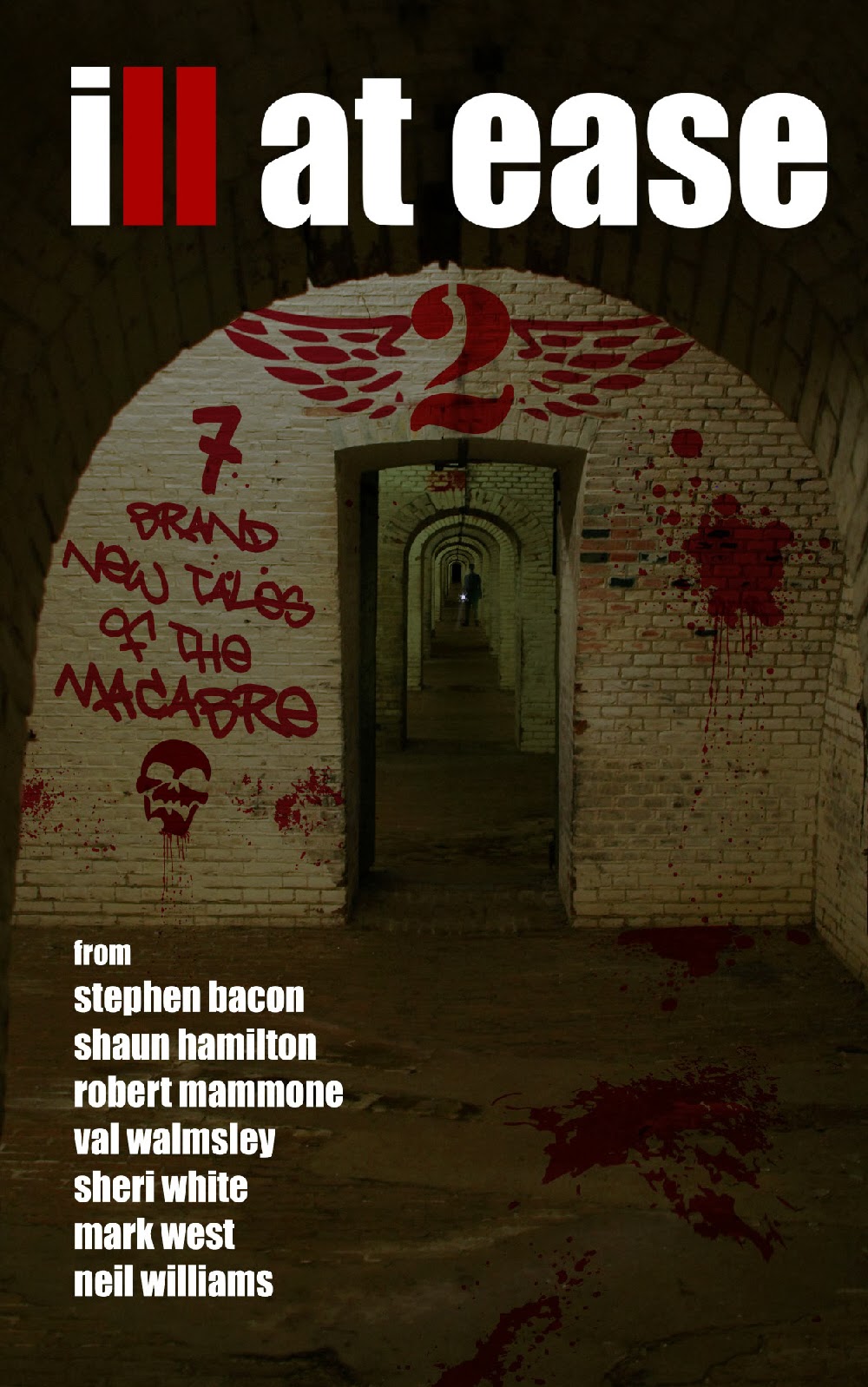
The original Ill At Ease was released a couple of years ago: a small anthology featuring Mark West, Stephen Bacon and Neil Williams. It presented three strong tales in which peril lurks behind the ordinary, so I was pleased to hear news of a sequel from Penman Press. Another four authors have been added to the original line-up and although the vibe is similar, this time you get a bit more variation and a few horrible surprises.Ill2 Cover ImageStephen Bacon is a fine purveyor of quiet horror and “Double Helix” kicks things off with a tale that showcases his trademark mood, character and prose. We meet Claire, a terminally ill woman on a trip to rural Scotland with an old ex who believes he can help her find treatment. This story engages at once through our protagonist’s fears and frustrations, and there are strong themes of guilt and regret. It’s ultimately less dark than I expected, actually quite sweet at times, but we’re never far from that heart-breaking human reluctance to let hope blossom as youth and health slip away. It still finds room for some seriously creepy atmosphere and the finale took me by surprise. It was something that both story tone and author familiarity hadn’t led me to expect, but it cements a beautifully-written piece with a memorable otherworldliness.

This assured start is followed by something of a very different flavour. “The Shuttle” by Shaun Hamilton involves Sally and Paul, a pleasant couple who move to rural Wales to start a family. Unfortunately, their parental plans are soon to be affected by the eponymous shuttle: a concrete tower that overlooks from a nearby quarry. I was deceived by the gentle start and the normal lives of these folk, but soon enveloped by the aura of unease. It made me guess as to if the supernatural was playing a part, and both visceral and emotional shocks combine as everything falls into place. I found it occasionally over-descriptive, especially during dialogue, but this is countered by some superb turns of phrase. Perhaps rather unsubtle for some, I loved the jugular-pouncing horror – in concept and delivery – and it’s a great contrast to Stephen Bacon’s opener.

Somewhere betwixt the two is “Masks” by Robert Mammone. We are introduced to Harry, the fiancé of a presumed dead girl, who discovers that she might have been spotted in the train station where she disappeared. We’re treated to a literal and metaphorical descent into the station’s lower levels of grime, dripping walls and threat, every detail of which is exquisitely painted. During the opening scene in a funeral parlour, I was briefly confused with character identities, but after this small false start I was gripped. This piece toys with our suspicions, layering on the chills as we’re dragged deeper towards a tense and unpleasant finale. Ill at ease, indeed.

“One Bad Turn” by Val Walmsley plunges us straight into the plight of Tim, a boy on the run from bullies. He finds refuge beneath an old yew tree – a place of local folklore with a grisly past – where he dreams of murder and everything spirals from there. Young Tim’s hurt and rage is very well conveyed, and understandable, providing the pathos that this kind of tale requires. Although I found the descriptive showdown slightly overlong, it’s far from predictable and I was swept along by this ghastly bag of horror tricks.

A familiar parental terror rises in “The Bureau of Lost Children” by Mark West. We meet Scott, who loses his seven year old son in a shopping mall, and his search soon takes a terrifying turn. The initial panic is perfectly captured (gleaned from experience, the afterword explains) and this tale teases with moments of hope amid the escalating strangeness. It makes you wonder what goes on behind closed doors, and I loved the superficially banal but chilling menace. Perhaps I’d have liked a little explanation for its nefarious intentions, but then maybe it works better with the mystery intact: the whole thing becomes reminiscent of 70s and 80s science fiction. Very cleanly written, I didn’t see any part of this story coming, which makes for a great horror thriller.

A gruesome short, “Paradise Lost” by Sheri White is the account of a man on a paradise beach holiday that suddenly becomes a snapshot from hell. It doesn’t hang about before family normality gives way to gore, and cranks up the claustrophobia of impending doom towards a horrific pay-off. With no background to the events, this is a glorious horror snippet that had me turning pages like some ghoulish voyeur and it lingers like the memory of a nightmare.

Finishing things off in thoughtful style is “There Shall We Ever Be” by Neil Williams. In this haunting piece, we find Mark – a discontented man – returning home to Warrington for a family funeral. He meets a familiar old man en route who tells him of a boarded up tunnel that’s a strange link to the past. The scene is set for a spooky build-up that provides incredible place, taking us right there into Mark’s ill-advised adventure into the darkness. I quite liked our downbeat protagonist, and the layers of the tale – urban evolution, childhood memory and fear – add plenty of depth. It takes its time, rightly so, towards an appropriately gauged finale that I wouldn’t dream of spoiling with any clues.

Given the obvious time and effort that went into the first volume, I was pleased to find that Ill At Ease 2 has the same stamp of quality. With an interesting authorial afterword for each, all seven stories are slick, emotionally investable, and deliver a range of genre textures. Whether you like slow-burning unease or a nasty kick in the pants, there’ll be something to satisfy your dark passenger.

Go on, let’s have a third.